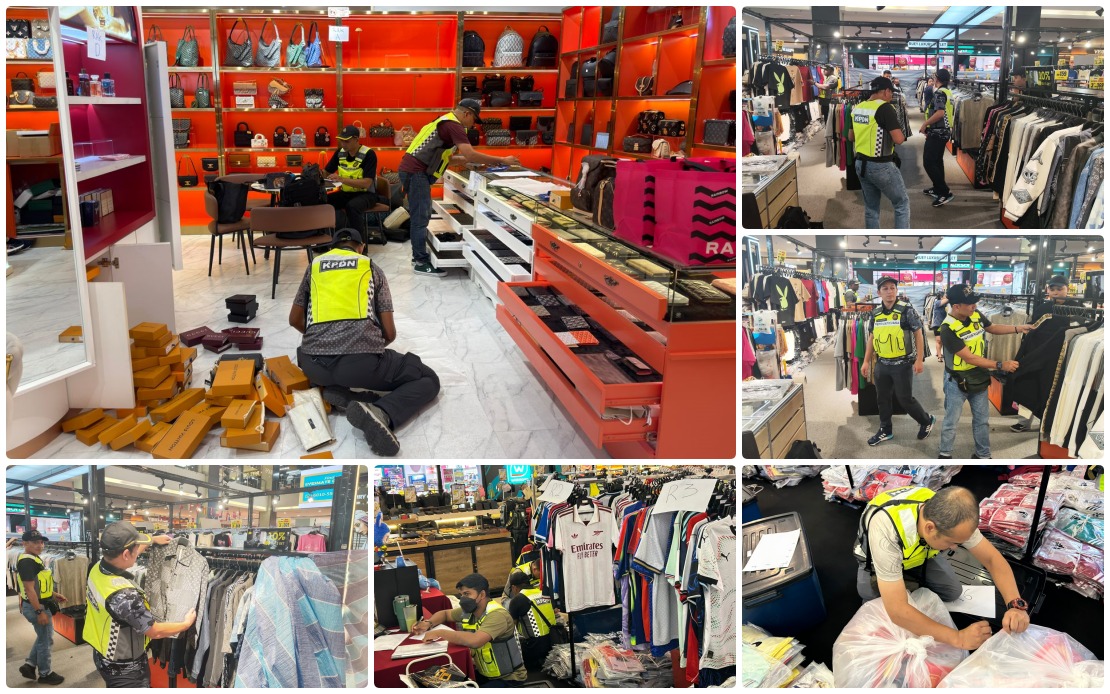
Malaysia's Ministry of Domestic Trade and Cost of Living (KPDN) has dismantled a significant counterfeiting network operating in Johor Bahru, with enforcement officers seizing approximately RM600,000 worth of illegal merchandise across three separate premises on June 15. The operation represents a focused crackdown on organized distribution channels that had been supplying counterfeit branded goods to major supermarkets and other retailers throughout the region.
Datuk Azman Adam, the enforcement director-general of KPDN, revealed that the raids were conducted by the Putrajaya Enforcement Division following extensive intelligence work spanning a full month. The investigation identified operators who were not only retailing fake branded items but were also functioning as wholesale distributors to other traders, suggesting a well-established supply chain rather than isolated vendors. This multi-tier distribution model would have extended the reach and impact of the counterfeit operation considerably beyond the initial points of sale.
The contraband seized during the raids encompassed a diverse range of consumer products that commonly attract counterfeiters due to high profit margins and strong market demand. Officers confiscated counterfeit clothing, handbags, wallets, belts, perfumes, and related business documentation, all bearing trademarks of established international brands that had not authorized their use. The breadth of product categories suggests the operation had developed sophisticated capabilities to replicate various types of branded goods, rather than focusing on a single product line.
Authorities detained four individuals in connection with the operation, including the proprietor and caretaker of the premises involved. These detainees are suspected of playing active roles in managing the day-to-day business operations, importing stock, and coordinating distribution to retail partners. The involvement of multiple personnel indicates this was not a small-scale operation but rather an organized enterprise with defined management structures and operational divisions.
Under Malaysia's Trademark Act 2019, the offense of possessing, controlling, or holding counterfeit goods with intent to trade carries substantial penalties designed to deter participation in such schemes. For individuals convicted on a first offense, sentences can reach three years imprisonment, a fine up to RM10,000 per counterfeit item, or both. This means that given the RM600,000 seizure, individual perpetrators could theoretically face cumulative fines far exceeding the initial value confiscated, creating a powerful financial disincentive.
Repeat offenders face even steeper consequences, with maximum imprisonment extended to five years and fines escalating to RM20,000 per item. Corporate entities face parallel but substantially higher fine structures, with first-time violations subject to RM15,000 per item and recidivist breaches reaching RM30,000 per item. These graduated penalty structures reflect policymakers' determination to make counterfeiting economically unviable across all organizational scales.
The significance of this bust extends beyond the immediate confiscation figures to encompass broader consumer protection concerns. Counterfeit goods undermine intellectual property rights, deprive legitimate brand owners of market revenue, and expose consumers to products of unknown quality and safety standards. Fake perfumes and cosmetics, for instance, may contain undisclosed chemicals or contaminants that pose health risks, while counterfeit electronics could present fire or electrical hazards. The operation's focus on premises supplying major supermarkets indicates that unwary consumers in established retail environments were at risk of purchasing fake items while believing they were obtaining authentic products.
The month-long investigation that preceded the raids demonstrates KPDN's shift toward proactive intelligence-gathering rather than purely reactive enforcement. By identifying supply networks and distribution patterns before intervention, authorities can target the organized criminal infrastructure behind counterfeiting rather than simply removing merchandise from shelves. This intelligence-led approach is essential for combating sophisticated operations that adapt quickly to enforcement actions.
The Johor Bahru case resonates particularly with Malaysian consumers and businesses given the state's geographic proximity to Singapore and its role as a major retail hub in the southern corridor. The cross-border implications are significant, as counterfeit goods can flow across state and international boundaries with relative ease. Johor's status as a transit point for regional trade makes it an attractive operational base for counterfeiters seeking to distribute fake merchandise throughout Malaysia and potentially into neighboring countries.
KPDN's enforcement director-general stressed that the ministry would persist in intensifying raids and investigations against counterfeiters, signaling sustained commitment to protecting consumers and legitimate business interests. The statement underscores that KPDN views intellectual property infringement and consumer deception as serious breaches warranting zero tolerance. This hardened stance reflects international pressure and trade obligations that increasingly require member nations to demonstrate robust protection of intellectual property rights.
The implications for Malaysian retailers and consumers merit careful consideration. Supermarkets and other retail outlets face reputational risks if discovered selling counterfeit goods, even unknowingly. Legitimate branded goods importers and retailers face unfair competition from counterfeiters operating with lower overheads and quality standards. Meanwhile, consumers purchasing unknowingly participate in criminal enterprises and expose themselves to substandard products masquerading as premium goods.
Looking forward, this operation illustrates both KPDN's investigative capabilities and the ongoing challenge posed by counterfeiting networks throughout Southeast Asia. While the RM600,000 seizure represents meaningful enforcement success, industry observers recognize that underground counterfeiting remains persistent and adaptable. Sustained coordination between KPDN, customs authorities, and international enforcement agencies will likely prove essential for addressing the systemic factors that make counterfeiting attractive to organized criminal groups throughout the region.