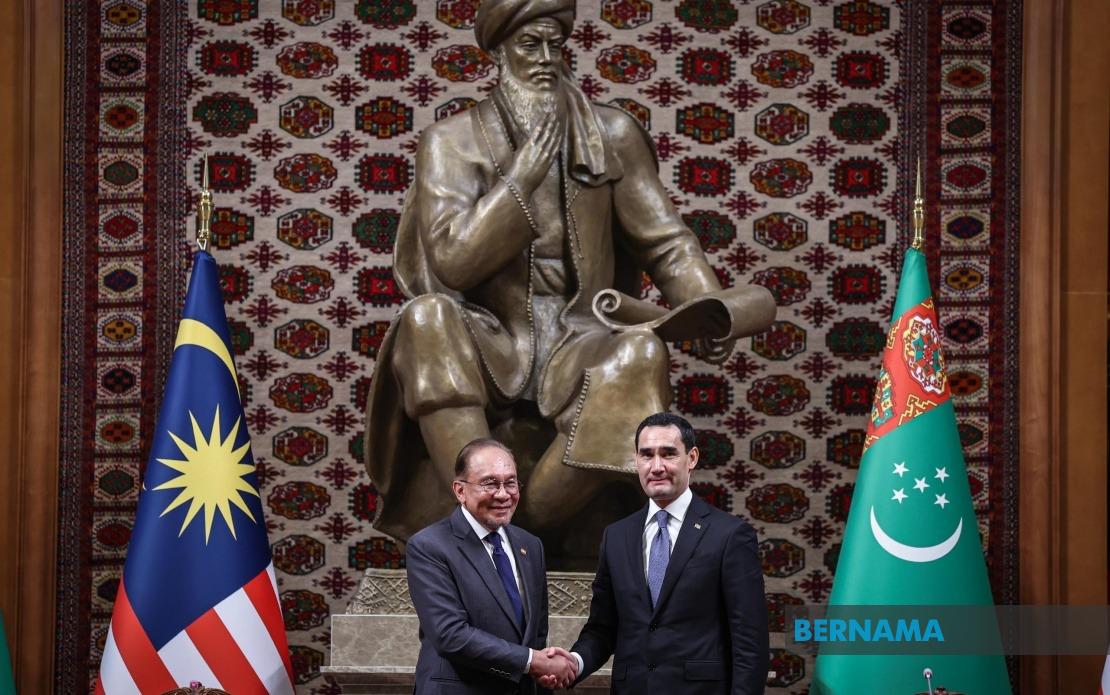
Prime Minister Datuk Seri Anwar Ibrahim has announced a comprehensive overhaul of Malaysia's relationship with Turkmenistan, framing it as a carefully structured partnership that will benefit both nations over the long term. The commitment emerged from substantive discussions between Anwar and Turkmenistan President Serdar Berdimuhamedov at the Presidential Palace in Ashgabat on Friday, during which the two leaders explored avenues for deepening cooperation across multiple sectors of strategic importance.
The bilateral engagement, which marked Anwar's inaugural official visit to Turkmenistan since assuming office as Malaysia's 10th Prime Minister in November 2022, resulted in the signing of several binding agreements that underscore the seriousness with which both governments view their relationship. Rather than settling for high-level rhetoric, the two nations formalized their intentions through concrete instruments designed to translate political will into actionable outcomes. This structured approach reflects a deliberate effort to move beyond ceremonial diplomacy and establish mechanisms that can sustain cooperation across changing political and economic circumstances.
Four key documents were exchanged during the formal ceremony, each addressing distinct dimensions of bilateral cooperation. An Air Services Agreement between the two governments creates a framework for expanding connectivity, potentially enabling direct flights that would facilitate people-to-people exchanges and business travel. Complementing this transportation initiative, an agreement governing maritime and land transport cooperation between Malaysia's Ministry of Transport and the State Service of Turkmenistan was also signed. These instruments collectively point toward Malaysia's interest in positioning itself as a gateway for Central Asian access to Southeast Asia and global markets.
The diplomatic layer of the partnership received particular emphasis through the exchange of a memorandum between Malaysia's Institute of Diplomacy and Foreign Relations and Turkmenistan's Institute of International Relations. This arrangement signals an intention to cultivate deeper understanding between the foreign policy establishments of both nations and potentially coordinate positions on regional and international matters. Alongside this, an academic partnership between the Academy of Sciences Malaysia and the Academy of Sciences of Turkmenistan opens pathways for research collaboration and knowledge exchange in fields ranging from energy technology to materials science.
When assessing the significance of this engagement for Malaysian interests, the energy dimension looms particularly large. Turkmenistan possesses substantial natural gas reserves and stands as a crucial node in Central Asian energy networks. For Malaysia, diversifying energy sources and establishing partnerships with resource-rich nations aligns with broader energy security objectives. The inclusion of energy cooperation among the priority areas discussed during the bilateral talks underscores this strategic calculation. As Southeast Asian nations grapple with energy transitions and the need to secure long-term supply arrangements, partnerships with stable Central Asian producers offer valuable alternatives to traditional Middle Eastern suppliers.
The emphasis on trade and investment cooperation reflects recognition that both economies can benefit from enhanced commercial ties. Turkmenistan's position along the Belt and Road Initiative corridors and its emerging role in regional connectivity initiatives create opportunities for Malaysian businesses to establish footholds in Central Asia. Conversely, Malaysian expertise in sectors ranging from financial services to manufacturing could find receptive markets in Turkmenistan's developing economy. The presence of Investment, Trade and Industry Minister Datuk Seri Johari Abdul Ghani in Anwar's delegation underscores the commercial dimensions of the visit.
The inclusion of Islamic banking and the halal industry among cooperation areas reflects recognition of shared values and market opportunities. Both Malaysia and Turkmenistan, as Muslim-majority nations, can leverage expertise in Islamic financial instruments and halal certification standards. For Malaysia, positioning itself as a hub for Islamic finance and halal commerce across Asia and Central Asia aligns with long-standing strategic objectives. Turkmenistan's growing middle class and integration into global supply chains create demand for halal-certified products and services, areas where Malaysian institutions and companies possess recognized capabilities.
Education and scientific research emerged as additional pillars of the envisioned partnership. Such cooperation typically involves student exchanges, scholarly collaboration, and capacity-building initiatives that generate lasting people-to-people connections. These educational linkages often produce generations of individuals with familiarity and goodwill toward partner nations, creating constituencies that support sustained cooperation regardless of short-term political fluctuations. For Malaysian universities and research institutions, partnerships with Central Asian counterparts expand international reach and create opportunities for collaborative research in fields aligned with both nations' development priorities.
Anwar emphasized that both governments have committed to implementing all agreed areas of cooperation in disciplined, transparent, and effective ways. This language carries significance, suggesting awareness that bilateral agreements often falter due to weak implementation mechanisms or lack of political follow-through. By explicitly committing to transparency and discipline, both leaders acknowledge potential pitfalls and signal resolve to avoid them. The appointment of specific ministries and institutions to oversee different areas of cooperation establishes clear lines of accountability.
Tourism cooperation also featured in the bilateral discussions, representing an often-overlooked but economically meaningful dimension of partnership. Turkmenistan's distinctive cultural heritage and geographic position as a crossroads between Europe and Asia hold appeal for Malaysian travelers. Simultaneously, Malaysia's reputation as a tourist destination attracts visitors from Central Asia seeking diverse experiences and warm climates. Enhanced air connectivity resulting from the Air Services Agreement would directly facilitate tourism flows in both directions.
The joint statement signed by both leaders serves as a political anchor for the entire arrangement, elevating the partnership above the level of routine administrative cooperation. Such statements typically reflect discussion of broader bilateral and regional matters, potentially including positions on Central Asian stability, regional security frameworks, and engagement with other powers. For Malaysia, careful cultivation of Central Asian relationships assumes added weight given the region's proximity to China and Russia, major powers with whom Southeast Asia must navigate complex relationships.
Anwar's visit, undertaken at Turkmenistan's invitation, represents reciprocal diplomatic engagement that strengthens bilateral trust. The two-day format allowed for detailed discussions that go beyond what is typically possible during brief state visits. This more extended engagement suggests both nations viewed the visit as substantively important rather than merely ceremonial. For Malaysia, positioning itself as a serious diplomatic player in diverse regions beyond Southeast Asia reinforces its claim to regional leadership and contributes to broader diplomatic influence.
Moving forward, the test of this partnership's durability will rest on implementation. The mechanisms established through the signed agreements must be activated and resourced appropriately. Regular high-level visits, ministerial consultations, and working-level meetings will be essential to maintain momentum. As Malaysia continues to diversify its international partnerships and expand its strategic footprint, the Turkmenistan relationship represents one element of a broader strategy to engage diverse regions and construct a multipolar diplomatic portfolio.