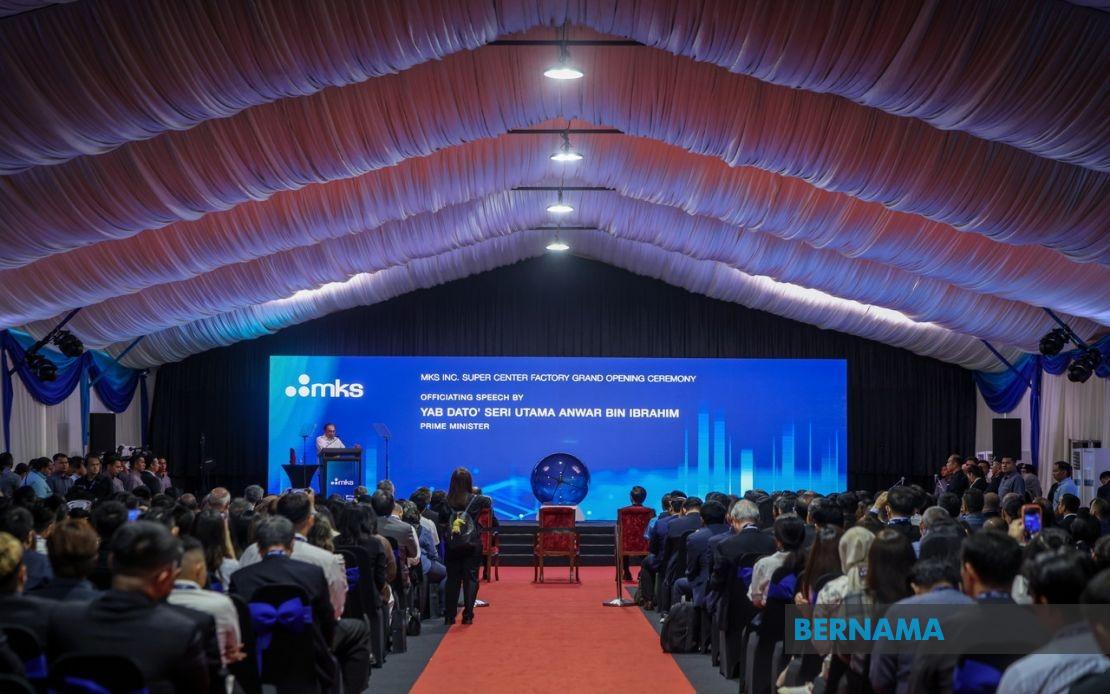
Prime Minister Datuk Seri Anwar Ibrahim has underscored Malaysia's strategic positioning as an independent actor in global affairs, contending that this principled stance has translated into tangible economic rewards and deepened international engagement. Speaking at the opening ceremony of the MKS Super Centre facility in Bandar Cassia Technology Park, Batu Kawan on June 20, Anwar emphasised that Malaysia's unwillingness to align exclusively with any single geopolitical bloc has proven instrumental in building trust among trading partners and investors worldwide.
The Prime Minister articulated a vision of Malaysian foreign policy centred on pragmatic engagement with all nations regardless of their position in broader strategic competitions. This approach, Anwar suggested, distinguishes Malaysia from countries forced to choose sides in the escalating rivalry between major powers. By maintaining independence while staying diplomatically active, Malaysia positions itself as a reliable neutral ground where business can flourish and partnerships can develop without the complications of ideological friction or alliance obligations.
Anwar pointed to concrete examples of this philosophy yielding measurable results, particularly highlighting recent commercial agreements reached between Petroliam Nasional Bhd, or Petronas, and Turkmenistan. These arrangements exemplify how Malaysia's balanced relationships enable national champions to access opportunities across diverse markets and resource-rich regions. The Turkmenistan deal carries particular significance given the hydrocarbon sector's importance to Malaysia's economy and the strategic location of Central Asian gas reserves in the global energy landscape.
The Prime Minister's remarks referenced his administration's engagement with several major powers over recent years. He specifically mentioned a significant visit from United States President Donald Trump during the previous year, underscoring Malaysia's continued importance to American strategic interests in Southeast Asia. Simultaneously, Anwar highlighted China, India, and Russia as partners with whom Malaysia maintains substantive economic and diplomatic relations. This multiplicity of high-level interactions illustrates how Malaysia has managed to sustain influence and opportunity across otherwise competing spheres of influence.
Anwar's characterisation of Malaysia's position as one of "centrality" reflects a deliberate attempt to position the nation as indispensable to regional stability and economic integration. Rather than being peripheral to major power dynamics, Malaysia claims a vital role as a bridge-builder and neutral arbiter capable of facilitating dialogue and commerce where tension might otherwise obstruct engagement. This self-conception shapes how Malaysian policymakers approach trade negotiations, investment promotion, and diplomatic protocol.
The distinction between merely professing neutrality and actively embodying it remains crucial to understanding Malaysia's approach. Anwar indicated that while Malaysia maintains its independent posture, the government simultaneously articulates clear positions on contentious international issues affecting global stability and welfare. This nuance suggests that Malaysian neutrality does not mean passivity or indifference to matters of principle, but rather a commitment to taking reasoned stances without subordinating national interest to alliance requirements or ideological commitments.
Investor confidence directly benefits from this perceived stability and predictability in Malaysia's diplomatic orientation. Multinational corporations and sovereign wealth funds increasingly value political reliability when allocating capital across emerging markets. A nation that maintains consistent principles while avoiding volatile alliance shifts presents a more attractive investment destination than one whose policy orientation shifts dramatically with changes in international power balances. Malaysia's reputation for steady-handed governance on the international stage thus translates into preference among sophisticated investors conducting long-term planning.
The opening of the MKS Super Centre facility provided a fitting venue for these remarks, as it exemplifies the type of industrial collaboration Malaysia seeks to attract. Located within Bandar Cassia Technology Park, a designated investment hub, the project represents precisely the kind of value-added manufacturing and technology transfer that Malaysia's economic diversification strategy requires. Present at the ceremony alongside Anwar were Penang Chief Minister Chow Kon Yeow and Deputy Minister of Investment, Trade and Industry Sim Tze Tzin, indicating the multi-level governmental support for such ventures and the intersection of federal and state-level development priorities.
For Southeast Asia more broadly, Malaysia's assertion of independent agency carries important implications. The region faces considerable pressure from major power competition, with nations increasingly called upon to choose preferred partners. Malaysia's insistence on retaining flexibility and avoiding exclusive alignments suggests an alternative model whereby regional states can benefit from engagement with all parties while refusing to become proxies or subordinates in external strategic competitions. This approach resonates across the Association of Southeast Asian Nations, where many members similarly prioritise stability and economic benefit over ideological alignment.
The practical consequences of Malaysia's balancing act extend to investment flows and technology transfer. By remaining accessible to enterprises from multiple countries and systems, Malaysia expands the pool of potential investors and partners far beyond what would be available to a nation locked into a particular bloc. This openness creates competitive dynamics among potential investors seeking Malaysian markets and resources, ultimately benefiting Malaysian workers, consumers, and businesses through improved terms of engagement and investment quality.
Looking ahead, Anwar's emphasis on Malaysia's independence and balanced diplomacy suggests the government intends to continue leveraging this positioning for economic gain. As global tensions persist between major powers, the value of stable, neutral nations willing to engage all parties only increases. Malaysia's sustained commitment to this approach positions it favourably for attracting investment, facilitating trade, and maintaining the regional stability essential for broader Southeast Asian prosperity. The government's message to investors and international partners remains consistent: Malaysia offers partnership without strings, engagement without ideological baggage, and opportunity within a framework of principled independence that has proven both sustainable and economically rewarding.