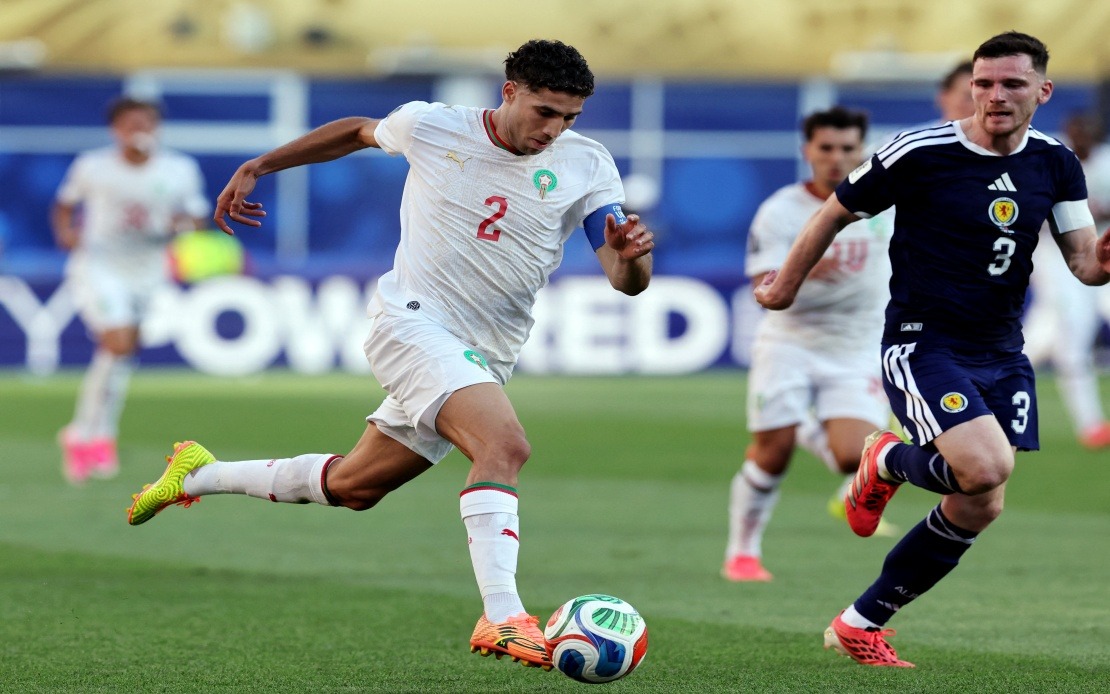
The Morocco national football team's coaching staff has rallied around captain Achraf Hakimi following a contentious World Cup encounter that coincided with a significant legal development in his personal circumstances. During Morocco's 1-0 victory against Scotland in Foxborough, Massachusetts, the Paris Saint-Germain defender was subjected to sustained booing and jeering from sections of the crowd, with the hostile reception beginning from the moment team lineups were announced and continuing whenever he engaged with the ball throughout the match.
The timing of the crowd's reaction was directly tied to an announcement made earlier that day by a French court system. A Versailles appeal court had determined that Hakimi must proceed to trial on rape charges related to an alleged incident involving a 24-year-old woman at his private residence in 2023. This legal development transformed what might have been an ordinary international football fixture into a complex situation requiring careful management by the Moroccan Football Federation and its coaching team.
Morocco's head coach Mohamed Ouahbi chose to address the situation by emphasizing collective team support rather than engaging with the substance of the legal allegations. In his statement to international media, Ouahbi deliberately sidestepped any discussion of the court proceedings, instead framing his position around maintaining team unity and tactical confidence. His measured response suggested a deliberate strategy to insulate the playing group from external distractions during a crucial World Cup campaign.
Ouahbi's defence of his captain extended to highlighting Hakimi's on-field performance despite the deeply uncomfortable circumstances he was facing. The coach asserted that the right-back had demonstrated resilience and composure during the Scotland match, describing him as "very strong" and noting that both Hakimi himself and the broader team environment remained composed. This characterization attempted to redirect the narrative towards sporting merit rather than allowing the legal proceedings to dominate discussion of the player's contributions to Morocco's World Cup effort.
The coach's statement included a forward-looking assertion about Hakimi's quality, declaring that the defender aimed to demonstrate at the World Cup that he ranks among the world's elite right-backs. By positioning Hakimi's participation in the tournament as an opportunity to reaffirm his professional standing, Ouahbi implicitly suggested that the player's focus remained unaffected by the legal challenge he faces. This framing sought to normalize Hakimi's continued selection and presence within the squad.
Throughout the situation, Morocco's player contingent maintained a unified stance of discretion regarding the legal matter. Ouahbi noted that his colleagues had deliberately avoided commenting on the case, respecting both Hakimi's privacy and the integrity of ongoing judicial proceedings. This collective silence from the playing group indicated a coordinated approach to not amplifying the controversy through player commentary, a strategy common in modern international football when dealing with off-field challenges affecting squad members.
Hakimi's own legal position involved a defiance of the allegations coupled with an apparent intention to engage more fully with the process. The PSG defender had previously denied the rape accusations and, following the court's trial determination, released a statement through social media suggesting he welcomed the opportunity to present his defence. His comment that "at last, I will be able to speak" implied frustration with legal processes that had perhaps limited his ability to address the allegations publicly during earlier stages of the investigation and appeal phase.
The circumstances surrounding Hakimi's participation in the World Cup reflect broader tensions in modern international football between legal proceedings affecting players and the operational demands of national team competition. Sports organizations globally have grappled with similar situations, attempting to balance due process protections with team cohesion and the expectations of supporters who may hold varied views on how athletes should be treated when facing serious allegations.
For Malaysian and Southeast Asian football observers, the situation underscores the complex intersection of sport and legal accountability in contemporary professional football. The region has seen its own instances of footballers facing serious allegations, and the Morocco squad's approach—maintaining team unity while allowing legal processes to proceed independently—provides a relevant case study in crisis management within national team environments.
Morocco's ability to secure victory against Scotland despite the significant distractions surrounding Hakimi's situation suggested that Ouahbi's team management approach had achieved its immediate objective of maintaining competitive focus. However, the ongoing trial process will undoubtedly continue to generate scrutiny and debate about the player's role within the squad throughout the remainder of the tournament, presenting ongoing challenges for the coaching staff's handling of team dynamics and public relations during what could prove to be a defining period both for Morocco's World Cup campaign and for Hakimi's career trajectory.