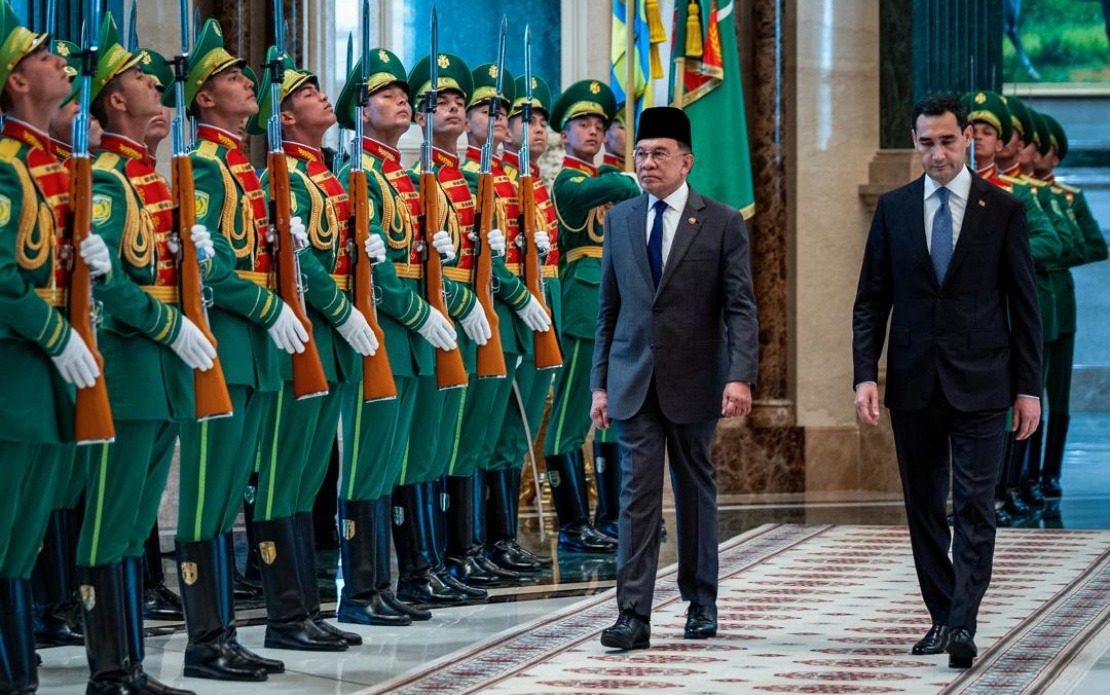
Prime Minister Datuk Seri Anwar Ibrahim received the full ceremonial treatment befitting a visiting head of government when he arrived at the Turkmenistan Presidential Palace in Ashgabat on June 19, underscoring the importance both nations are placing on their bilateral relationship. The formal welcome ceremony, complete with a military guard of honour and the playing of national anthems from both Malaysia and Turkmenistan, marked a significant diplomatic moment for Malaysia's engagement with Central Asia at the highest level.
The reception was personally extended by Turkmenistan President Serdar Berdimuhamedov, who greeted Anwar upon his arrival. This direct presidential reception signals the strategic significance Ashgabat attaches to strengthening ties with Kuala Lumpur. Following the initial formal proceedings, Anwar was introduced to key members of the Turkmenistan Cabinet and other high-ranking government officials, establishing face-to-face connections that typically form the foundation of sustained diplomatic cooperation between nations.
As part of the visit protocol, Anwar presented the members of Malaysia's accompanying delegation to President Berdimuhamedov, facilitating introductions that extend engagement beyond the prime ministerial level. This multi-tier approach to state visits enables officials from both sides to develop working relationships across various government departments and ministries, enhancing communication channels that will support future cooperation initiatives.
The formal agenda proceeded with a private bilateral meeting between the two leaders, followed by expanded discussions involving senior officials from both delegations. These back-to-back sessions—first a confidential one-on-one conversation and then broader talks—typically allow leaders to address sensitive bilateral matters privately before moving into substantive discussions on cooperation frameworks, trade relations, and regional concerns.
The two-day visit, which commenced on June 18, represents a watershed moment in Malaysia-Turkmenistan relations under Anwar's leadership. As Malaysia's 10th Prime Minister, having assumed office in November 2022, Anwar has sought to broaden Malaysia's diplomatic footprint beyond traditional Southeast Asian and Islamic world relationships. Central Asia, with its vast energy resources, strategic location along historical trade routes, and growing geopolitical importance, presents significant opportunities for Malaysian interests in energy security, trade diversification, and technological cooperation.
Turkmenistan, as one of Central Asia's major energy producers and an increasingly important player in regional geopolitics, offers particular strategic value to Malaysia. The country's substantial natural gas reserves and its position as a corridor between East and West make it a valuable partner for nations seeking to diversify their economic partnerships and secure long-term energy cooperation agreements. For Malaysia, accessing Turkmenistan's resources and participating in Central Asian economic integration represents a long-term strategic consideration.
The timing of this inaugural official visit also reflects broader shifts in Malaysia's foreign policy orientation under Anwar's tenure. Beyond the traditional focus on ASEAN, the Organisation of Islamic Cooperation, and established Commonwealth partnerships, Malaysia under Anwar has demonstrated greater interest in expanding engagement with underexploited diplomatic relationships. Central Asia, home to significant Muslim populations and emerging economies, aligns with Malaysia's multifaceted foreign policy approach.
The visit was undertaken at the formal invitation of President Berdimuhamedov, indicating that the initiative came through official Turkmenistan channels. This invitation-based diplomatic overture suggests Turkmenistan's own interest in deepening relations with Southeast Asia's largest Muslim-majority nation and strengthening connections within the broader Islamic world. Such reciprocal interest creates a strong foundation for establishing sustained bilateral cooperation.
Malaysia's engagement with Turkmenistan also carries implications for Malaysia's positioning within emerging regional and international groupings. As Central Asian nations increasingly seek diversified partnerships and look beyond traditional Russian and Chinese relationships, Malaysia's participation in developmental and diplomatic dialogues offers these countries an alternative perspective and partnership model. Similarly, Malaysia's presence in Central Asia strengthens its credentials as a truly global player rather than a purely regional one.
The discussions during this visit are expected to cover matters spanning trade and investment, energy cooperation, educational and cultural exchanges, and possible technical collaborations. Given Malaysia's technological expertise in areas such as Islamic finance, halal certification, and digital innovation, combined with Turkmenistan's resource endowments and strategic location, there exist multiple avenues for mutually beneficial cooperation that could extend beyond the immediate bilateral relationship to encompass broader Southeast Asian-Central Asian connectivity.
For Malaysian readers and policymakers, this visit underscores the administration's commitment to expanding the nation's diplomatic reach and exploring new avenues for economic partnership and strategic alignment. As global supply chains reconfigure and nations seek greater energy independence, relationships with energy-rich Central Asian nations become increasingly valuable components of long-term national strategy.
The success of this inaugural visit may well pave the way for expanded institutional cooperation, including regular high-level exchanges, joint economic ventures, and collaboration within international forums. If the discussions yield concrete agreements on trade, investment, or energy matters, the foundation laid during this state visit could catalyse a broader transformation in Malaysia-Turkmenistan relations from cordial diplomatic acquaintance to substantive strategic partnership.