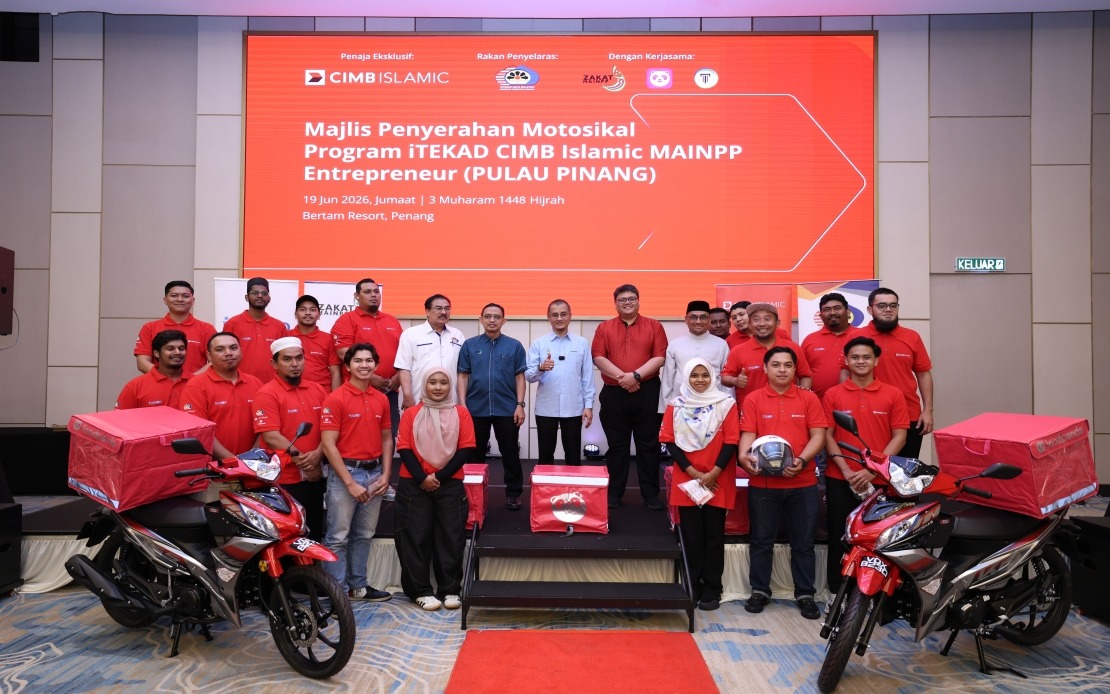
Twenty selected beneficiaries have received motorcycles through the iTEKAD CIMB Islamic-MAINPP Entrepreneur programme, marking a significant step in an integrated effort to lift low-income households out of poverty through employment and sustainable livelihood opportunities. The motorcycle handover ceremony took place in Kepala Batas, Penang, with Penang Deputy Chief Minister I Datuk Dr Mohamad Abdul Hamid presiding over the event, underscoring the state government's commitment to supporting the asnaf community through targeted economic interventions.
The initiative represents a collaborative approach bringing together multiple stakeholders, each contributing specialised expertise and resources. CIMB Islamic Bank Berhad and the Penang Islamic Religious Council (MAINPP) serve as the primary architects, with Zakat MAINPP administering the zakat component. The programme's reach extends further through partnerships with implementation partners including the Malaysian Youth Foundation (YBM), Taylor's Community and foodpanda Malaysia, demonstrating how effective poverty alleviation requires coordination across financial institutions, community organisations and private sector players.
At its core, the programme goes beyond simply distributing assets. Participants receive not only a motorcycle and delivery equipment but also structured training in foundational financial management, workplace discipline and entrepreneurial fundamentals. This comprehensive approach acknowledges that asset distribution alone is insufficient for long-term poverty reduction; beneficiaries require the knowledge and mindset shifts necessary to operate independently and sustain income generation over time. The combination of tangible resources and human capital development creates the conditions for participants to transition from dependency to self-sufficiency.
The financial architecture of iTEKAD reflects innovative zakat deployment. A seed fund totalling RM400,000 comprises matching grants from two sources: RM200,000 derived from the CIMB Islamic Bank Berhad Wakalah Zakat fund and RM200,000 from Bank Negara Malaysia. This structure demonstrates how central bank support can amplify the reach and impact of religious endowment mechanisms, creating multiplier effects that benefit larger segments of the vulnerable population than either institution could achieve independently.
The selection process was deliberately rigorous. From an initial pool of 151 applications, prospective participants underwent comprehensive evaluation including formal interviews and an intensive Entrepreneurship Camp conducted between May 31 and June 3, 2026. This bootcamp approach combines classroom instruction with practical mentoring and peer learning, preparing candidates for the demands of self-employment while allowing assessors to evaluate motivation, resilience and aptitude under real conditions. Only twenty applicants emerged from this filtering process as the most promising candidates for motorcycle grants.
For Malaysia's Islamic finance sector, programmes like iTEKAD illustrate the evolution beyond traditional transaction-based banking toward social impact investing. CIMB Islamic's engagement signals that Islamic financial institutions increasingly view poverty alleviation and asnaf empowerment as core competencies rather than peripheral corporate social responsibility exercises. This positioning aligns with the philosophical foundations of Islamic finance, which emphasises equitable wealth distribution and economic justice alongside profit maximization.
Datuk Dr Mohamad Abdul Hamid emphasised that asnaf development cannot proceed in isolation, requiring instead coordinated effort, genuine commitment and authentic collaboration among government, religious bodies, financial services and private enterprises. This observation carries particular weight in the Malaysian context, where initiatives attempting to address poverty without such multi-stakeholder coordination frequently falter due to fragmented efforts, duplicated resources or misalignment between institutional objectives.
The programme's alignment with the Penang Islamic Religious Development Agenda 2030 (APAI2030) positions iTEKAD within a broader long-term vision encompassing education, economic development, family stability and youth empowerment. This integration prevents the initiative from remaining a disconnected intervention and instead anchors it within systematic state-level poverty alleviation strategy. Such alignment increases prospects for sustainability and scaling, as resources and institutional commitment flow through established governance frameworks rather than remaining dependent on ad hoc project funding.
The motorcycles and associated equipment provided to participants enable entry into the gig economy, particularly as foodpanda delivery partners. This pathway offers flexibility attractive to individuals managing multiple constraints—caregiving responsibilities, health limitations or irregular employment history—while providing immediate income-generating opportunities. The partnership with foodpanda signals how ride-sharing and last-mile delivery platforms can function as employment bridges for disadvantaged populations, though success ultimately depends on individual participant initiative and market demand sustainability.
For Malaysian policymakers observing from other states, the iTEKAD model offers replicable components. The emphasis on seed capital combined with skills development, the rigorous selection methodology ensuring grant quality, and the multi-stakeholder architecture all represent transferable elements adaptable to different contexts. However, effectiveness hinges on genuine commitment from partners, adequate monitoring mechanisms tracking participant progress beyond initial asset distribution, and willingness to adjust interventions based on real-world performance data.
The broader significance extends to how Southeast Asian economies approach informal sector development and urban poverty. As rural-urban migration continues across the region, informal employment and street vending provide survival mechanisms for millions. Programmes formalising pathways within the gig economy through structured training, asset provision and ongoing support potentially offer superior outcomes to unregulated informal work, though debate persists regarding worker protections, income sustainability and social insurance coverage in gig arrangements.
Success measurement for iTEKAD will ultimately depend on longitudinal tracking of participant outcomes—income levels achieved, sustainability of business operations, debt management capacity and integration into broader economic structures. Short-term motorcycle distribution metrics mask the genuine challenge: maintaining participant success beyond the initial enthusiasm phase, when challenges emerge, market conditions fluctuate and external support mechanisms wind down. Programmes demonstrating genuine impact design exit strategies and follow-up support ensuring participants achieve genuine economic independence rather than temporary income bumps.