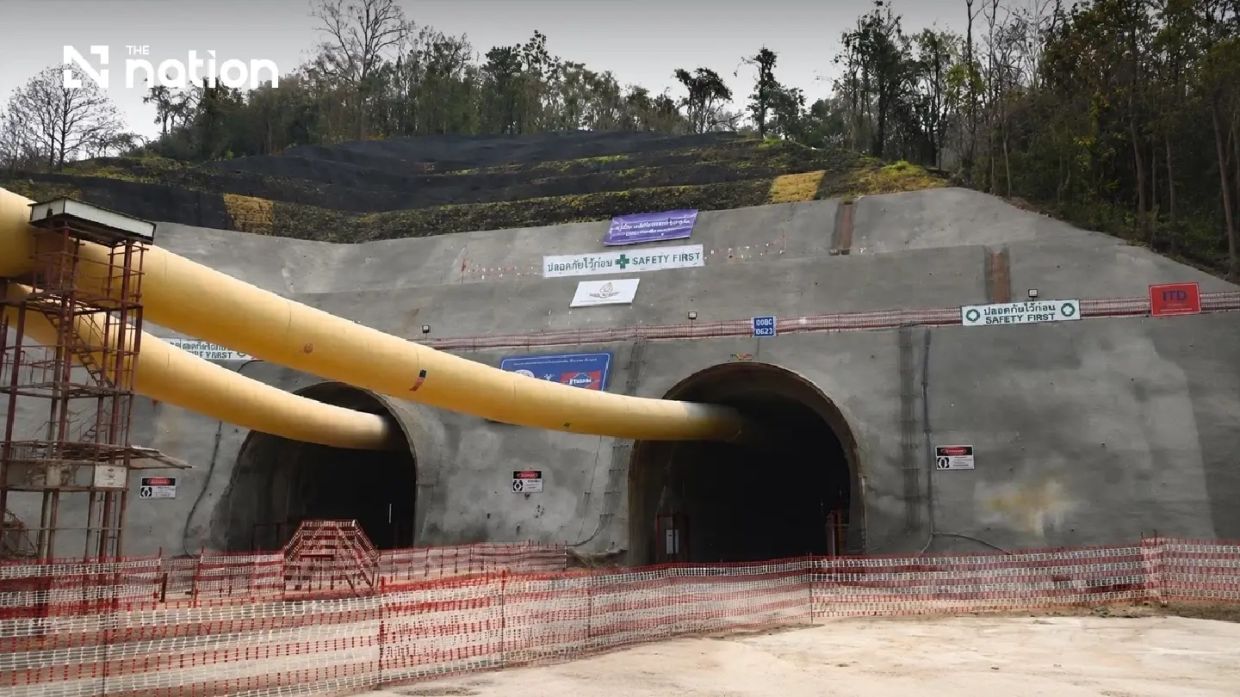
A deadly accident unfolded inside a railway tunnel under construction in northern Thailand on Saturday evening when scaffolding gave way, claiming the lives of two workers and leaving seven more requiring medical attention. The incident occurred at the Doi Luang railway tunnel in Chiang Rai's Chiang Saen district, part of the State Railway of Thailand's ambitious Den Chai-Chiang Rai-Chiang Khong railway development project. Emergency responders received initial reports at 8.35pm, triggering immediate rescue and medical response operations to the site.
Deputy Transport Minister Siripong Angkasakulkiat provided early details about what authorities believe triggered the collapse. According to preliminary findings released after the accident, rocks dislodged from the tunnel wall appear to have been the primary cause, striking workers who were actively engaged in installing a waterproofing system inside the excavation. Earlier accounts from the scene had suggested the incident originated in the shotcrete work area, though officials cautioned that investigations were ongoing to establish the precise sequence of events. The complexity of establishing cause in such environments—where multiple construction activities occur simultaneously in challenging underground conditions—means conclusions remain provisional pending thorough examination.
The human toll from the incident reflects the inherent hazards of deep tunnel construction in mountainous terrain. Medical assessments categorized the nine affected workers into two groups: three sustained serious injuries requiring intensive care, while four others suffered minor wounds. All victims were transported to hospital facilities for treatment. The fatalities underscore the risks tunnel workers face when operating in confined underground spaces where rock stability and structural integrity cannot always be predicted, despite extensive engineering surveys.
Immediate containment measures followed swiftly after the collapse was reported. Officials sealed the accident zone to prevent further injuries and allow investigators safe access to examine the scene. Siripong confirmed that the project's dedicated safety unit had assumed direct control of the construction site and was maintaining close monitoring of conditions. This layering of oversight—involving both the railway authority's special projects division and the safety management team—reflects standard protocols for major infrastructure incidents in Thailand.
The Doi Luang tunnel represents a substantial engineering undertaking. At 3.4 kilometers in length, the completed boring through the mountain already represents significant progress, with interior finishing and systems installation now underway. The tunnel forms a critical component of Contract 3 of the broader Chiang Rai-Chiang Khong section, valued at THB19.385 billion. This contract encompasses extensive infrastructure beyond the tunnel itself, including construction of both ground-level and elevated railway tracks spanning approximately 87 kilometers, three passenger stations, three smaller halts, signalling systems, telecommunications infrastructure, and allied works necessary for operational rail service.
The construction work involves a substantial multinational consortium, demonstrating the scale and complexity of the overall project. The CKST-DC3 Joint Venture brings together CH. Karnchang Public Company Limited, a major Thai construction firm, alongside Sino-Thai Engineering & Construction Public Company Limited, reflecting China's significant involvement in Southeast Asian infrastructure development, and Chiangmai Construction Co., Ltd. This combination of local and international expertise is typical for major Thai infrastructure projects requiring both substantial technical capability and local knowledge.
The Den Chai-Chiang Rai-Chiang Khong railway project holds significance beyond individual contract segments. For northeast Thailand and the broader Mekong region, this rail corridor represents improved connectivity and economic integration. The line facilitates movement between Thailand's central plains and the Chiang Rai province, while ultimately extending toward the Thai-Laotian border at Chiang Khong. Such projects align with regional development frameworks emphasizing infrastructure linkages across Southeast Asia and between Thailand and neighboring countries.
Safety in underground construction remains a persistent challenge for Thailand's expanding rail network. Tunnel projects require constant vigilance regarding rock stability, ground conditions, worker safety protocols, and equipment reliability. The accident at Doi Luang will likely trigger renewed attention to safety procedures across other ongoing tunnel construction projects in Thailand. Investigations into how the waterproofing installation was being conducted and whether proper support structures were in place may reveal systemic issues requiring broader corrective action.
The ministry indicated that further updates would be released as investigations progressed and damage assessments were completed. Such transparency is crucial for maintaining public confidence in major infrastructure projects, particularly when accidents result in fatalities. The railway authority and transport ministry face pressure to demonstrate that safety reviews will produce meaningful improvements and that contractor accountability mechanisms are functioning effectively.