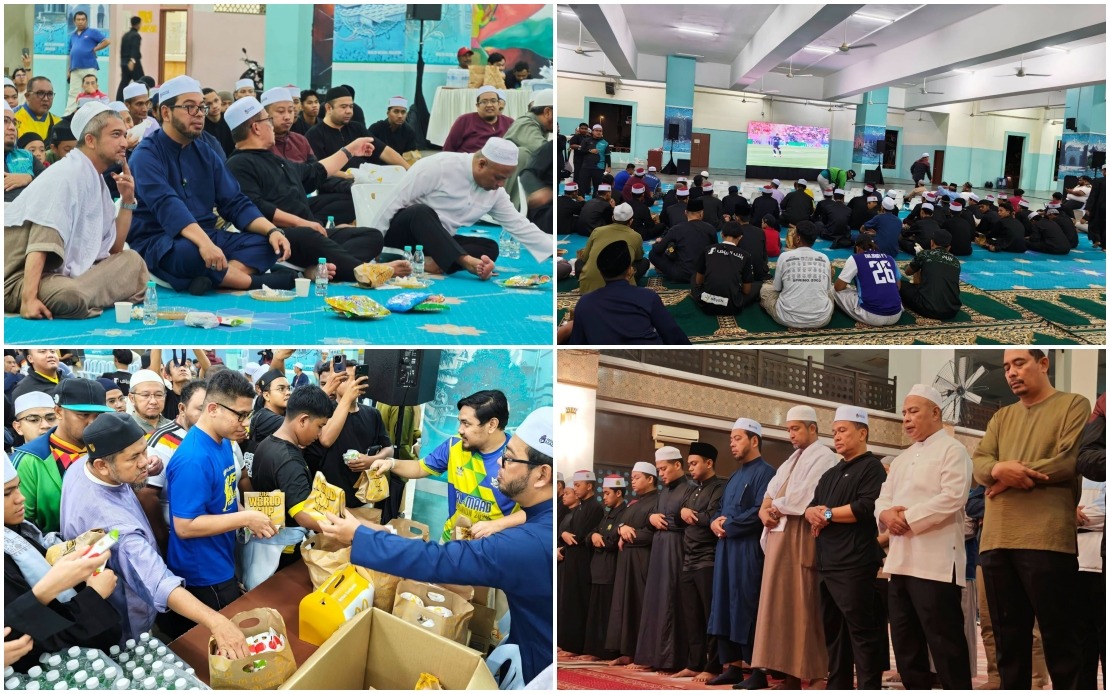
In an innovative fusion of spiritual practice and contemporary entertainment, more than 300 young worshippers converged at Masjid Usamah bin Zaid in Wangsa Maju before sunrise on June 21 to participate in Qiyamullail—the optional pre-dawn prayers traditionally observed during significant nights—before settling in to watch a World Cup screening. The initiative reflects a deliberate strategy to engage Malaysia's youth by meeting them at the intersection of their religious identity and sporting passion, demonstrating how religious institutions can remain relevant to younger demographics without compromising spiritual substance.
Dr Zulkifli Hassan, the Minister in the Prime Minister's Department (Religious Affairs), attended the event and offered a perspective that reframes how Malaysian authorities perceive youth engagement with Islam. Rather than viewing football fandom as a distraction from religious observance, he positioned the programme as evidence that young people's sporting interests can be meaningfully integrated with purposeful spiritual activities. This represents a subtle but significant departure from more restrictive interpretations of religious conduct, instead embracing what he termed a wisdom-based approach to dakwah, the Islamic concept of invitation or outreach to faith. By legitimising football as a vehicle for engagement rather than dismissing it, the programme signals a modernising stance within Malaysia's religious establishment.
The featured match was the 2026 World Cup Group E encounter between Germany and Ivory Coast, with Germany ultimately securing a 2-1 victory. The choice to broadcast this particular fixture suggests deliberate programming aimed at maintaining attendance and engagement throughout the early morning hours, as matches involving traditional football powerhouses tend to generate sustained interest among viewers across Southeast Asia. The scheduling placed the spiritual component in the predawn darkness, creating a natural rhythm that honoured traditional Islamic practice while the secular entertainment followed as the sun rose, providing food and fellowship during daylight hours.
During the interval between halves, the mosque brought in expert analysis from Malaysian football personalities. Shahril Arsat, a figure with legendary status in the local football landscape, and Khushairi Aizad, formerly associated with Selangor FA's President's Cup campaigns, offered technical commentary on the teams' tactical approaches and performance dynamics. This deliberate integration of recognised sports personalities serves multiple purposes: it elevates the credibility of the broadcast experience, provides mentorship visibility from established figures within Malaysian sports culture, and creates a narrative that positions Islamic spaces as intellectually engaging venues where serious discussion of sports happens rather than mere passive consumption.
The gathering attracted significant institutional representation from Malaysia's Islamic bureaucracy. Datuk Nizam Yahya, chief executive of the Federal Territories Islamic Religious Council (MAIWP), and Datuk Ajib Ismail, deputy director-general of the Malaysian Islamic Development Department (JAKIM), both attended and participated in preparation of breakfast refreshments alongside Dr Zulkifli and the Federal Territories Mufti. The choice to have senior officials personally preparing roti canai—a labour-intensive, traditionally prepared Indian-Muslim dish—represented more than token involvement. It demonstrated a commitment to service and community care that transcends bureaucratic hierarchy, creating a memorable example of religious leadership actively engaged in hospitality rather than merely delivering directives from podiums.
The coordination required to execute the programme reflected the complexity of engaging multiple layers within Malaysia's Islamic administrative structure. The organising coalition included the Federal Territories Mufti Department, JAKIM, MAIWP, the Federal Territories Islamic Religious Department (JAWI), the Malaysian Islamic Dakwah Foundation (YADIM), the Malaysian Islamic Economic Development Foundation (YAPEIM), mosque management directly, the Islamic Youth Movement (ABIM), religious marksman associations, and commercial food sponsors. This breadth of participation suggests that the initiative carried endorsement from across Malaysia's fragmented Islamic governance landscape, where coordination between federal, state, and municipal religious authorities can sometimes prove challenging.
The inclusion of ABIM—the Angkatan Belia Islam Malaysia—particularly signals an intentional focus on youth mobilisation and activism rather than passive consumption. ABIM brings institutional capacity for youth organising and has historically functioned as a bridge between religious authority and younger constituencies seeking meaningful Islamic engagement. Its presence suggests the programme was designed not as a one-time novelty but as part of a broader strategy to build sustained youth involvement in mosque-based activities and religious community life.
From a Malaysian and Southeast Asian perspective, this initiative reflects broader regional trends in how Islamic institutions are adapting to compete for youth attention in increasingly secular, entertainment-saturated societies. Unlike approaches that pit religion against popular culture, this model explicitly integrates them, suggesting confidence that Islamic identity remains compatible with contemporary interests. For Malaysia specifically, where Islam occupies a constitutionally privileged position and religious authority intersects with state power, the programme demonstrates how government religious agencies are proactively responding to demographic shifts and changing expectations about how faith institutions should operate.
The event also carries subtle implications for interfaith and multicultural Malaysia. By prominently featuring a match involving African teams and showcasing Malaysia's multicultural football heritage through the participation of personalities like Shahril Arsat, the programme positioned Islamic spaces as inclusive of national and international sporting cultures. This moves beyond narrow ethnoreligious identity toward a more expansive vision of Islamic community that encompasses Malaysian plurality. The early morning gathering of 300 young people, predominantly Malaysian youth, demonstrated that contemporary Islam in Malaysia is not confined to Friday sermons or formal ritual spaces but is actively being reimagined and practised within flexible, creative contexts that reflect how young Malaysians actually live.