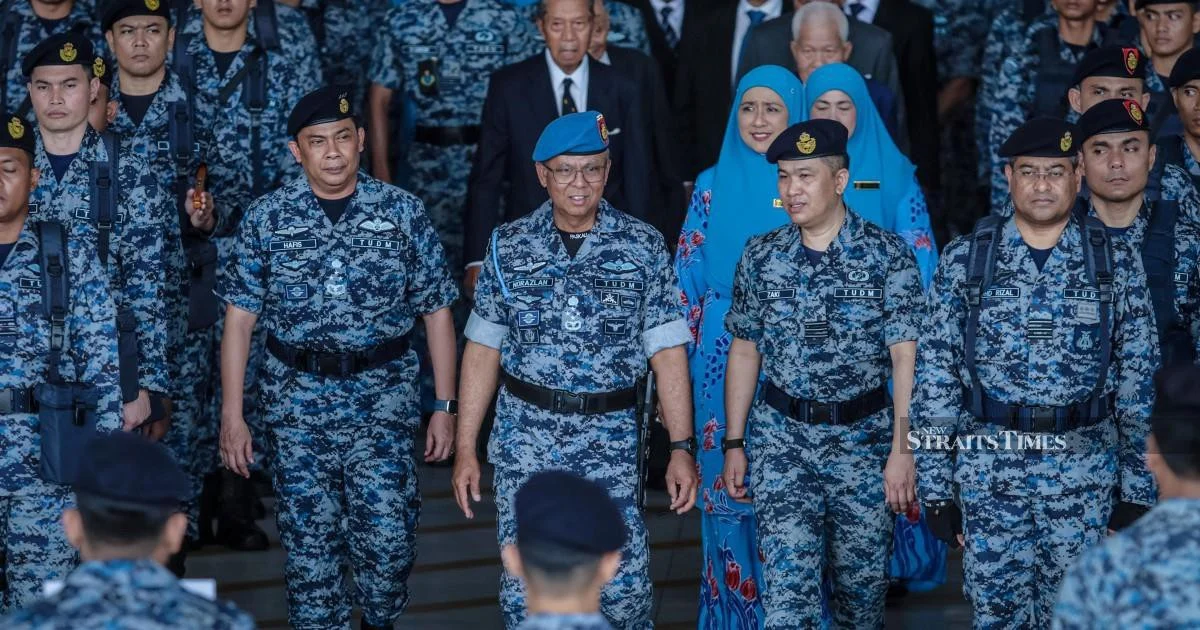
Protecting Malaysia's vital maritime corridors increasingly depends on robust air defence capabilities, according to Royal Malaysian Air Force chief General Tan Sri Muhamad Norazlan Aris, who underscored the necessity of strengthening airborne operations to counter evolving regional threats.
The RMAF commander's assertion reflects deeper anxieties within Malaysia's defence establishment about the nation's ability to monitor and secure critical shipping lanes that remain fundamental to economic prosperity. As Southeast Asia's geopolitical landscape grows more volatile, Malaysian military planners have begun reassessing the adequacy of existing air assets and their deployment patterns across the country's extensive maritime boundaries.
General Muhamad Norazlan Aris highlighted that modern maritime security extends far beyond traditional naval vessels, requiring sophisticated airborne surveillance and rapid-response capabilities that only contemporary air forces can reliably deliver. The emphasis on air power reflects a strategic pivot in how Malaysia conceptualizes territorial defence, moving away from purely surface-based approaches toward integrated systems that leverage speed, altitude, and technological sophistication.
Malaysia's maritime zones encompass some of the world's busiest shipping lanes, including the Strait of Malacca, through which trillions of dollars in global commerce flow annually. The vulnerability of these routes to various threats—from piracy and smuggling to deliberate territorial encroachments—has prompted defence officials to examine whether current air force capabilities sufficiently deter hostile actors and respond swiftly to incidents.
Regional tensions involving competing territorial claims, power competition between major nations, and the militarisation of adjacent waters have intensified pressure on Malaysia to demonstrate effective control over its airspace and maritime approaches. The RMAF chief's comments suggest the military institution views air superiority as a critical determinant of whether Malaysia can maintain genuine sovereignty over its claimed waters and maintain freedom of navigation.
Enhancing air-based maritime protection presents significant budgetary and logistical challenges for the Malaysian military establishment. Current aircraft platforms require continuous modernisation, and maintaining operational readiness across dispersed airbases demands substantial resource allocation that competes with other national defence priorities and civilian government programmes.
The geopolitical context animating these defence concerns encompasses multiple dimensions beyond traditional maritime disputes. China's expanding military presence across Southeast Asian waters, ongoing great-power competition for regional influence, and the strategic importance of maintaining international maritime norms all factor into Malaysian strategic calculations about necessary air force capabilities.
From a regional perspective, Malaysia's air power dilemma mirrors challenges facing neighbouring countries struggling to maintain maritime domain awareness across vast ocean territories. The coordinated approach some Southeast Asian nations have attempted through information-sharing and joint patrols demonstrates recognition that individual capacity remains constrained, suggesting air force modernisation alone cannot resolve all maritime security concerns.
The RMAF chief's statement implicitly acknowledges that Malaysia must carefully balance deterrence capabilities with measured force posture that avoids escalatory cycles while signalling credible resolve. This delicate equilibrium becomes increasingly difficult as competing powers project military presence more aggressively throughout Southeast Asian waters, creating pressure on smaller nations to demonstrate enhanced capability and commitment.
Investment in air-based maritime protection technologies—including advanced surveillance systems, longer-range aircraft, and integrated command networks—represents a substantial financial commitment Malaysia must contemplate amid broader economic constraints. Defence budgets remain finite, and allocating greater resources toward maritime air capabilities necessarily involves difficult trade-offs with other military modernisation priorities or domestic spending.
The commander's emphasis also reflects professional military consensus that future maritime security challenges will require increasingly sophisticated technological solutions rather than rely on legacy systems designed for earlier threat environments. Artificial intelligence, unmanned platforms, and network-centric operations represent frontiers where air forces like Malaysia's must develop competency to maintain effective maritime protection.
Malaysia's strategic location between major powers and critical sea lanes positions it as a linchpin of regional stability, yet this importance contrasts with the nation's military capabilities relative to larger regional actors. Consequently, demonstrating credible air-based maritime defence serves broader political purposes beyond conventional military objectives, signalling to international partners and potential adversaries alike that Malaysia possesses genuine capacity to manage its territories responsibly.
The path forward requires sustained political commitment to air force modernisation alongside diplomatic engagement with regional partners on maritime security cooperation. General Muhamad Norazlan Aris's warning ultimately reflects institutional conviction that Malaysia's security and prosperity fundamentally depend on mastering the airspace above its waters—a recognition that should guide defence investment decisions for years ahead.