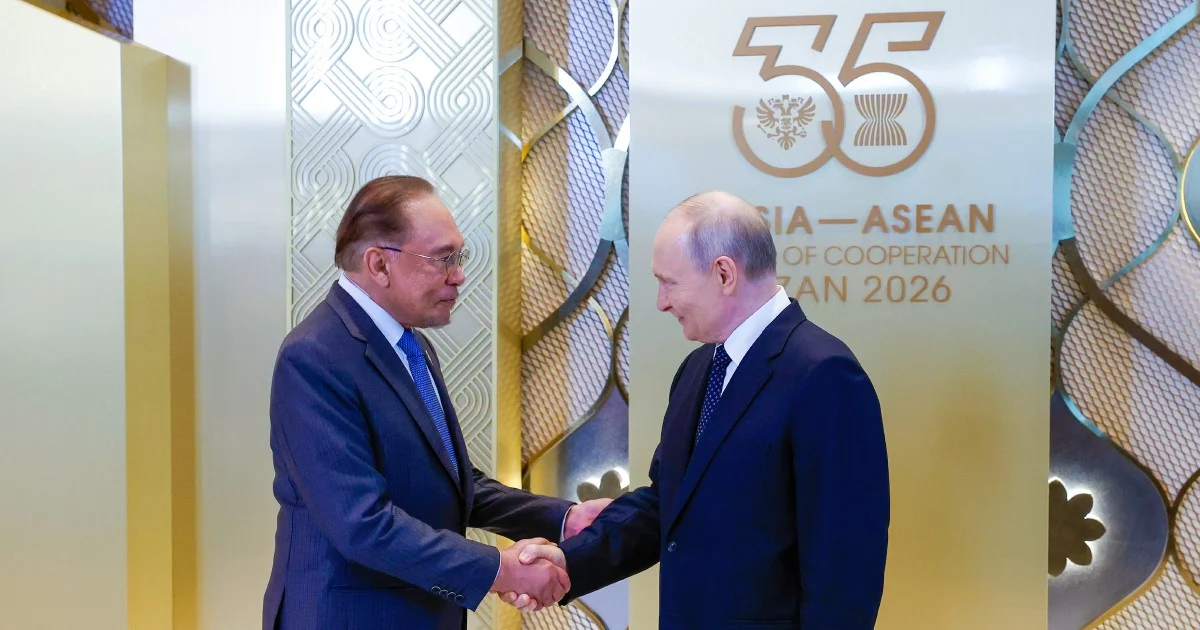
Prime Minister Datuk Seri Anwar Ibrahim and Russian President Vladimir Putin have signalled a broadening of Malaysia-Russia relations during high-level discussions focused on energy cooperation and financial innovation. The talks, held in Kazan, underline growing momentum between Kuala Lumpur and Moscow at a time when both nations are recalibrating their international partnerships and exploring alternatives to Western-dominated trade frameworks.
Energy security has become a priority for Malaysia as the country navigates rising global energy demands whilst managing its own resource constraints. The discussion between Anwar and Putin highlights Russia's strategic importance as a major hydrocarbon supplier and the potential for deeper engagement on oil and gas supply chains. For Malaysia, securing diversified energy sources—particularly from reliable partners outside traditional Western spheres—provides greater insulation against price volatility and geopolitical disruptions in critical supply corridors.
The emphasis on energy cooperation carries particular significance given Southeast Asia's rapid industrialisation and growing electricity consumption. Malaysia, as a regional manufacturing hub and a nation with expanding petrochemical and refining sectors, requires stable energy arrangements to maintain competitiveness. Russian energy exports, combined with Malaysian refineries' processing capabilities, could create mutual commercial opportunities that strengthen both economies whilst reducing dependence on Middle Eastern suppliers.
Beyond conventional energy trade, the bilateral discussions suggest movement towards structural economic diversification. Anwar and Putin's focus on expanding trade using Malaysian ringgit and Russian ruble rather than relying on major reserve currencies reflects a broader shift occurring throughout the Global South. This approach reduces exposure to currency fluctuations imposed by third parties and insulates bilateral commerce from sanctions regimes or financial restrictions emanating from Western capitals—a consideration increasingly relevant given geopolitical tensions.
Currency localisation in bilateral trade has gained traction among emerging market partners seeking greater financial autonomy. For Malaysia, conducting more commerce in ringgit strengthens domestic currency demand, potentially boosting its attractiveness in regional payment systems. Similarly, expanding ruble usage in Malaysian-Russian transactions provides Russia with alternative mechanisms for settling international accounts, particularly valuable given Western financial restrictions imposed following geopolitical disputes.
The Kazan meeting reflects Malaysia's pragmatic approach to foreign policy under Anwar's leadership—one that maintains traditional Western partnerships whilst simultaneously developing relationships with major non-aligned powers. This balancing act remains essential for a nation dependent on open global trade, foreign investment from diverse sources, and freedom of navigation through critical waterways. Russia, despite international isolation in certain quarters, remains a significant player in commodity markets and technological development.
From a Southeast Asian perspective, Malaysia's deepening ties with Russia signal the region's continued importance as a geopolitical focal point. Southeast Asian nations increasingly serve as bridges between competing blocs, and Malaysia's engagement demonstrates how regional countries can pursue independent foreign policies whilst maintaining strategic flexibility. The energy cooperation discussions specifically show how nations can find common ground on practical economic matters even amid broader geopolitical tensions.
The bilateral framework also carries implications for the broader regional architecture. As Malaysia strengthens partnerships across different poles of influence—maintaining ties with Western democracies, deepening engagement with China, and expanding cooperation with Russia—it reinforces ASEAN's principle of strategic autonomy. This approach allows Southeast Asian nations collectively and individually to benefit from multiple partnerships rather than being forced into exclusive alignments.
Trade expansion between Malaysia and Russia, particularly when denominated in local currencies, could encourage similar arrangements throughout Southeast Asia. If successful, such mechanisms might provide a template for other regional partnerships, gradually building an alternative financial infrastructure that reduces dependency on dollar-dominated systems. For Malaysian businesses, this opens new export markets and sourcing opportunities, though commercial engagement with Russia remains subject to various international limitations.
Anwar's engagement with Putin also underscores Malaysia's interest in becoming a hub for South-South cooperation and alternative trade mechanisms. As developing nations increasingly seek independence from Western-controlled financial systems, Malaysia—with its advanced banking sector, strategic location, and diplomatic sophistication—positions itself as a potential facilitator for such arrangements. The ringgit-ruble trade initiatives discussed in Kazan may represent early steps towards building broader networks of local currency arrangements across the Global South.
Looking ahead, the energy cooperation framework may extend beyond traditional fossil fuels. Russia possesses significant expertise in nuclear technology, renewable energy research, and industrial processes that could appeal to Malaysia's long-term diversification goals. As countries worldwide transition energy systems, partnerships combining Russia's technical capabilities with Malaysia's manufacturing strength could generate new economic opportunities in green technology sectors.
The bilateral discussions also reflect domestic political considerations within both nations. For Anwar, demonstrating Malaysia's capacity to engage meaningfully with major powers reinforces his government's economic credentials and foreign policy independence. For Putin, meaningful engagement with Southeast Asian partners provides counterweight to Western isolation and demonstrates that Russia maintains viable international relationships despite geopolitical pressures.
Ultimately, the Anwar-Putin discussions in Kazan exemplify how contemporary international relations increasingly operate beyond traditional Cold War binaries. Nations like Malaysia pursue multifaceted partnerships calibrated to specific economic benefits and strategic interests rather than ideological alignment. As energy security becomes more pressing and financial systems grow more multipolar, bilateral arrangements focused on practical cooperation using local currencies represent rational responses to evolving global conditions.