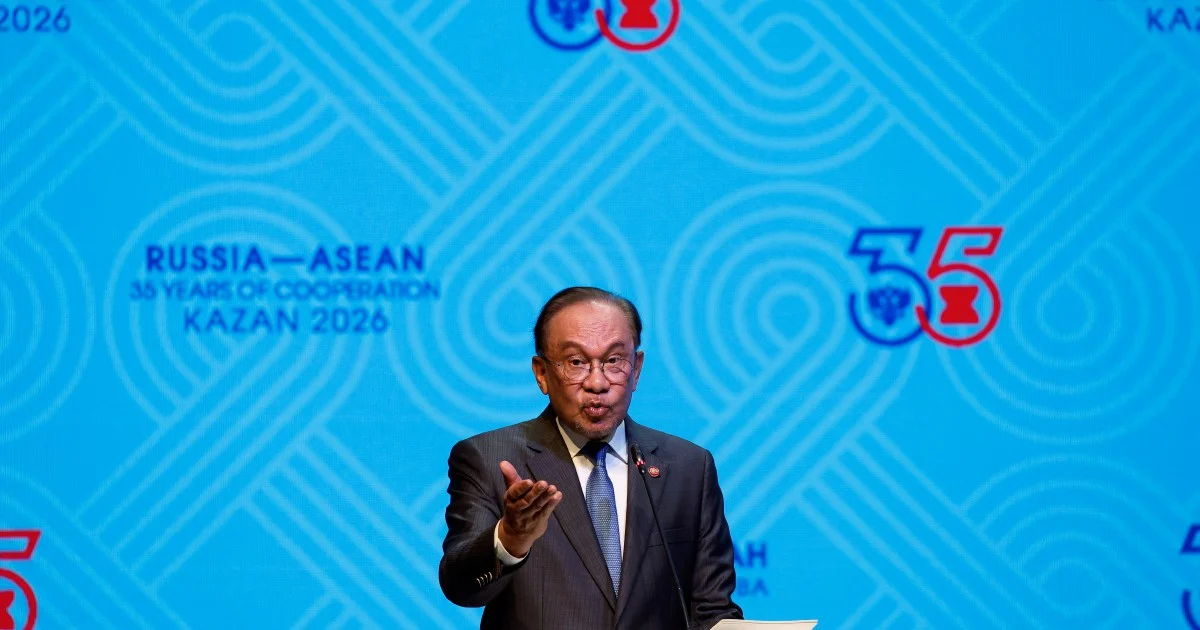
Prime Minister Datuk Seri Anwar Ibrahim has characterised the finalisation of the Asean-Russia Strategic Programme on Trade and Investment Cooperation 2026-2035 as a significant endorsement of closer economic collaboration between the regional grouping and the Russian Federation. Speaking in Kazan, Anwar portrayed the completion of this framework as a catalyst that could propel bilateral and multilateral trade relations into a new phase of expansion and development. The agreement represents years of negotiation and strategic positioning by both Asean and Russia to forge stronger commercial ties amid a shifting global economic landscape.
The programme's completion assumes particular relevance for Malaysia and other Southeast Asian nations seeking to diversify their economic partnerships beyond traditional Western markets. As geopolitical tensions reshape international commerce, Asean has pursued a doctrine of strategic autonomy—establishing frameworks with multiple partners rather than relying on any single power bloc. The Asean-Russia initiative demonstrates this hedging strategy, offering member states opportunities to tap into Russian markets, technology, and investment capital. For Malaysia specifically, which has sought to strengthen ties with non-aligned powers while maintaining pragmatic relationships across the geopolitical spectrum, the roadmap opens pathways for sectoral cooperation in energy, agriculture, and manufacturing.
However, Anwar's emphasis on the necessity of an enabling environment underscores deeper complexities facing the implementation of such ambitious plans. International sanctions regimes, logistical bottlenecks, and infrastructure constraints have historically impeded the realisation of Asean-Russia economic ambitions. The geopolitical context surrounding Russia's international isolation following its invasion of Ukraine has complicated trade patterns, currency convertibility, and financing mechanisms that underpin commercial relationships. Anwar's implicit acknowledgment of these obstacles suggests a measured optimism—one cognisant that frameworks alone do not guarantee prosperity without deliberate action to remove barriers.
The 2026-2035 timeline positions the roadmap as a medium-to-long-term strategy, spanning a decade of potential evolution in global trade dynamics. This duration allows for the development of institutional mechanisms, regulatory harmonisation, and infrastructure investments necessary to transform commitments into tangible commercial flows. Asean nations must align customs procedures, establish payment systems that circumvent Western financial restrictions on Russia, and create corridors for goods movement. Malaysia's role as a financial and logistical hub within Southeast Asia suggests it could serve as a pivot point for channelling Asean-Russia trade, provided domestic regulatory frameworks adapt appropriately.
The strategic rationale behind Asean's deepened engagement with Russia extends beyond economics into the realm of political balance. As the United States and China compete for regional influence, Asean's commitment to non-alignment and centrality requires maintaining substantive relationships with secondary powers. Russia, despite its current geopolitical isolation in Western circles, remains a significant actor in Asian affairs—a major energy supplier, a permanent UN Security Council member, and a neighbour to several Asian nations. Engaging Russia through trade frameworks allows Asean to reinforce its independence and prevent the region from becoming bifurcated into competing spheres of influence.
For Malaysian businesses, the roadmap offers potential entry points into sectors where Russia possesses comparative advantages or complementary capabilities. Energy cooperation has traditionally been a cornerstone of Asean-Russia ties, with Malaysian companies exploring opportunities in oil and gas exploration, refining, and technology transfer. Agricultural trade could expand as Russian producers seek access to Southeast Asian markets, and Malaysian agricultural exporters develop Russian clientele. Manufacturing partnerships might develop in industries where logistics and raw material sourcing benefit from closer integration. The roadmap's sectoral approaches remain to be detailed through subsequent negotiating processes.
The geopolitical implications of strengthening Asean-Russia ties reverberate across Asia-Pacific security architectures. Enhanced economic interdependence typically reduces the likelihood of military confrontation and creates shared interests in regional stability. For Southeast Asia, a region navigating territorial disputes and great power rivalry, expanded engagement with Russia signals to all actors—particularly China and the United States—that the region will maintain principled autonomy in its foreign relations. This autonomy has become essential as the US-China competition intensifies and smaller nations seek to avoid forced alignments.
Implementing the trade roadmap will require sustained commitment from both Asean secretariat and individual member governments. Institutional mechanisms must be established to monitor progress, resolve disputes, and adjust strategies as circumstances evolve. Malaysia, holding considerable diplomatic weight within Asean, can advocate for practical measures that facilitate rather than merely declare cooperation. This includes fostering people-to-people connections, supporting joint ventures between Malaysian and Russian enterprises, and creating regulatory sandboxes where businesses can experiment with new trading modalities.
The roadmap also reflects broader recognition within Asean that economic resilience depends on multiple trade relationships. The diversification imperative—driven by pandemic-related supply chain disruptions, climate vulnerabilities, and geopolitical unpredictability—has convinced many Southeast Asian leaders that overreliance on any single market or partner carries unacceptable risks. Russia, with its abundant natural resources and technical expertise, complements rather than competes with the region's primary economic relationships. Whether the 2026-2035 programme translates into meaningful commercial expansion will ultimately depend on whether member states translate diplomatic commitments into concrete investments, policy reforms, and institutional support that Anwar's cautionary remarks suggest cannot be taken for granted.