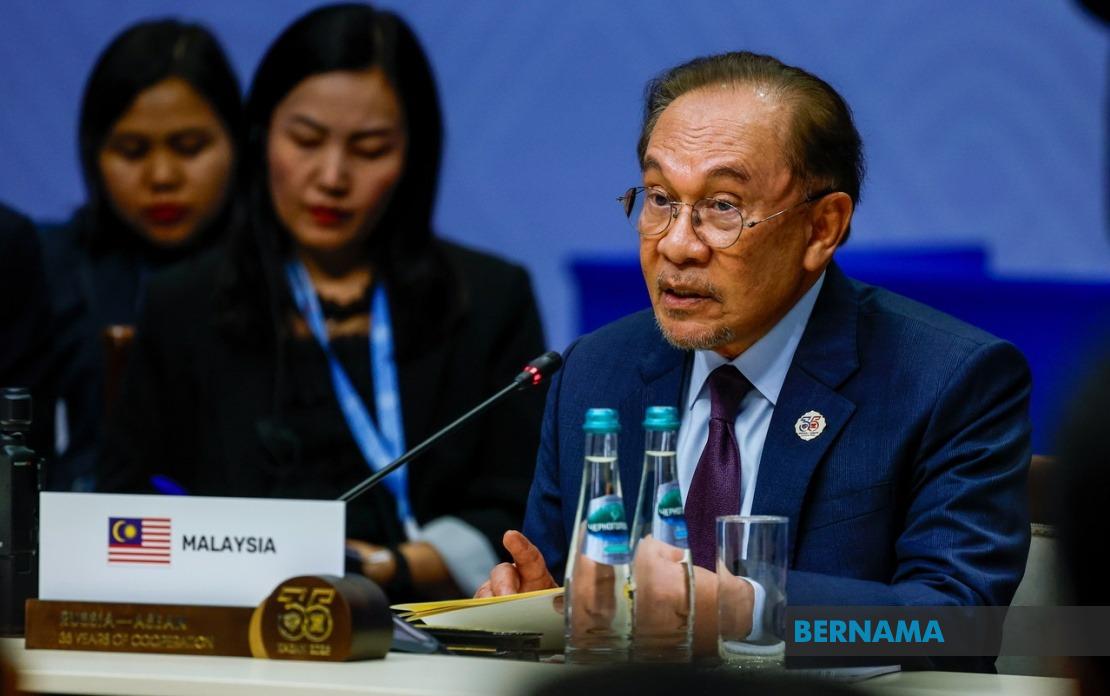
Prime Minister Datuk Seri Anwar Ibrahim has issued a call for ASEAN and Russia to pursue deeper strategic cooperation across diverse economic and technological domains, speaking at a landmark summit in Kazan that celebrates three decades and a half of diplomatic ties between the two regional entities. The ASEAN-Russia Commemorative Summit serves as a pivotal opportunity for both sides to reassess past achievements and establish a roadmap for future engagement in an increasingly unstable international landscape.
During his address to the plenary session, Anwar underscored that sustained dialogue and diplomatic channels remain indispensable tools for resolving conflicts and managing geopolitical tensions that continue to roil the global system. His emphasis on peaceful resolution reflects Malaysia's consistent position as a proponent of multilateral engagement and rules-based international conduct. The summit itself represents the highest institutional mechanism through which ASEAN and Russia can synchronize their strategic interests and address issues of mutual concern.
The Malaysian leader identified several priority areas requiring enhanced bilateral and multilateral engagement. Trade and investment frameworks warrant strengthening to facilitate greater commercial flows and capital movement between ASEAN economies and Russia. Digital infrastructure and technological advancement present opportunities for knowledge transfer and capacity building, particularly as nations grapple with rapid digitalization. Artificial intelligence development and deployment have emerged as critical domains where collaborative research and regulatory harmonization could yield significant benefits for both regions.
Energy cooperation constitutes another pillar in the proposed partnership framework. As Southeast Asian nations navigate the energy transition while maintaining economic growth, engagement with Russia—a major energy producer—offers strategic diversification opportunities. Food security has similarly gained urgency as geopolitical disruptions threaten global supply chains. Malaysia's promotion of the halal industry as a cooperation avenue reflects the country's economic interests and positions Islamic economies at the centre of a growing global market segment valued at hundreds of billions annually.
People-to-people exchanges deserve particular attention as the foundation for sustained political and economic partnerships. Educational exchanges, cultural programs, and civil society engagement create constituencies within both regions favouring continued cooperation. These human connections often prove more resilient than government-to-government ties when political tensions arise, thereby providing stabilizing influences in bilateral relationships.
Anwar reiterated Malaysia's foundational commitment to achieving enduring peace through dialogue, mutual comprehension, and adherence to international legal frameworks. This statement carries particular weight given Malaysia's active mediation efforts in regional disputes and its advocacy for strengthening the rules-based international order. The assertion reflects concern among ASEAN capitals about the erosion of international law as powerful nations pursue interests through unilateral action.
The prime minister articulated Malaysia's position on the Middle Eastern conflict with notable clarity. An immediate cessation of hostilities in Gaza remains non-negotiable from Kuala Lumpur's perspective, coupled with unimpeded delivery of humanitarian assistance to civilian populations. Malaysia's demands for protection of Palestinian self-determination rights align with broader ASEAN positions, though specific member states maintain varying diplomatic approaches to the Israeli-Palestinian question.
Anwar's condemnation of Israeli military operations into Lebanese territory and attacks on UNIFIL positions demonstrates Malaysia's intolerance of regional destabilization and violations of international peacekeeping mandates. These statements reinforce Malaysia's activist foreign policy stance, particularly on issues affecting Muslim-majority populations and international peace operations. The rhetoric also signals solidarity with other ASEAN members holding similar positions on Middle Eastern affairs.
The summit will produce four significant outcome documents shaping future cooperation. The Kazan Declaration commemorates the 35-year relationship milestone and establishes political commitments. Specialized joint statements on energy and cultural cooperation provide detailed frameworks for sectoral engagement. Most consequentially, the comprehensive action plan for 2026 through 2030 operationalizes the ASEAN-Russia Strategic Partnership with specific objectives, timelines, and accountability mechanisms. These documents transform aspirational statements into concrete cooperation mechanisms with measurable outcomes.
The gathering attracted high-level representation from across ASEAN, including Philippines President Ferdinand Marcos Jr., who chairs ASEAN for 2024. This attendance underscores the summit's significance as a platform for strategic conversation beyond bilateral Malaysia-Russia engagement. Multiple ASEAN members participating ensures that cooperation frameworks address regional priorities rather than reflecting isolated national interests.
The 35-year timeline of ASEAN-Russia relations began in 1991 in Kuala Lumpur, originating during a transformative period following the Cold War's conclusion and the Soviet Union's dissolution. Initial engagement reflected Russia's efforts to rebuild relationships in Southeast Asia following geopolitical realignment. Over succeeding decades, cooperation expanded incrementally despite fluctuations in international attention and competing regional priorities, establishing foundations for the more ambitious partnership frameworks now under discussion.
For Malaysia and other Southeast Asian nations, deepened Russia engagement offers strategic hedging opportunities in an era of great power competition. Rather than choosing exclusively between Western and Chinese spheres of influence, ASEAN members benefit from cultivating relationships with multiple centres of power. Russia's technology and energy sectors present alternatives to established suppliers, potentially reducing economic vulnerability and enhancing negotiating leverage with traditional partners.
The summit's outcome documents position ASEAN and Russia as committed partners in addressing transnational challenges extending beyond traditional security parameters. Climate change, pandemic preparedness, maritime governance, and economic resilience emerge as shared concerns requiring sustained cooperation. These frameworks acknowledge that contemporary security extends far beyond military dimensions, encompassing economic, environmental, and social stability. For Malaysian policymakers and businesses, the agreements create institutional pathways for engagement across multiple sectors, potentially generating new opportunities while advancing the nation's regional leadership aspirations.