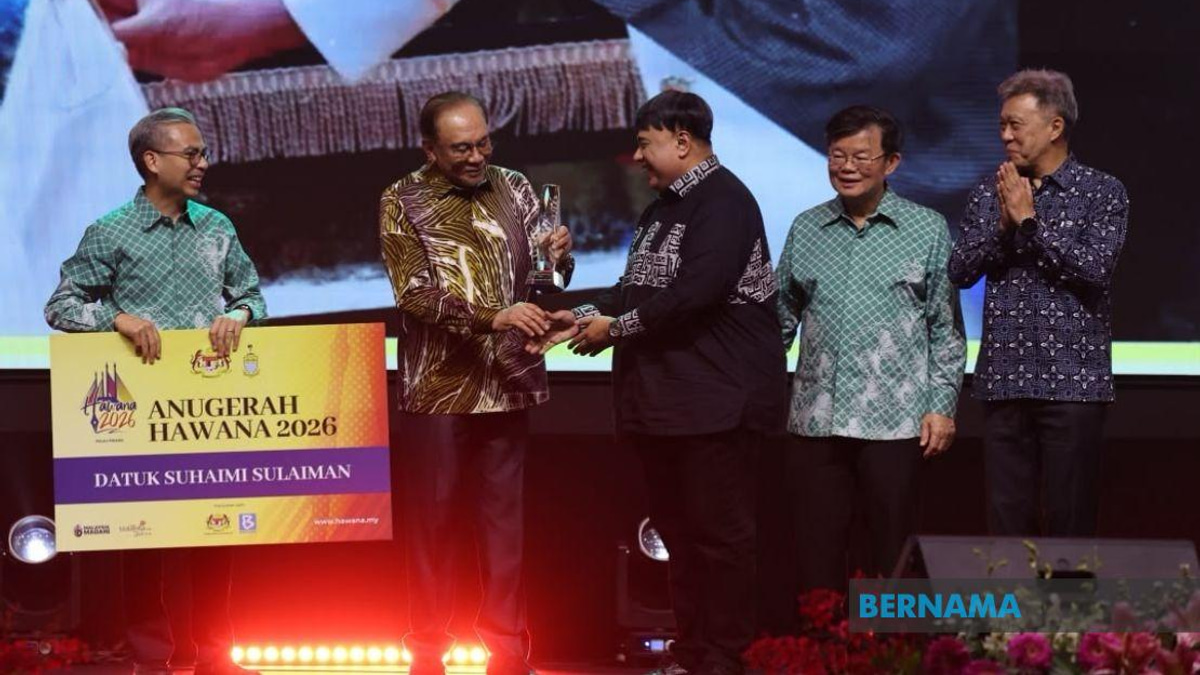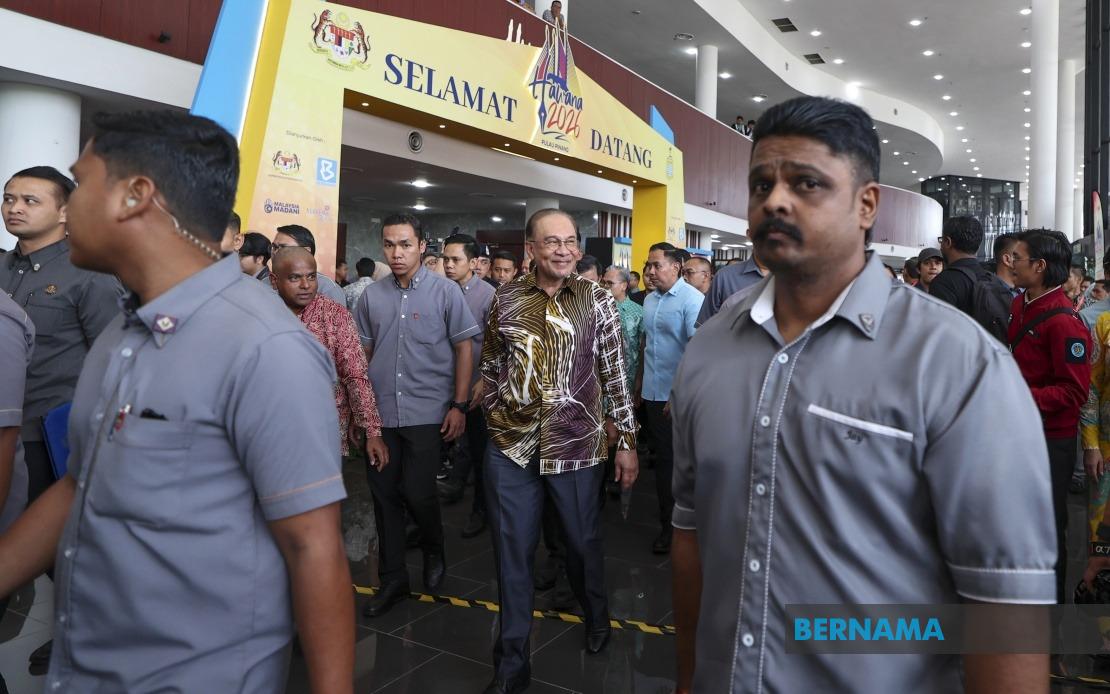
Prime Minister Datuk Seri Anwar Ibrahim arrived at the PICCA Convention Centre @ Butterworth Arena on Wednesday afternoon to formally inaugurate the main event of National Journalists' Day (HAWANA) 2026, an annual occasion that recognises the contributions and professionalism of Malaysia's media community. The Prime Minister touched down at 2.40 pm and was welcomed by Penang Chief Minister Chow Kon Yeow, Communications Minister Datuk Fahmi Fadzil and the Communications Ministry's secretary-general Datuk Abdul Halim Hamzah, underscoring the significance attached to the gathering at both federal and state levels.
Imediately upon arrival, Anwar Ibrahim took the opportunity to engage with the event's interactive elements, touring the various exhibition booths and browsing the dedicated HAWANA 2026 Photo Gallery positioned in the venue's foyer. This gesture—though seemingly ceremonial—demonstrates the leadership's direct engagement with the working press and their recent achievements. The exhibition format allowed attendees and officials alike to showcase developments within Malaysia's media landscape and to display documentations of past HAWANA celebrations, providing both archival value and contemporary relevance.
The occasion drew substantial representation from Malaysia's news industry hierarchy, including Malaysian National News Agency (Bernama) chairman Datuk Seri Wong Chun Wai, chief executive officer Datin Paduka Nur-ul Afida Kamaludin, and editor-in-chief Arul Rajoo Durar Raj. The presence of these senior figures, alongside deputy editor-in-chief Mohd Shukri Ishak, who serves as the HAWANA 2026 project director, reflects the institutional importance Bernama places on this annual event as both a professional gathering and a platform for advancing journalistic standards.
What distinguishes this year's HAWANA celebration is its pronounced international dimension. The event attracted delegates from across the Association of Southeast Asian Nations region, signalling Malaysia's commitment to fostering regional dialogue on media practices and professional journalism. Attendees included Timor-Leste's Secretary of State for Social Communication Expedito Loro Dias Ximenes, Cambodia's Undersecretary of State at the Ministry of Information Prak Thaveak Amida, and Laos's Permanent Secretary of the Cabinet Office of the Ministry of Technology and Communications Phuangpasert Keosouvanh. The participation of these officials highlights how media development and regulatory frameworks have become issues of cross-border policy significance within ASEAN.
Representation from regional news agencies further broadened the gathering's international scope. Timor-Leste's Agencia Noticiosa de Timor-Leste (TATOLI) sent its president Noemio Mateus Soares Falcao and deputy president Madalena DE JCP Carlos, while established agencies from Vietnam, Indonesia, and China—the Vietnam News Agency (VNA), Indonesia's Antara News Agency, and Xinhua News Agency respectively—fielded delegates. This convergence of regional media institutions creates opportunities for cross-border knowledge transfer and the development of shared professional standards, particularly valuable in an era when digital platforms blur traditional boundaries between national media spheres.
The Prime Minister's ceremonial role at the event centred on recognising individual achievement within Malaysia's journalism sector. Anwar Ibrahim was scheduled to present the HAWANA Award and Special HAWANA Award to individuals whose contributions to journalism and public discourse have proven substantial and enduring. Beyond honouring past achievement, the event also featured the distribution of contributions from the Kasih@HAWANA Fund to deserving media veterans, a tangible mechanism for supporting journalists who have spent their careers in the profession. This dual approach—celebrating excellence whilst simultaneously providing material assistance to veterans—reflects a government policy acknowledging both the non-pecuniary rewards of journalism and the practical financial challenges facing long-serving practitioners.
The broader thematic framing of HAWANA 2026 as 'Media Integrity Strengthens Credibility' speaks to contemporary anxieties surrounding information reliability and public trust in news organisations. This theme proves especially pertinent in Malaysia's media landscape, where concerns about misinformation, digital platform dynamics, and the erosion of subscription-based revenue models have created genuine pressures on traditional newsrooms. By centring the conversation on integrity, the organisers position this celebration not merely as a retrospective acknowledgement of journalism's past contributions but as a forward-looking assessment of how the profession might adapt to retain public confidence amid rapid technological and social change.
The event accommodated approximately 1,000 media practitioners from both domestic and international contexts, establishing it as a substantial professional gathering rather than a ceremonial footnote. This scale permits genuine substantive engagement, enabling working journalists, editors, agency executives, and media regulators to exchange perspectives on contemporary challenges including digital transformation, business model innovation, journalistic training, and the intersection of technology and editorial independence. For Malaysian participants especially, the presence of peers from across the region provides benchmarking opportunities and exposure to differing regulatory approaches and professional practices.
Organisational oversight of HAWANA 2026 rested with the Ministry of Communications, with Malaysia's official news agency Bernama serving as the implementing body. This institutional arrangement reflects a considered approach to state engagement with the media profession—rather than direct governmental control of the event's messaging or outcomes, the structure permits the government to provide official sponsorship and leadership presence while delegating operational responsibility to a news agency with professional standing and institutional distance from political direct control. The Ministry of Communications' involvement ensures policy-level engagement with media development questions, while Bernama's role as implementing partner preserves space for journalistic perspectives to shape the agenda.
The thematic emphasis on 'Media Integrity Strengthens Credibility' emerged from broader regional and global contexts in which trust in information institutions has declined. For Malaysian readers and media practitioners, this theme resonates with domestic experiences of recent years, during which debates over press freedom, political pressure on newsrooms, and the challenge of combating deliberately false information have dominated professional discourse. The celebration thus functions not simply as recognition of past achievement but as a statement of intent regarding professional standards and public responsibility moving forward, positioning journalism as integral to democratic health and social cohesion.
The HAWANA platform, organised annually under Ministry of Communications auspices, has evolved into the primary institutional mechanism through which Malaysia's government, media industry, and international partners engage in dialogue about journalism's role, challenges, and future direction. By honouring practitioners and veterans, by convening regional peers, and by articulating thematic priorities such as integrity and credibility, HAWANA creates space for the profession to take stock of its position within Malaysian society while asserting journalism's essential function in delivering accurate, authentic information to the public. For Southeast Asian practitioners monitoring developments in Malaysia's media landscape, the event provides instructive insights into how governments and news institutions navigate contemporary pressures on professional journalism.