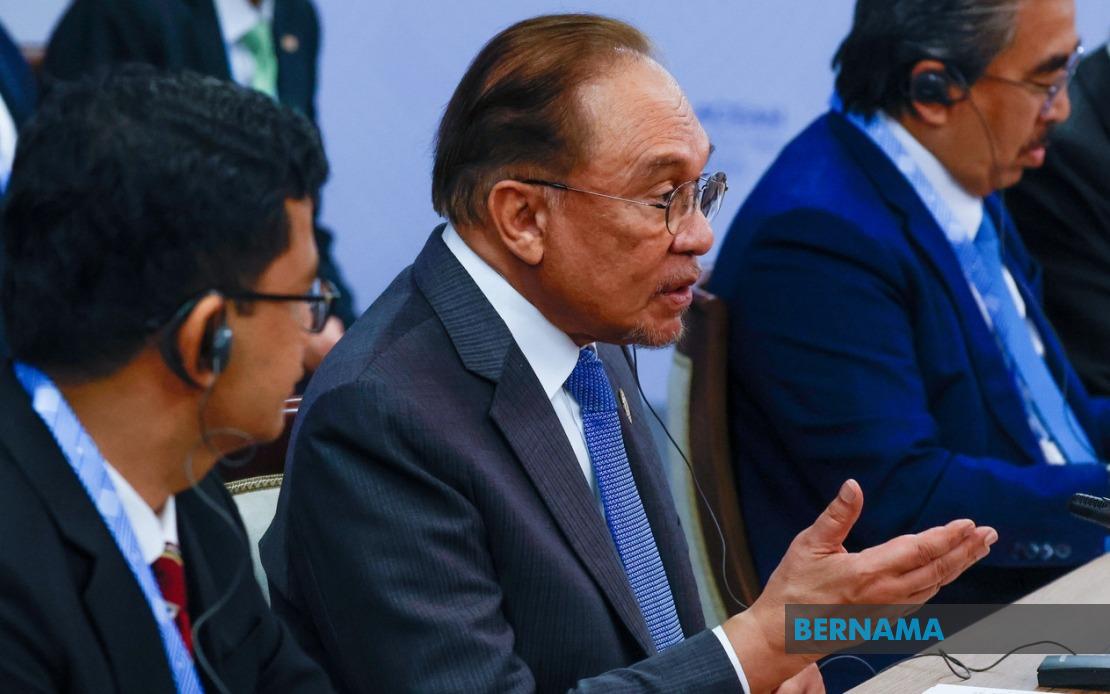
Malaysian Prime Minister Datuk Seri Anwar Ibrahim met with Russian President Vladimir Putin in Kazan on Wednesday evening, where he voiced Malaysia's appreciation for Russia's unwavering approach to two of the most pressing geopolitical issues confronting the Middle East. During their bilateral discussion, Anwar highlighted Moscow's steadfast handling of the Gaza crisis and its broader engagement with Iran, characterising both as exemplifying a commitment to principled diplomacy that deserves international recognition and respect.
Anwar's commendation reflects Malaysia's broader diplomatic alignment with nations that have advocated for a more balanced approach to Middle Eastern affairs. In his opening remarks, the Prime Minister explicitly thanked Putin for Russia's positions, emphasising the consistency with which Moscow has pursued its stated objectives. The language Anwar employed—describing Russia's stance as "very consistent" and "principled"—underscores Kuala Lumpur's view that geopolitical decisions should be grounded in clear values rather than shifting strategic pressures from rival powers.
The Malaysian leader extended his appreciation beyond bilateral concerns, noting that the international community, particularly the Malaysian people, admired what he termed Putin's "tenacity and conviction." This framing is significant because it positions Russia not merely as a state actor pursuing narrow national interests but as a power willing to maintain unpopular positions when it believes them to be justified. Such language carries particular weight in Malaysia's foreign policy context, where the government has sought to project itself as a voice for developing nations and a champion of international justice, especially regarding Palestinian rights.
Russia's position on Gaza has centred on consistent calls for an immediate ceasefire and unimpeded humanitarian access for Palestinian civilians trapped in the territory. Moscow has repeatedly stressed the need for diplomatic engagement and condemned what it characterises as disproportionate military responses. Additionally, Russia has advocated for solutions that address the underlying political grievances driving the conflict, positioning itself as supportive of international law and the rights of occupied populations—a narrative that resonates with Malaysia's own foreign policy rhetoric.
Parallel to its Gaza diplomacy, Russia has maintained longstanding strategic ties with Iran while simultaneously advocating for negotiated settlements rather than military escalation in the region. Moscow's approach contrasts sharply with Washington's more confrontational posture toward Tehran, a distinction that influences how many Southeast Asian nations, including Malaysia, perceive the geopolitical balance. By maintaining dialogue channels with Iran while resisting pressure to isolate the Islamic Republic, Russia projects an image of diplomatic independence that appeals to countries wishing to avoid being forced into rigid geopolitical camps.
For Malaysia specifically, Anwar's embrace of Russia's approach carries implications for Kuala Lumpur's broader foreign policy orientation. Malaysia has long sought to maintain strategic flexibility, avoiding exclusive alignments while retaining the freedom to cooperate with multiple powers across different sectors. By publicly praising Russia's consistency on Middle Eastern issues, Anwar signals that Malaysia values principled positions that are maintained regardless of external pressure—a message that also applies domestically, where the government emphasises its own commitment to unwavering principles.
The timing of this bilateral meeting in Kazan also deserves consideration within the wider context of great power competition in Southeast Asia. As Western powers, particularly the United States, seek to consolidate partnerships against China and Russia, Malaysia's willingness to engage positively with Moscow demonstrates the region's refusal to adopt a binary worldview. Southeast Asian nations are increasingly sophisticated in their diplomatic engagement, recognising that constructive relations with multiple powers better serve their long-term interests than alignment with any single bloc.
Russia's Middle Eastern diplomacy has become increasingly central to its global positioning, particularly as it faces Western sanctions and isolation in other spheres. By cultivating partnerships with key players like Malaysia that publicly acknowledge and validate its diplomatic efforts, Moscow reinforces its narrative as a responsible power committed to international stability. Anwar's remarks thus provide valuable diplomatic credit to the Kremlin at a moment when Russia seeks to demonstrate that its international standing extends beyond its immediate regional sphere.
For the Malaysian government, such engagement serves multiple purposes. Domestically, supporting Palestinian causes and maintaining independence from Western-led initiatives appeals to significant segments of the Malaysian electorate and broader Muslim world. Internationally, it positions Malaysia as a thoughtful actor capable of recognising principled positions regardless of their source, enhancing Kuala Lumpur's credibility as a bridge-builder in regional and global affairs. The conversation between Anwar and Putin therefore reflects not merely a transactional diplomatic exchange but a convergence of interests in maintaining alternative models of international engagement.
The Middle East remains a flashpoint where regional instability carries global ramifications, affecting energy markets, security arrangements, and the broader international order. Malaysia, as a significant Southeast Asian economy with substantial Muslim populations and energy interests, has legitimate reasons to engage with how major powers approach these issues. Anwar's public affirmation of Russia's consistency suggests that Malaysia views Moscow's approach as preferable to alternatives that might involve regional militarisation or diminished attention to humanitarian concerns.
Looking forward, this bilateral engagement may signal deeper cooperation between Malaysia and Russia across multiple domains. When senior leaders publicly validate each other's positions on geopolitically sensitive matters, it often precedes expanded collaboration in trade, defence, technology, and cultural exchanges. Russia, seeking to deepen ties with Asian partners as Western relationships remain strained, likely views such affirmations as opportunities to strengthen relationships that can provide diplomatic and economic dividends over the long term.