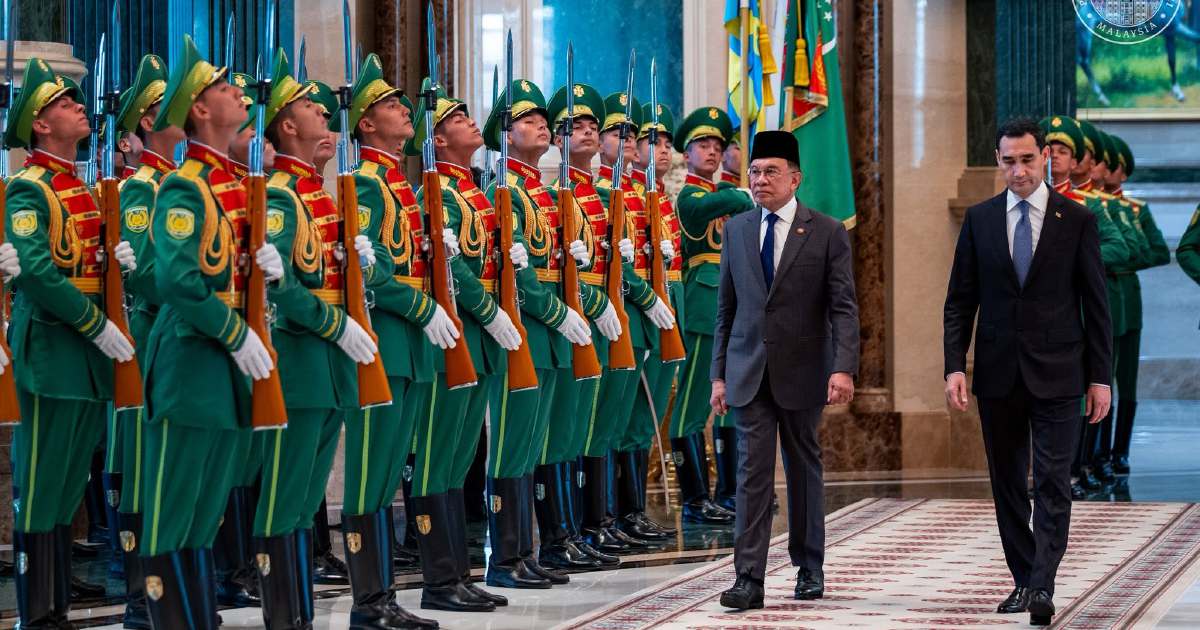
Prime Minister Datuk Seri Anwar Ibrahim was given full state honours at Turkmenistan's Presidential Palace in Ashgabat today, underscoring Malaysia's commitment to strengthening diplomatic relationships across Central Asia's strategic energy-rich region. The ceremonial reception, featuring the formal protocol typically reserved for visiting heads of government, signals the government's intention to elevate bilateral engagement with a nation that remains relatively less prominent in Malaysia's traditional foreign policy orbit.
The visit represents Anwar's first official trip to Turkmenistan since his assumption as Prime Minister, a timing that suggests careful diplomatic planning to establish personal relationships with Central Asian leadership at the highest level. Such inaugural visits often set the tone for future cooperation frameworks and allow sitting heads of government to communicate directly their administration's policy priorities and vision for regional partnership without the constraints of intermediate diplomatic channels.
Turkmenistan occupies a geographically strategic position along the historic Silk Road corridor, positioning it as a potential facilitator of trade flows between Southeast Asia and Europe whilst also serving as a crucial energy supplier. The nation's vast natural gas reserves and emerging economic diversification initiatives present tangible opportunities for Malaysian business involvement, from energy sector investments to participation in infrastructure development projects that could support regional connectivity objectives.
For Malaysia, expanding connections with Central Asian nations addresses broader geopolitical considerations regarding the diversification of diplomatic partnerships and economic dependencies. Rather than concentrating relationships primarily within Southeast Asia or established Western partnerships, engaging substantively with emerging economies in Central Asia reflects an increasingly multipolar approach to foreign policy that recognises the economic and strategic importance of Eurasian connectivity.
The official welcome ceremony itself carries symbolic weight beyond mere protocol observance. Presidential palace receptions are typically reserved for visiting dignitaries whose nations Malaysia deems strategically significant or with whom the government wishes to demonstrate elevated commitment. By affording Anwar such formal recognition, Turkmenistan's leadership has reciprocated Malaysia's overture and signalled openness to expanded bilateral cooperation across multiple domains including trade, investment, cultural exchange, and diplomatic coordination within international forums.
Central Asia more broadly has increasingly attracted attention from Southeast Asian nations seeking to diversify their international partnerships and expand their economic footprints. The region's transition from historical periphery to emerging market destination reflects changing global investment patterns and the recognition that sustainable economic growth requires engagement with multiple regional poles rather than concentration within traditional bilateral relationships. Malaysia's renewed focus on the region aligns with this broader shift in Southeast Asian strategic thinking.
Turkmenistan's development trajectory offers particular interest for Malaysian investors and policymakers. The nation has pursued modernisation initiatives whilst managing significant hydrocarbon wealth, navigating similar developmental challenges to those faced by resource-rich emerging economies. Exchange of expertise between Malaysia's financial sector, manufacturing base, and technology industries with Turkmen counterparts could generate mutually beneficial outcomes whilst establishing foundations for deeper institutional partnerships.
Anwar's personal engagement in this inaugural visit carries additional significance given his track record of cultivating international relationships and his recognised standing amongst global leadership circles. The Prime Minister's hands-on approach to diplomatic engagement, particularly during initial bilateral interactions, often facilitates the establishment of substantive working relationships that transcend ceremonial formality and translate into concrete cooperation frameworks implemented by government agencies and private sector entities.
The timing of this visit may also reflect Malaysia's broader engagement strategy within multilateral forums operating across Eurasian space. The Organisation of Islamic Cooperation, of which both Malaysia and Turkmenistan are members, provides a natural institutional framework for deepened bilateral discussion alongside coordination on broader organisational priorities. Bilateral meetings during such visits frequently address positions on international issues and opportunities for coordinated advocacy within such membership organisations.
Looking ahead, the ceremonial welcome today likely precedes substantive discussions addressing trade agreements, investment frameworks, cultural collaboration, and technical cooperation arrangements. Malaysian diplomatic missions typically leverage initial high-level visits to identify specific sectoral opportunities where Malaysian enterprises possess competitive advantages or where complementarities between economies could generate shared prosperity. Energy cooperation, whilst traditionally dominating Malaysia-Central Asia discussions, increasingly shares space with manufacturing, technology transfer, and value-added services where Malaysian experience could prove valuable.
For the broader Southeast Asian region, Malaysia's proactive engagement with Central Asia reinforces the principle of strategic autonomy and multi-directional foreign policy that has increasingly characterised the region's approach to international relations. As major powers contend for influence across Eurasia, nations like Malaysia demonstrate that middle powers retain considerable agency in shaping their strategic partnerships and can profitably engage with multiple regions without compromising regional commitments or existing alliance structures.
The Presidential Palace reception today represents not merely a ceremonial moment but rather a substantive statement of bilateral intent. As Anwar's administration continues calibrating Malaysia's position within an increasingly complex geopolitical landscape, deepened engagement with Central Asian nations through such high-level diplomatic interactions establishes the relational infrastructure upon which longer-term economic, security, and political partnerships can be constructed. The success of this inaugural visit will likely be measured not in immediate announcements but rather in subsequent months through the maturation of concrete cooperation frameworks that emerge from today's discussions.