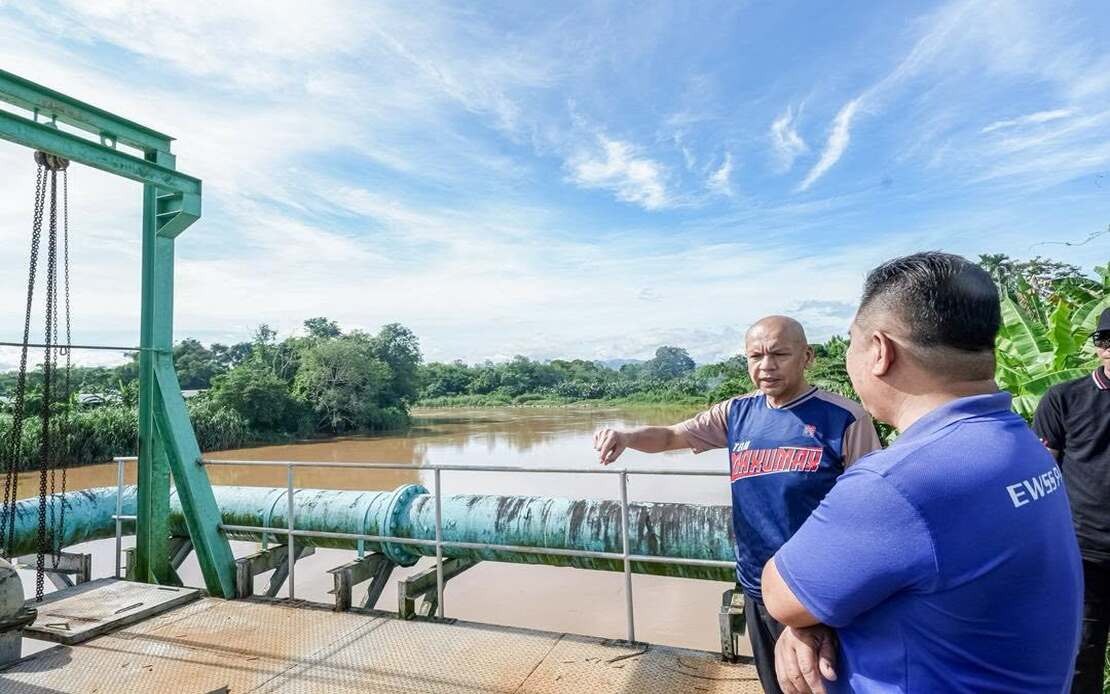
Domestic Trade and Cost of Living Minister Datuk Armizan Mohd Ali has conducted a comprehensive review of water supply infrastructure initiatives in Papar, moving to ensure that critical projects designed to alleviate chronic water shortages in the district remain on track. The ministerial inspection, undertaken in his capacity as the Member of Parliament for Papar, follows a dedicated coordination meeting held on June 15 to assess the progress of various stabilisation schemes targeting the region's increasingly strained water system.
The district faces mounting pressure on its water infrastructure as demand continues to grow, prompting authorities to pursue two major upgrade initiatives currently in advanced stages of implementation. The Kogopon Water Treatment Plant stands at the centre of expansion efforts, with plans to nearly double its operational capacity from 40 million litres per day to 80 million litres per day. Complementing this enhancement, the Kampung Kabang intake is simultaneously undergoing modernisation, with both projects forming part of a broader strategy to reinforce the resilience and efficiency of Papar's water supply network.
However, the district's water infrastructure faces immediate operational challenges that threaten service continuity for residents. During his field visit, Armizan examined conditions at the EWSS Plant and the JETAMA Limbahau Plant, both of which have recently experienced forced shutdowns stemming from deteriorating raw water quality. The facilities encountered problems related to elevated nephelometric turbidity unit (NTU) values at their intake points, a measurement indicating suspended particles and cloudiness in untreated water that can overwhelm conventional filtration systems.
Turbidity spikes represent a persistent vulnerability in tropical water systems like those serving Sabah. When NTU levels exceed treatable thresholds, plants must suspend operations temporarily until upstream conditions normalise, during which period water shortages inevitably propagate through the supply network. The timing of these disruptions underscores the fragility of Papar's existing infrastructure and the urgency of completing the announced capacity expansions, which should provide greater operational flexibility and redundancy to absorb such disruptions.
Armizan's direct observation of field conditions reflects the practical importance of ministerial oversight in infrastructure management. By conducting hands-on inspections at treatment facilities experiencing active problems, decision-makers gain firsthand understanding of operational constraints and technical bottlenecks that may not be fully apparent through conventional reporting channels. Such engagement enables more targeted identification of resource gaps and implementation barriers that could otherwise delay project completion or reduce effectiveness of interventions.
The Papar situation illuminates broader water security challenges facing Sabah as the state undergoes economic development and urbanisation. Infrastructure systems designed decades ago increasingly struggle to meet contemporary demand patterns, particularly in districts experiencing population migration or industrial expansion. Without proactive capacity-building initiatives, water supply becomes a limiting factor for economic activity and quality of life, potentially deterring investment and constraining growth.
The Kogopon Water Treatment Plant expansion represents a substantial investment in long-term infrastructure resilience, nearly doubling throughput capacity to serve anticipated demand growth over the coming decade. However, such capital projects typically require years to complete, during which interim vulnerabilities persist. The recent turbidity-related shutdowns illustrate that authorities must simultaneously implement short-term operational improvements and intermediate maintenance strategies to sustain service reliability during the extended construction and commissioning phases.
Water supply stabilisation requires coordinated action across multiple domains beyond treatment plant capacity. Source water quality management through upstream catchment protection, intake design refinement, and pre-treatment systems all contribute to reducing turbidity fluctuations that trigger operational disruptions. Armizan's focus on both the EWSS and JETAMA Limbahau facilities suggests recognition that addressing raw water quality represents an equally important pathway to improved reliability alongside supply-side expansion.
The ministerial engagement in Papar water infrastructure carries implications extending beyond the district itself. Sabah's broader development aspirations depend substantially on reliable utility services, and water supply ranks among the most fundamental. Federal government attention to specific district-level infrastructure challenges, as demonstrated through the June 19 review, signals commitment to addressing subnational service delivery gaps that might otherwise receive insufficient priority in national resource allocation frameworks.
Moving forward, successful project implementation will require sustained attention to both construction timelines and quality assurance across the Kogopon upgrade and Kampung Kabang intake works. Concurrent attention to operational reliability at existing facilities through turbidity management and preventive maintenance represents an essential complement to long-term capacity expansion. The integration of these short, medium, and long-term strategies will determine whether Papar achieves stable water supply capable of supporting continued economic and social development.