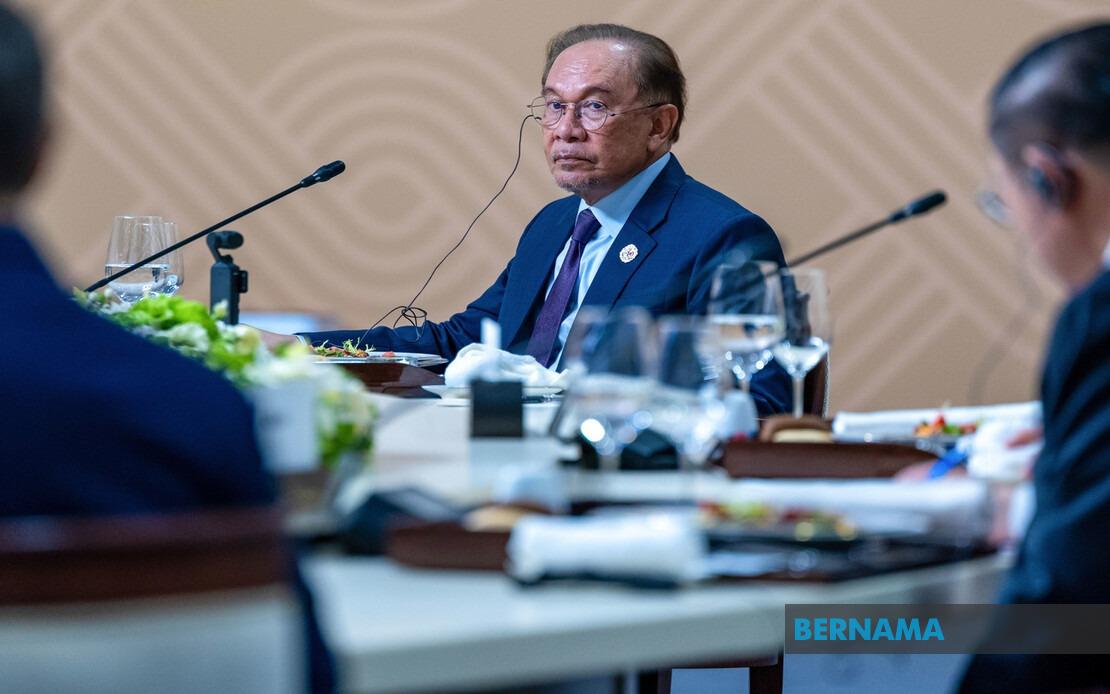
Prime Minister Datuk Seri Anwar Ibrahim has called for ASEAN and the Shanghai Cooperation Organisation to adopt a unified approach in confronting shared challenges that extend across borders, particularly transnational crime and energy security. Speaking during an ASEAN-Russia working lunch in Kazan on June 18, Anwar stressed that neither bloc can effectively address these pressures acting independently, and that pooling resources represents the most pragmatic pathway forward for both organisations.
The groundwork for such collaboration already exists between the two groupings. A memorandum of understanding signed in 2005 established cooperative frameworks spanning counter-terrorism initiatives, drug and narcotic control, money laundering prevention, and economic and financial partnerships. Energy cooperation—particularly involving hydroelectric projects and biofuel development—has also featured within this agreement. Rather than initiating entirely new mechanisms, Anwar argued, both blocs should deepen and operationalise the existing foundations through focused, results-oriented strategies with clearly defined targets and measurable deliverables.
Transnational criminal enterprises represent an immediate policy concern that demands urgent regional attention. Online fraud schemes, illicit financial operations, and human trafficking networks increasingly demonstrate an alarming capacity to circumvent national borders faster than government enforcement agencies can respond. The velocity and scale of these crimes have outpaced traditional law enforcement structures designed for territorial governance. Anwar highlighted that meaningful progress requires systematic intelligence sharing between ASEAN and SCO member states, coupled with capacity-building initiatives that strengthen each nation's investigative and prosecutorial capabilities. Without coordinated action, individual countries attempting to address these phenomena in isolation will struggle to achieve lasting impact.
Energy cooperation emerged as a second pillar in Anwar's strategic vision, reflecting both the SCO's strengths and Malaysia's broader development priorities. The SCO membership encompasses numerous energy-rich nations and brings together considerable technological expertise in hydrocarbon extraction, processing, and distribution. This concentration of energy resources and knowledge within a single bloc positions it uniquely to drive practical advancements in energy security—a concern that has intensified across Asia following geopolitical disruptions to global supply chains. Anwar, who holds the concurrent position of Finance Minister, articulated Malaysia's vision for pragmatic, technology-driven cooperation encompassing energy efficiency improvements, grid infrastructure reliability, liquefied natural gas and conventional gas commerce, renewable energy integration, and shared protocols for operational safety and system resilience.
The Eurasian Economic Union represents a third avenue for deepened ASEAN engagement that merits parallel attention. Like the SCO framework, ASEAN and the EAEU possess existing institutional machinery for bilateral cooperation that remains underutilised. Anwar proposed redirecting focus toward commercial development and business confidence-building, identifying three actionable priorities that could generate tangible economic returns. First, private sector representatives from both regions should be incentivised to participate more frequently in each other's commercial events, including dedicated business dialogues scheduled alongside flagship forums such as the Eastern Economic Forum and the St Petersburg International Economic Forum. Such regular interaction fosters relationship networks essential for sustained trade expansion.
Smaller enterprises face particular barriers to meaningful participation in either regional bloc. The second priority therefore centres on providing market access support, facilitating technology transfer, and developing human capacity within smaller firms to operate competitively across both ASEAN and EAEU jurisdictions. These businesses typically lack the resources to independently navigate regulatory environments, identify trade partners, or invest in technical modernisation. Targeted assistance programmes could unlock significant economic potential by enabling these enterprises to scale operations regionally.
Emerging technological domains represent the third priority area where ASEAN and EAEU interests increasingly converge. Digital economy development, artificial intelligence applications, cybersecurity infrastructure, and food security constitute domains of mutual interest where collaborative research and capacity-sharing could accelerate development outcomes for member states. Unlike traditional sectors where competitive dynamics dominate, these emerging areas often benefit from coordinated standard-setting and knowledge exchange, generating positive externalities for all participants.
Anwar's remarks during the ASEAN-Russia Commemorative Summit—held in Kazan, the capital of Tatarstan—reflect Malaysia's pragmatic approach to regional multilateralism. Rather than pursuing grandiose strategic partnerships that demand extensive institutional machinery, the Prime Minister advocated for targeted cooperation within existing structures, emphasising implementation over expansion. This reflects recognition that transnational challenges increasingly demand regional responses, yet existing national governance capacity remains constrained.
The SCO itself comprises ten full members (Belarus, China, India, Iran, Kazakhstan, Kyrgyzstan, Pakistan, Russia, Tajikistan, and Uzbekistan) alongside two observer states (Afghanistan and Mongolia), making it a consequential bloc in Eurasian geopolitics. Since its establishment in 2001 as a political, economic, and security organisation, the SCO has gradually expanded its institutional footprint. Deepened ASEAN engagement could amplify the bloc's capacity to tackle regional challenges while simultaneously providing Southeast Asian nations with access to energy resources and technological expertise concentrated within Central Asia and South Asia.
For Malaysia specifically, Anwar's diplomatic positioning reflects a broader strategy of maintaining constructive engagement with major powers and regional organisations without surrendering strategic autonomy. By advocating for practical cooperation frameworks grounded in existing institutional arrangements, Malaysia signals willingness to contribute to collective problem-solving while managing expectations regarding the pace and scope of integration. This measured approach aligns with Malaysian interests in preserving bilateral relationships with both China and India—each major SCO members—whilst maintaining ASEAN's centrality in Southeast Asian regional affairs.
The emphasis on energy cooperation carries particular significance for Malaysian policymakers. As a mid-range energy producer facing long-term demand pressures and transition imperatives toward cleaner sources, Malaysia benefits from engagement with both established energy exporters and nations advancing renewable energy technologies. The SCO framework offers pathways to explore LNG partnerships, grid modernisation approaches, and renewable integration methodologies that could inform Malaysia's own energy transition strategy. Similarly, food security cooperation addresses vulnerabilities exposed during recent global supply chain disruptions, affecting Malaysia's ability to maintain price stability and nutritional security for its population.
Anwar's two-day working visit to Kazan underscores Southeast Asia's expanding engagement with Eurasian actors beyond traditional Western-centric frameworks. As global power dynamics continue rebalancing, ASEAN positioning itself as a constructive partner across multiple regional organisations enhances its negotiating leverage whilst creating opportunities for pragmatic cooperation addressing shared challenges. The emphasis on transnational crime, energy security, digital economy, and food security reflects contemporary policy priorities that transcend traditional geopolitical alignments, suggesting a future in which regional cooperation increasingly organises around functional challenges rather than ideological or military blocs.


