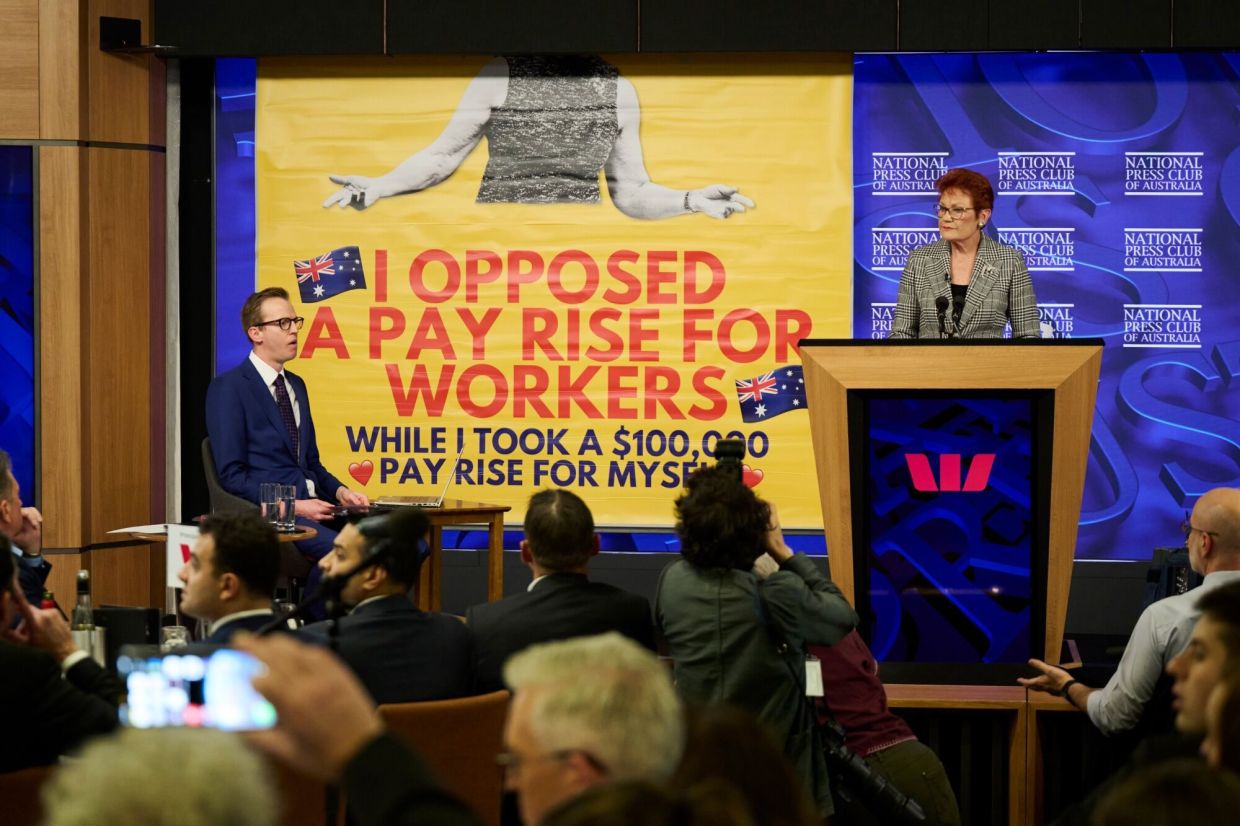
Pauline Hanson, the controversial leader of Australia's hard-right One Nation party, has declared that her country must abandon multiculturalism and become monocultural, framing the shift as essential to resolving an acute housing shortage. Speaking at the National Press Club in Canberra on Wednesday, Hanson drew a distinction between racial and cultural identity, arguing that while Australia could remain multiracial, it must function under a single cultural framework. Her remarks represent a full-throated rejection of the multicultural policies that have shaped Australian society for decades, replacing them with an assimilationist vision that would require newcomers to conform to a dominant cultural standard.
For Hanson, the housing affordability crisis consuming Australian politics has a straightforward diagnosis: immigration levels have grown to unsustainable extremes, artificially inflating demand for residential property and pricing ordinary Australians out of home ownership. By tying demographic change directly to one of the most pressing economic grievances facing voters, she has positioned One Nation as offering a simple solution to a complex problem. The speech, delivered at an institution where Hanson has never appeared in her three-decade political career, signals both her growing prominence and her willingness to test the boundaries of mainstream political discourse on identity and belonging.
One Nation's surge in the opinion polls reflects broader disenchantment with Australia's established political parties and deepening anxiety about economic security. The centre-right coalition government suffered a dramatic collapse in voter support last May, creating political space that populist movements have eagerly filled. Hanson capitalized on this opening by positioning immigration and cultural integration as the root cause of multiple interconnected crises afflicting ordinary Australians. Beyond housing, she linked immigration to inflation, elevated interest rates, and climbing fuel costs—consequences that she attributed partly to geopolitical tensions, including conflict in the Iran region, but more fundamentally to immigration policy itself and the cost of transitioning to green energy.
Hanson's specific targeting of immigration from regions she characterized as "immersed in extremism like radical Islam" reveals the underlying anxieties driving One Nation's appeal. While framed as a security concern, the language mirrors classic populist rhetoric that conflates religious and cultural difference with threat, allowing her to position restrictive immigration not merely as economic pragmatism but as national self-protection. Her commitment to "slash" migration numbers, without specifying targets, leaves room for increasingly stringent policies should One Nation gain greater parliamentary influence.
Prime Minister Anthony Albanese's Labor government has responded to the housing and cost-of-living crisis with more targeted interventions, including temporary reductions in fuel excise taxes and proposed tax reforms aimed at improving housing affordability. These incremental policy adjustments stand in stark contrast to Hanson's call for wholesale societal transformation through cultural uniformity and immigration restriction. Albanese has publicly diagnosed the political challenge facing his government as a rise in "simplistic grievance-based politics," suggesting that populist movements exploit economic anxiety by reducing complex systemic problems to easily identifiable villains—in this case, immigrants and multicultural policies.
The tension between these competing diagnoses reflects a fundamental disagreement about Australia's future direction. Hanson's monoculturalism represents a retreat from the integration model that has theoretically guided Australian immigration since the 1970s, when the government formally abandoned the White Australia Policy. That shift toward multiculturalism coincided with Australia's transformation into a genuinely diverse society, drawing migrants from across Asia, Europe, and the Middle East. Hanson's call to reverse this trajectory would require not merely restricting future immigration but also enforcing conformity on existing communities—a proposition that raises troubling questions about minority rights and social cohesion.
For regional observers, particularly in Southeast Asia, Hanson's ascendancy carries significant implications. Malaysia, as a diverse, multi-ethnic democracy with substantial experience managing plural societies, offers an instructive counterpoint to monoculturalism. While Malaysia has experienced communal tensions and periodic backlashes against minority communities, the constitutional framework that recognizes multiple ethnic and religious identities remains fundamental to its legitimacy. Should One Nation gain legislative power and implement monocultural policies, it could signal a concerning global retreat from pluralist democracy at precisely the moment when demographic diversity is becoming a defining feature of modern nation-states.
The economic argument that Hanson advances—that immigration drives housing inflation—requires scrutiny in the Australian context. While population growth certainly increases housing demand, supply-side constraints, including restrictive zoning laws and limited construction capacity, play equally important roles in affordability crises. Several developed democracies with comparable immigration rates to Australia maintain more affordable housing markets, suggesting that immigration alone cannot explain Australian price levels. By focusing exclusively on demand-side factors related to population growth, Hanson sidesteps more difficult conversations about land use policy, housing taxation, and construction industry productivity.
One Nation's electoral momentum also reflects the limited appeal of existing political alternatives. Labor's incremental approach has failed to convincingly address voter anxiety about housing, while the coalition's centrist policies have lost credibility following years of government. In this vacuum, Hanson offers a comprehensive narrative that attributes multiple crises to a single, readily identifiable cause. Whether voters ultimately embrace her monocultural vision or whether Albanese's government can develop more compelling responses to affordability and cost-of-living pressures will significantly shape Australian politics in coming years.
As Australian society grapples with the tension between its multicultural reality and Hanson's monocultural prescription, the debate carries lessons for other immigrant-receiving democracies. The electoral viability of assimilationist politics depends partly on the credibility of explanations linking immigration to concrete harms. In Australia's case, if housing affordability, inflation, and wage stagnation persist despite potential future restrictions on immigration, the political appeal of monoculturalism may diminish. Conversely, if these conditions worsen, Hanson's framing could become increasingly persuasive, regardless of its analytical accuracy.