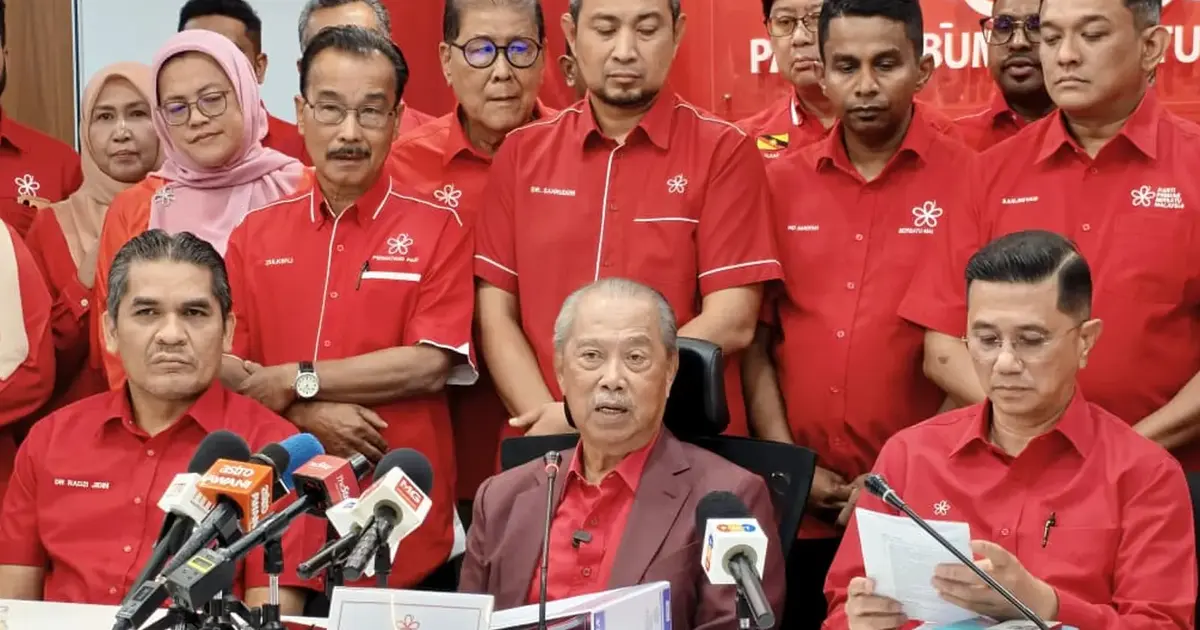
Bersatu will continue its membership within the Perikatan Nasional coalition, according to party president Muhyiddin Yassin, who has sought to anchor this strategic decision in the demonstrated public backing the political grouping enjoys across Malaysia. The declaration comes amid ongoing shifts in the nation's political landscape, where coalition stability remains a persistent concern for both government formation and legislative continuity.
Muhyiddin's statement represents a formal consolidation of Bersatu's position within PN, suggesting that despite various pressures and realignments affecting Malaysian politics, the party views its future as intrinsically linked to the coalition's fortunes. The emphasis on public acceptance as justification for this commitment reveals how contemporary Malaysian politics increasingly hinge on perceived popular legitimacy rather than purely factional calculations. For Bersatu, which emerged from internal upheaval within UMNO and subsequently experienced its own internal tensions, maintaining coalition solidarity offers both organisational stability and a buffer against political isolation.
The Perikatan Nasional coalition, which includes Bersatu, PAS, and other component parties, has been a significant force in Malaysian politics since its formation. The coalition's evolution has reflected broader patterns of political regrouping, particularly following the 2018 general election's disruption of the longstanding federal political structure. Bersatu's role within PN has been consequential, providing a bridge between different ideological and demographic constituencies, though this positioning has occasionally created internal tensions regarding the coalition's direction and priorities.
Muhyiddin's grounding of Bersatu's commitment in public acceptance signals an awareness that coalition survival in modern Malaysian politics depends increasingly on demonstrable public support rather than mere elite agreements. This reflects a maturation in how political leaders justify institutional choices, moving beyond closed-door arrangements toward appeals to popular legitimacy. For Malaysian voters, particularly those in regions where PN maintains strength, such statements carry weight in shaping expectations about governance continuity and coalition reliability during election cycles.
The timing of this reaffirmation matters considerably given Malaysia's political rhythms. With federal elections eventually due and state-level contests periodically reshaping regional power dynamics, coalition partners must regularly reassure their membership and supporters about structural stability. Bersatu's explicit confirmation that it remains committed to PN provides internal party discipline and signals to potential coalition partners that the arrangement enjoys leadership backing grounded in what the party leadership perceives as genuine grassroots sentiment.
For Southeast Asian observers tracking Malaysian politics, Bersatu's continued PN membership underscores how coalition mathematics remain central to the region's largest electoral democracy. Malaysia's constitutional framework, which requires majority support in Parliament, makes coalition stability a fundamental governance concern rather than a peripheral consideration. Bersatu's decision to remain within PN therefore has implications extending beyond the party itself to the broader stability of Malaysia's political institutions and legislative processes.
The emphasis on public acceptance as the basis for Bersatu's commitment also reflects evolving internal party dynamics. As a party that has experienced significant leadership transitions and ideological repositioning, Bersatu's assertion of public backing provides legitimacy for decisions that might otherwise appear driven purely by elite calculations. This rhetorical move demonstrates how contemporary Malaysian political parties increasingly must articulate policy decisions through narratives emphasizing popular will, even when actual decision-making may involve more complex factional and strategic considerations.
Within the PN framework, Bersatu occupies a distinctive position. The party appeals to specific demographic segments and regional constituencies, contributing electoral weight that would be difficult for the coalition to replace. Muhyiddin's leadership has sought to position Bersatu as a moderate and inclusive force within PN, though this positioning occasionally creates tensions with other coalition partners possessing different ideological orientations or demographic appeal. The party's continued membership thus involves navigating these internal coalition dynamics while maintaining its separate identity and organizational interests.
The assertion that the public has accepted PN as a coalition worthy of their support invites scrutiny regarding how such acceptance is measured and defined. Political leaders typically interpret polling data, election results, and grassroots feedback through frameworks that support their strategic preferences. Muhyiddin's claim about public acceptance likely reflects genuine assessment of sentiment within Bersatu's core constituencies, though the broader Malaysian public's views on PN remain complex and contested, varying significantly across regions and demographic groups.
Looking forward, Bersatu's commitment to remaining in PN establishes a baseline expectation for how the coalition will function through upcoming electoral contests and legislative sessions. The party's explicit reaffirmation reduces uncertainty regarding potential realignments, at least in the short to medium term, providing some stability to Malaysian politics. However, the conditional language—basing the decision on public acceptance—contains implicit flexibility, suggesting that should the party leadership perceive a shift in public sentiment, recalibration could occur.
For Malaysian policymakers and observers concerned with governance continuity, Bersatu's reaffirmation of PN membership offers some reassurance about coalition durability. Malaysia's experience with coalition politics has demonstrated both the possibilities and perils of multi-party arrangements, and maintaining coalition cohesion through deliberate leadership choices and public engagement represents a more stable approach than allowing alliances to dissolve through attrition or hidden tensions. Muhyiddin's statement thus functions as both an internal party communication and a broader political signal about expectations for the months and years ahead.


