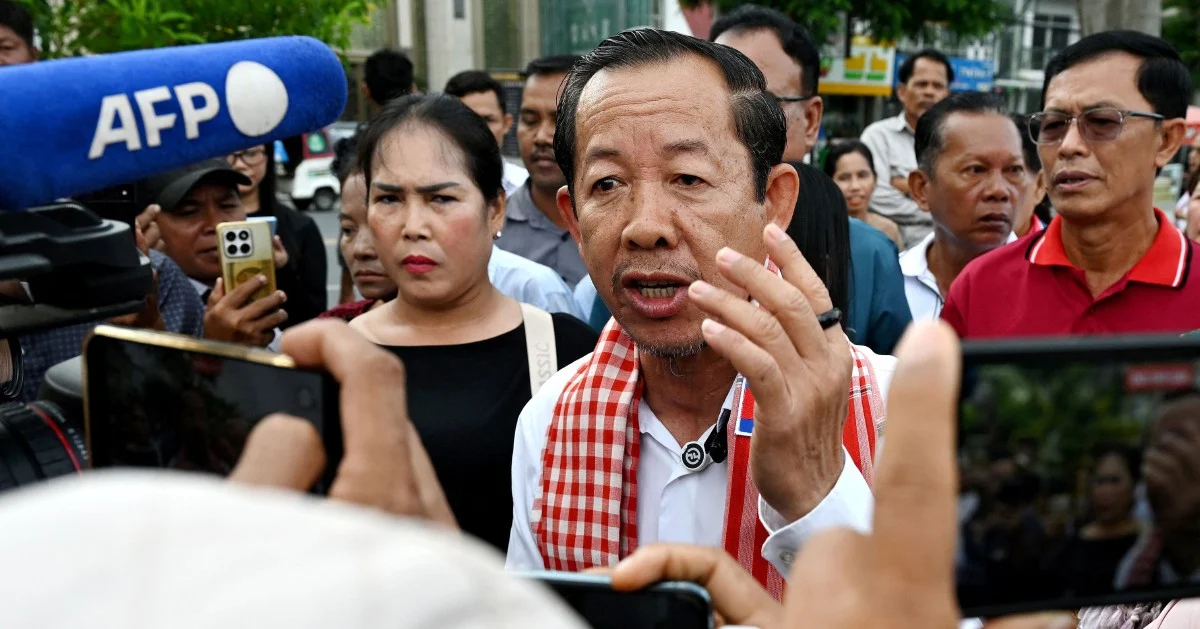
Cambodia's Supreme Court delivered a mixed ruling on Friday regarding opposition politician Rong Chhun, suspending an imposed prison sentence while leaving intact an electoral prohibition that bars him from participating in future elections. The decision, confirmed by Rong Chhun's legal representatives, illustrates the continued judicial constraints facing the Cambodian opposition movement in one of Southeast Asia's most closely controlled political environments.
The suspended prison sentence represents a partial reprieve for the seasoned opposition figure, who has long been a vocal critic of the ruling coalition. However, the court's determination to maintain the electoral ban underscores the more consequential aspect of the ruling—effectively sidelining him from formal political participation for the foreseeable future. This bifurcated outcome reflects a pattern observed in Cambodian jurisprudence where courts appear to calibrate their decisions to allow symbolic clemency while preserving substantive political restrictions.
Rong Chhun's legal predicament stems from activities and statements deemed problematic by the authorities, though the precise charges and circumstances remain subject to differing interpretations between his legal team and government sources. His case has drawn attention from international human rights organizations monitoring the political climate in Cambodia, particularly regarding constraints on dissent and opposition activity in the lead-up to and following electoral cycles.
The electoral ban effectively removes Rong Chhun from direct electoral politics, preventing him from standing as a candidate in upcoming parliamentary, communal, or other electoral contests. For an opposition politician in Cambodia, where the ruling Cambodian People's Party maintains substantial control over state institutions, such exclusions significantly limit avenues for political influence and representation. The prohibition extends beyond his personal candidacy to implicitly constrain his organizational influence within opposition structures.
This ruling arrives amid broader regional developments affecting political space across Southeast Asia. Cambodia's situation reflects wider patterns of electoral restrictions and institutional constraints affecting opposition movements throughout the region, though the specific mechanisms and intensity vary by country. For Malaysian observers, Cambodia's experience offers instructive lessons regarding the fragility of political pluralism when judicial and electoral institutions lack independence from executive influence.
The suspension of the prison sentence might suggest judicial pragmatism or recognition of procedural irregularities, yet its paired maintenance of the electoral ban reveals the ruling's strategic purpose. Suspending imprisonment allows authorities to claim proportional justice while preserving the more significant punishment—political incapacitation. This approach minimizes international criticism while achieving substantive political objectives through ostensibly neutral judicial mechanisms.
For Cambodia's opposition ecosystem, Rong Chhun's situation carries particular significance given his history as a vocal advocate for labor rights, transparency, and democratic accountability. His marginalization from electoral competition diminishes the diversity of political voices available to Cambodian voters and reinforces concerns among international observers regarding the competitiveness of Cambodia's democratic processes.
The timing of this judgment coincides with Cambodia's ongoing political evolution following recent elections and shifting regional dynamics. As ASEAN members grapple with questions about democratic governance and institutional accountability, Cambodia's judicial handling of opposition figures continues to attract scrutiny from Southeast Asian civil society organizations and foreign governments invested in regional democratic standards.
For the broader Cambodian opposition movement, the ruling presents a tactical challenge. Opposition groups must navigate an environment where key figures face systematic legal obstacles while attempting to maintain organizational coherence and political relevance. The electoral ban on prominent opposition members effectively tilts the political playing field, reducing the quality and diversity of electoral competition that characterizes genuinely competitive democratic systems.
Cambodia's judiciary, while formally independent in constitutional structure, operates within a political context where institutional pressures and executive influence substantially shape outcomes in politically sensitive cases. International legal experts and observers have documented patterns suggesting that judicial decisions in cases involving opposition figures frequently align with government preferences, raising questions about separation of powers and rule of law in practice.
The implications extend beyond Cambodia's borders. For Malaysia and other ASEAN nations, Cambodia's experience underscores how legal and institutional mechanisms can be deployed to constrain political opposition while maintaining surface-level democratic appearances. Understanding these dynamics proves essential for regional policymakers and civil society advocates monitoring democratic trends across Southeast Asia.
Moving forward, Rong Chhun's case will likely continue attracting international attention as it exemplifies broader questions about political freedoms and judicial independence in Cambodia. Whether subsequent legal proceedings or evolving political circumstances might alter the electoral ban remains uncertain, though Cambodia's historical patterns suggest sustained restrictions on opposition figures' participation are likely to persist absent significant political shifts or external pressure.