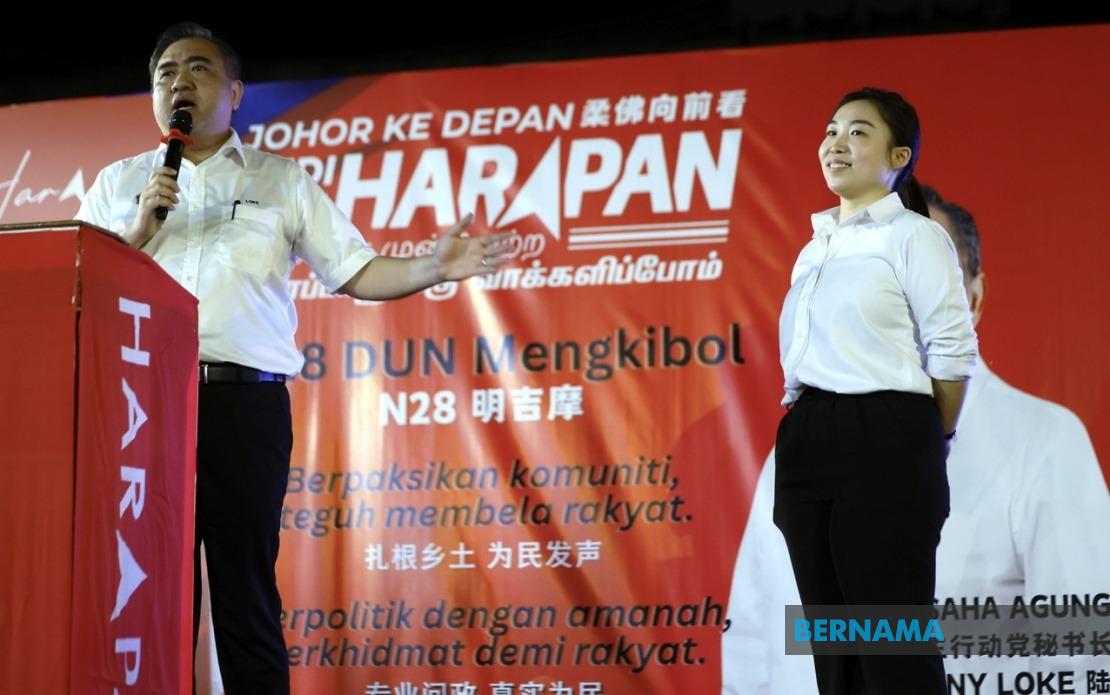
The Democratic Action Party has made its opening move in the Johor state election campaign by announcing 33-year-old lawyer Chu Poh Yee as its candidate for the Mengkibol state seat. The announcement, made at a ceremony in Kluang on June 18, represents a generational shift for the constituency as the party prepares to field a fresh face with legal expertise and deep community connections.
Chu's candidacy marks a deliberate strategic decision to clear the way for incumbent assemblyman Chew Chong Sin to pursue higher elected office. Chew, who has represented Mengkibol for two consecutive terms, has been identified by party leadership as having the calibre necessary for federal-level politics. According to DAP secretary-general Anthony Loke, the party has earmarked Chew as its nominee for the Labis parliamentary seat, which will fall vacant when the current MP Pang Hok Liong steps aside following his announcement that he will not contest the next General Election.
The transition illustrates how political parties strategically manage their human resources during electoral cycles, promoting experienced representatives upward while simultaneously developing new talent at state level. Loke explained that this approach aligns with the party's broader organisational objectives, ensuring continuity of leadership while creating advancement pathways for promising candidates. The decision to promote Chew to the parliamentary tier suggests DAP views him as capable of handling the more demanding responsibilities that come with representing a federal constituency and participating in national legislative processes.
Chu's professional background as a lawyer brings particular relevance to her candidacy given Mengkibol's demographic composition and development needs. Loke highlighted her substantial experience assisting local elected representatives with legal aid matters, suggesting that her expertise addresses genuine constituent concerns around justice access and legal support. This focus on practical legal assistance resonates with growing demands in Malaysian constituencies for representatives who can offer tangible help navigating bureaucratic and legal challenges.
The party's emphasis on Chu's educational credentials and multilingual capabilities underscores DAP's effort to present a candidate equipped for contemporary governance. In an increasingly complex political environment where constituencies face diverse challenges from urban development to rural infrastructure, representatives require sophisticated skill sets. Loke's reference to her proficiency in multiple languages also reflects the linguistic diversity within Malaysian constituencies and the practical advantage of having representatives who can communicate effectively with various community segments.
Chu's appointment carries significance beyond Mengkibol specifically as it exemplifies DAP's stated commitment to expanding opportunities for female representation in elected office. The Chinese-majority party has long positioned itself as progressive on gender equality, and this nomination demonstrates that commitment through concrete candidate selections rather than rhetoric alone. As Malaysian politics gradually incorporates more women into legislative bodies, each individual selection contributes incrementally to shifting the gender composition of state assemblies and Parliament.
The party leadership's unanimous agreement to nominate Chu for the seat suggests internal consensus on the decision, reducing the likelihood of dissent or factionalism that might undermine her campaign. In a political context where candidate selection sometimes generates controversy or internal divisions, securing unanimity indicates that party elders have positioned this transition as strategically sound for both DAP's electoral prospects and internal cohesion.
Chu's deep ties to the Mengkibol constituency, as Loke emphasised, provide her with distinct advantages over external candidates who might lack community knowledge or local networks. Building electoral support often depends significantly on social capital and familiarity within communities, factors that prove particularly valuable in state-level politics where local issues predominate. Her established connections should facilitate grassroots campaigning and help her understand the specific grievances and aspirations of constituents.
The DAP's Mengkibol nomination represents merely the opening salvo in a broader candidate deployment strategy across Johor's 17 state seats where the party is contesting. With 10 incumbent-held seats to defend, four previously lost seats to reclaim, and three additional seats to contest for the first time, DAP faces a complex electoral mathematics in Johor. The party's decision to stagger candidate announcements, with four more names to be revealed the following Saturday before the bulk of candidates unveiled alongside other Pakatan Harapan coalition members, suggests careful coordination with coalition partners to avoid candidate clashes and duplicate nominations.
For Malaysian politics more broadly, this nomination demonstrates how opposition parties systematically prepare for electoral contests by identifying promising candidates across various backgrounds and professional sectors. Rather than relying solely on party loyalists or political dynasties, DAP's selection of a legal professional signals an attempt to broaden the pool of elected representatives beyond traditional political networks. This approach, if emulated across Malaysian political parties, could contribute to greater diversity in the types of expertise and experience represented in state and federal legislatures.
The broader context of Chu's nomination also reflects DAP's strategic positioning within Malaysian electoral competition. As a party consistently seeking to expand its representation beyond traditional strongholds, DAP pursues expansion into new constituencies while defending held ground. The Mengkibol decision, promoting Chew upward while deploying Chu downward, exemplifies this dual strategy of consolidation and expansion.
For Johor specifically, these candidate announcements preview the competitive dynamics that will characterise the state election. The state has historically been contested terrain where multiple parties vie for dominance, and the detailed candidate planning evident in DAP's approach suggests intense preparation for what promises to be a closely fought contest. As Malaysia continues to experience competitive electoral politics with no single party commanding permanent dominance, the quality and profile of candidates becomes increasingly consequential for electoral outcomes.


