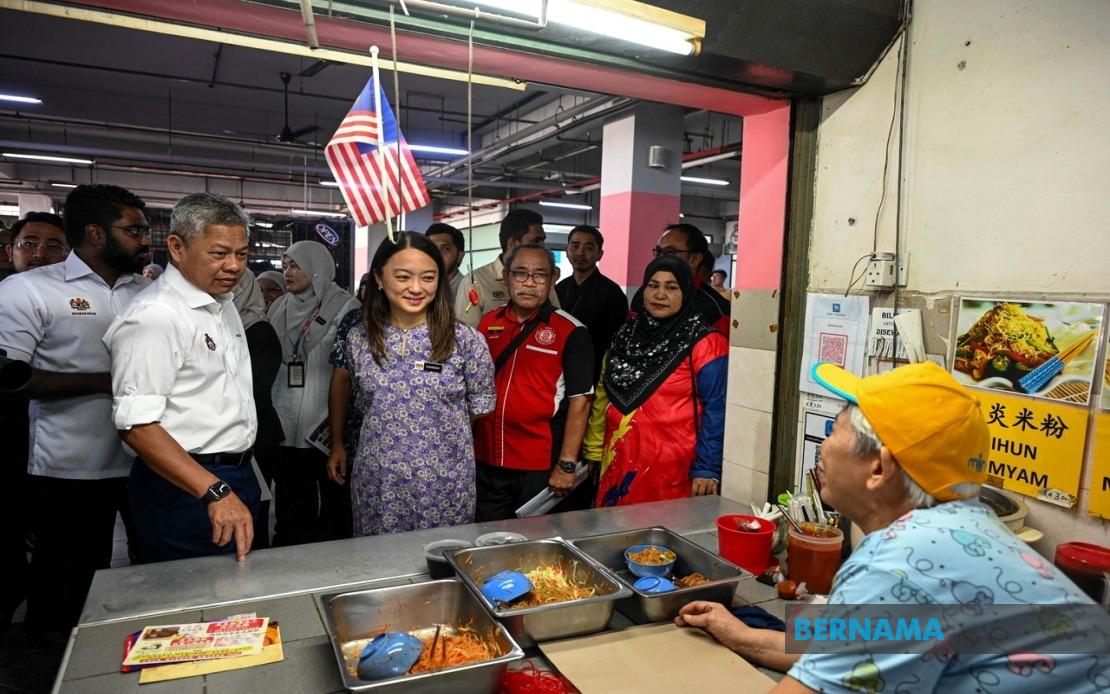
Kuala Lumpur City Hall (DBKL) has committed RM200 million towards a comprehensive modernisation programme spanning 287 hawker locations across the capital, as part of its ambitious Lestari Niaga @ Kuala Lumpur 2026 initiative. The scheme represents one of the largest infrastructure investments dedicated to the informal food trading sector in the city, targeting systematic upgrades that will touch the livelihoods of over 11,000 hawkers and small traders operating throughout Kuala Lumpur's bustling neighbourhoods.
Minister in the Prime Minister's Department (Federal Territories) Hannah Yeoh outlined the government's commitment to balancing the competing interests of multiple stakeholders when implementing such large-scale urban programmes. She emphasised that DBKL approaches each relocation and upgrading initiative with careful consideration for residents seeking improved traffic conditions, traders requiring viable commercial spaces, and building tenants operating their own enterprises. This multi-stakeholder approach reflects growing recognition that hawker relocation—historically contentious in Malaysian cities—demands collaborative planning rather than top-down mandates. The Lestari Niaga rollout across multiple locations throughout 2026 will test whether this consultative methodology can achieve consensus on one of Kuala Lumpur's most persistent urban management challenges.
The UTC Sentul hawker project exemplifies the broader initiative's approach. Located near the Urban Transformation Centre, this RM1.6 million undertaking represents a pilot case demonstrating how DBKL intends to execute upgrades citywide. Rather than displacing traders indefinitely, the authority plans to replace existing informal structures with 20 modern modular kiosks, a format chosen for its efficiency and scalability. The three-month construction timeline, targeted to conclude before October, indicates DBKL's determination to minimise operational disruption. This compressed schedule also signals confidence in the modular construction methodology—a potential blueprint for accelerating similar projects elsewhere in the city.
A novel financial support mechanism underscores the initiative's concern for trader welfare during transition periods. DBKL has introduced a special monthly assistance of RM1,500 for each affected trader during construction—a first in the council's programme design. Kuala Lumpur Mayor Datuk Seri Fadlun Mak Ujud argued that direct cash support proves more efficient than establishing temporary trading sites, which typically suffer from poor visibility, unsuitable locations, and ultimately reduced foot traffic. This departure from conventional relocation practice acknowledges that displaced hawkers face genuine income loss regardless of whether temporary facilities exist, making direct compensation a pragmatic alternative that preserves trader dignity while maintaining revenue during transitions.
The scope of the larger Lestari Niaga programme reveals the complexity of formalising Kuala Lumpur's sprawling hawker economy. Of the 287 targeted locations, the initial phase focuses on 224 sites encompassing diverse trading configurations. Approximately 4,000 traders operate as street hawkers—mobile vendors without permanent structures—while roughly 5,000 run businesses from DBKL-managed municipal assets such as designated hawker centres and market stalls. The remaining thousand-odd traders occupy a reapplication category, suggesting they may be informal operators seeking formal recognition or traders whose previous licences require renewal. This segmentation indicates DBKL's recognition that hawker communities are heterogeneous, requiring differentiated support strategies rather than uniform solutions.
Expansion beyond UTC Sentul is already materialising. Similar simultaneous projects backed by the RM1,500 monthly incentive are scheduled to launch at Jalan Dato Senu, Pudu Ulu, and Bandar Tun Razak. These diverse locations span different urban contexts—from the established Pudu Ulu area with its concentrated food trader ecosystem to Bandar Tun Razak's newer suburban character. Rolling out parallel projects across demographically and geographically varied sites will generate valuable implementation data. Success across such varied contexts could validate the model's scalability, while challenges in specific locations may reveal contextual factors requiring programme adjustments.
The financial commitment itself warrants scrutiny within Malaysia's urban development landscape. RM200 million allocated to hawker infrastructure represents substantial public investment in the informal economy—a sector historically marginalised in city planning despite its cultural significance and employment value. For Malaysian cities grappling with balancing heritage preservation, informal sector formalisation, and modernisation pressures, Kuala Lumpur's commitment offers a template. The sum demonstrates political will to acknowledge hawkers not as urban management problems to be eliminated, but as legitimate economic actors deserving infrastructure investment comparable to formal commercial developments.
The consultation process underlying these plans deserves attention given hawker relocation's contentious history in Malaysian cities. Stakeholder engagement sessions conducted before the UTC Sentul redevelopment and the incorporation of feedback into revised plans suggest DBKL has learned from previous relocation controversies where inadequate communication bred trader resentment. By actively seeking trader input before finalising designs rather than presenting completed plans for passive acceptance, DBKL potentially reduces future disputes. However, true consultation requires genuine responsiveness—the extent to which initial feedback actually shaped final designs remains crucial to assessing programme credibility.
The Lestari Niaga initiative carries implications extending beyond Kuala Lumpur's immediate context. As Southeast Asian cities increasingly grapple with formalising informal economies while preserving street food culture, this RM200 million programme represents a significant data point in regional urban development discourse. Malaysian cities like George Town, Malacca, and Kota Kinabalu have pursued their own hawker modernisation efforts with mixed results. Kuala Lumpur's approach—emphasising stakeholder consultation, direct financial support, and phased implementation—may offer lessons for other Malaysian municipalities considering comparable programmes. Conversely, challenges encountered could illuminate obstacles other cities should anticipate.
The programme's success metrics will likely extend beyond physical infrastructure completion. Trader retention rates—whether hawkers actually occupy the new kiosks following construction rather than migrating elsewhere—will indicate genuine acceptance. Customer patronage patterns will reveal whether upgraded facilities genuinely attract commerce or whether traders simply trade informality for higher rents in less convenient locations. Income levels for participating traders will demonstrate whether modernisation translates to improved livelihoods or merely represents structural reorganisation without economic benefit. These operational outcomes will ultimately determine whether Lestari Niaga becomes a replicable model or a cautionary example of infrastructure investment divorced from trader economic realities.
Looking ahead, the 2026 completion target sets clear benchmarks for accountability. Whether DBKL successfully modernises all 287 sites within the specified timeframe will test municipal execution capacity and sustained political commitment. The programme's trajectory will also reflect broader questions about Kuala Lumpur's urban identity—whether the city embraces street food culture as integral heritage worthy of investment, or whether modernisation schemes ultimately commodify and domesticate informal economies beyond recognition. For Malaysian traders, policymakers, and urban planners observing this initiative, the Lestari Niaga programme represents a crucial experiment in balancing informal economy formalisation with trader autonomy and livelihoods.