%22%2F%3E%3C%2Fpattern%3E%3C%2Fdefs%3E%3Crect%20width%3D%22100%25%22%20height%3D%22100%25%22%20fill%3D%22url(%23ph2hndsg)%22%2F%3E%3Crect%20width%3D%22100%25%22%20height%3D%22100%25%22%20fill%3D%22url(%23ph2hndsp)%22%2F%3E%3Ctext%20x%3D%2250%25%22%20y%3D%2250%25%22%20text-anchor%3D%22middle%22%20dominant-baseline%3D%22central%22%20fill%3D%22rgba(255%2C255%2C255%2C0.95)%22%20font-family%3D%22Georgia%2C%20'Times%20New%20Roman'%2C%20serif%22%20font-weight%3D%22700%22%20font-size%3D%22320%22%20letter-spacing%3D%22-0.02em%22%3EG7%3C%2Ftext%3E%3C%2Fsvg%3E)
The world's most economically powerful democracies have closed ranks around Ukraine despite deepening rifts on multiple fronts, as the Group of Seven concluded crucial discussions at their annual summit in the French resort town of Evian-les-Bains. The gathering represented a rare moment of diplomatic convergence at a time when the transatlantic alliance faces mounting pressures over trade disputes, security commitments, and competing geopolitical interests that threaten to fragment Western cohesion.
During the two-day session near the Swiss border, G7 members—comprising Britain, Canada, France, Germany, Italy, Japan, and the United States, alongside the European Union—endorsed a comprehensive approach to ending the Ukraine conflict through sustained military assistance combined with diplomatic pressure on Moscow. This balancing act between arms provision and peace negotiations has become increasingly complicated as Ukraine strengthens its battlefield position through closer engagement with European allies, a shift that underscores changing dynamics within the Western alliance and potential realignment of security partnerships in the region.
US President Donald Trump's messaging on Russia during the summit reflected his broader negotiating philosophy, as he publicly urged Moscow to pursue a settlement given the massive human toll on both nations since Russia's February 2022 full-scale invasion. Trump indicated that Washington could tighten the economic screws further, potentially reinstating suspended sanctions on Russian energy once oil markets stabilize following a preliminary agreement with Iran to reopen the Strait of Hormuz, a critical global shipping chokepoint. This linkage between Middle Eastern and European conflicts reveals how interconnected global crises shape diplomatic leverage and economic statecraft in contemporary international relations.
Ukrainian President Volodymyr Zelenskyy addressed the assembled leaders directly, outlining his government's priorities through the remainder of the conflict. Zelenskyy emphasized the necessity of strengthening Ukraine's air defence capabilities—a persistent vulnerability that Russian missiles continue to exploit—while simultaneously advancing diplomatic channels that could compel Russia toward cessation of hostilities. His framing of these objectives as complementary rather than contradictory reflects Ukraine's strategy of negotiating from a position of growing military strength rather than desperation, a fundamental shift from earlier stages of the war when Kyiv faced existential threats.
Japanese Prime Minister Sanae Takaichi articulated the group's determination to maintain unified pressure on Russia, warning that any unilateral attempts to alter territorial arrangements through military force must be decisively rejected. Takaichi's comments carried particular weight given Japan's own security concerns regarding China and Russia, as she explicitly flagged deepening military cooperation between Moscow and Beijing alongside the expanding Russia-North Korea defense partnership. These security alignments represent a fundamental reconfiguration of the global balance of power, with authoritarian states constructing alternative blocs that challenge Western primacy in critical regions ranging from East Asia to Central Europe to the Middle East.
The Ukraine discussion occurred within a broader agenda that extended well beyond the Eastern European conflict, as leaders devoted substantial attention to West Asia following the preliminary US-Iran agreement. The G7 welcomed the preliminary accord that would reopen the Strait of Hormuz and de-escalate tensions that had threatened to destabilize global energy markets and shipping lanes. Japanese officials emphasized the critical importance of securing lasting guarantees for free passage through this strategic waterway while urging swift finalization of comprehensive agreements between Washington and Tehran, recognition that temporary ceasefires without institutional frameworks remain inherently fragile and vulnerable to renewed escalation.
French President Emmanuel Macron's stewardship of this year's G7 presidency reflected Paris' ambition to reshape international development finance, a lower-profile but strategically significant agenda item that nonetheless revealed fundamental differences in how Western powers approach competition with emerging economies and China specifically. France led the group toward acknowledging that traditional official development assistance has proven inadequate in addressing the infrastructure and investment needs of developing nations, a candid admission that Western aid models have lost competitive advantage relative to China's infrastructure-focused Belt and Road initiatives and other bilateral arrangements.
The group's joint declaration on development cooperation emphasized the necessity of mobilizing private capital toward long-term projects in developing regions while simultaneously protecting strategic interests—language that thinly masks the competitive dimension of development assistance in an era of great power competition. By framing partnerships as mutually beneficial rather than unidirectional aid, the G7 attempted to counter narratives of Western benevolence masking extractive relationships, while simultaneously ensuring that development investments serve Western geopolitical objectives and corporate interests. This recalibration reflects recognition that development finance has become inseparable from strategic competition for influence in Africa, Southeast Asia, and other regions where multiple powers compete for advantage.
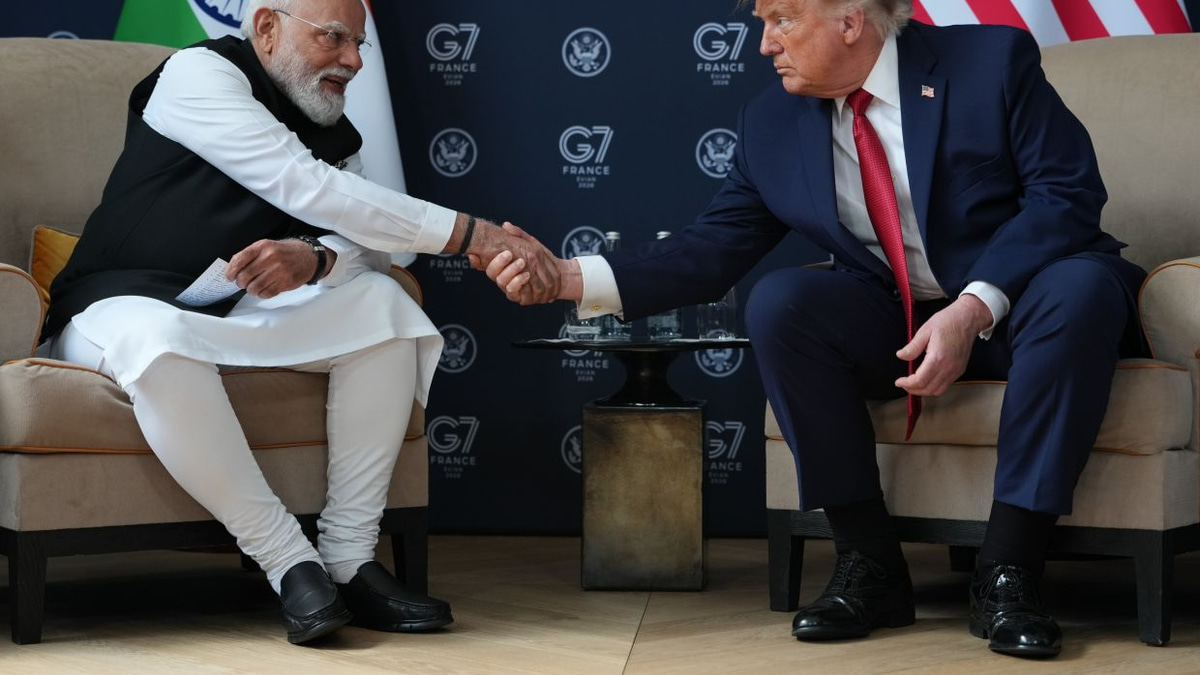
France invited leaders from Brazil, Egypt, India, Qatar, South Korea, and the United Arab Emirates to participate in select sessions, an expansion that both strengthens consensus-building by including major developing economies while simultaneously complicating decision-making in a group already strained by divergent interests. This inclusive approach acknowledges that addressing contemporary crises requires buy-in from major non-Western powers, particularly India and South Korea whose geopolitical positions make them simultaneously valuable partners and potential defectors to rival blocs. The presence of Middle Eastern states in discussions about West Asia reflected recognition that regional powers increasingly chart independent courses based on their own security calculations rather than automatically aligning with Western preferences.
Underlying the summit's apparent consensus lay considerable tension between the United States and its traditional allies over trade protectionism, NATO burden-sharing, and Trump's various geopolitical fixations including Greenland acquisition. These strains threaten to erode the institutional cohesion that has underpinned Western strategy for decades, even as security challenges from Russia, China, and Iran arguably demand greater rather than lesser unity. The fact that leaders could still produce joint statements and unified positions on Ukraine and development finance suggests that acute shared threats still outweigh bilateral grievances, though the fragility of this consensus should not be underestimated as Trump potentially returns to office with an agenda that fundamentally challenges postwar international arrangements.
For Southeast Asian observers and policymakers, the G7 summit's outcomes carry significant implications regarding regional security architectures and development financing. As Western powers recalibrate their approach to development partnerships and grapple with managing simultaneous crises in Europe, the Middle East, and potentially East Asia, the region must anticipate reduced American focus on Indo-Pacific affairs combined with increased competition as Western powers seek to prevent countries from gravitating toward Chinese or Russian orbits. The G7's commitment to reforming development finance could create opportunities for Southeast Asian nations to access alternative capital sources while simultaneously making the region a battlefield where Western and Chinese visions of development partnerships directly compete for influence and alignment.