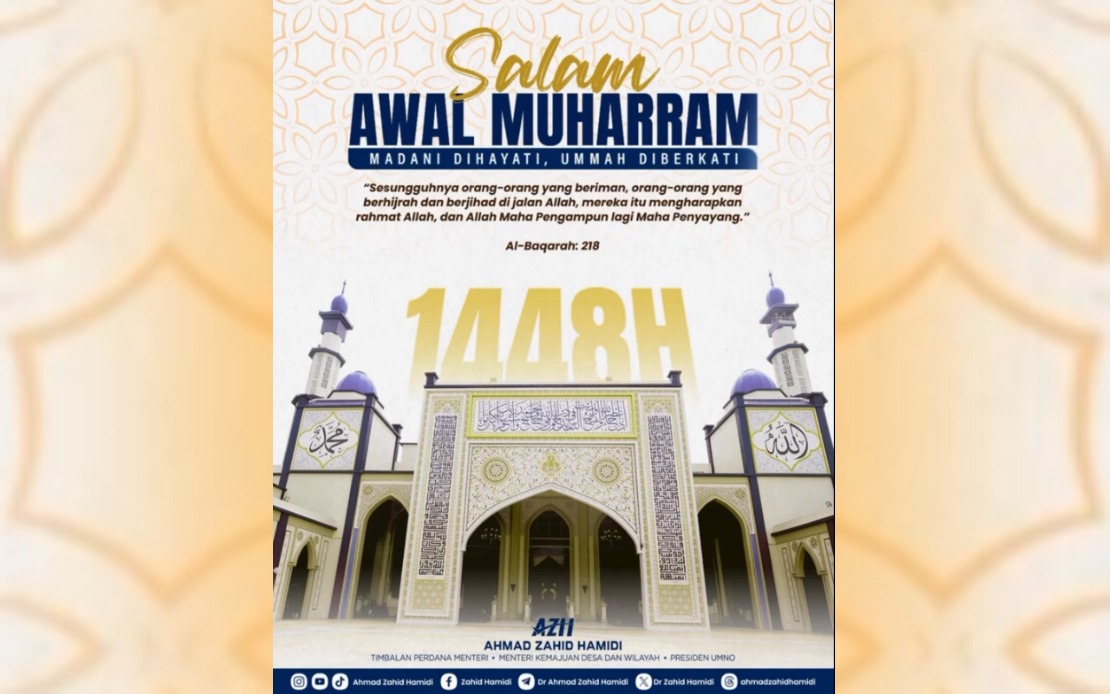
Malaysia's political leadership has issued a unified call for citizens to harness the deeper meaning of Hijrah—the Islamic concept of positive transformation and migration—as the nation marks Awal Muharram 1448H. Rather than treating the occasion as merely a date change on the Islamic calendar, senior government figures have positioned the moment as a timely invitation for personal renewal and strengthened national cohesion at a time when Malaysia faces mounting external pressures.
Deputy Prime Minister Datuk Seri Dr Ahmad Zahid Hamidi has framed Hijrah as fundamentally about action rather than rhetoric, emphasising that meaningful change demands sustained effort, discipline and commitment to continuous improvement. Speaking through social media, he drew a parallel between the historical Hijrah and contemporary Malaysian challenges, suggesting that the values underpinning the Prophet's migration—sacrifice, perseverance and moral courage—remain directly applicable to how the nation should navigate present-day complexities. His intervention signals an attempt to move beyond ceremonial observance toward substantive behavioural and institutional change.
The economic dimension featured prominently in messaging from Deputy Prime Minister Datuk Seri Fadillah Yusof, who explicitly connected the Hijrah spirit to Malaysia's vulnerability to external shocks. He referenced the global supply chain disruptions, commodity price volatility and broader economic uncertainties that have rippled through Southeast Asian markets, arguing that these pressures demand a recalibration of national practices around resource management. His emphasis on prudence—reducing wastage in food, electricity and water, and prioritising essential consumption over discretionary spending—reflects official recognition that public behavioural shifts at scale could meaningfully impact fiscal resilience and household budgeting during volatile periods.
Fadillah's framing also carried an implicit critique of contemporary consumption patterns across Malaysian society. By invoking Islamic teachings on moderation and restraint, the Deputy Prime Minister attempted to reframe fiscal discipline not as austerity imposed from above, but as a moral and spiritual obligation. This rhetorical strategy aims to generate voluntary compliance with resource conservation without triggering the political friction typically associated with direct government restrictions or price controls. For Malaysian households already navigating cost-of-living pressures, the message attempts to position individual sacrifice as contributing to collective national wellbeing.
Social cohesion emerged as an equally central preoccupation across ministerial statements. Fadillah pointedly cautioned against allowing societal differences to become divisive, positioning unity and mutual respect as essential infrastructure for maintaining the stability upon which economic progress depends. This warning appears calibrated to Malaysia's documented religious and ethnic diversity, suggesting that government officials view social fragmentation as a latent risk that could be exacerbated during periods of economic strain. By anchoring calls for unity in Islamic theological language accessible to Muslim-majority populations while simultaneously invoking inclusive concepts of national interest, the leadership attempted to craft messaging that resonates across community lines.
Communications Minister Datuk Fahmi Fadzil contributed a more introspective dimension, characterising the Hijrah moment as an opportunity for individual reflection and spiritual recalibration. His emphasis on courage to change, patience amid adversity and sincere effort framed the observance as personally transformative rather than purely collective or national in scope. This multi-layered messaging—operating simultaneously at individual, family and national registers—reflects sophisticated understanding that government exhortations gain traction only when they align with citizens' own spiritual and psychological needs.
The Religious Affairs dimension received explicit attention from Zulkifli Hasan, Minister in the Prime Minister's Department (Religious Affairs), who guided the Muslim community through specific devotional practices marking the transition between Islamic years. His detailed guidance on prayers and family-centred observance underscores how the government leverages administrative and religious authority to structure public participation in national observances. By embedding spiritual practice within this framework, the state positions itself as a custodian not merely of public order but of authentic religious experience.
The breadth of ministerial participation—spanning agriculture, science, women's development, education, health and youth portfolios—illustrates the comprehensiveness of the government's attempt to mobilise institutional resources around the Hijrah message. This coordination suggests that the observance functions as a strategic moment for reinforcing government messaging across multiple policy domains simultaneously. Whether addressing food security, technological innovation or youth engagement, ministers leveraged the occasion to reconnect departmental objectives to overarching themes of resilience, reform and national purpose.
For Malaysian readers navigating economic uncertainty and social complexity, these interventions carry both symbolic and practical significance. The government's insistent framing of Hijrah as demanding tangible behavioural change—rather than mere celebration—signals expectations that citizens should demonstrate observable shifts in consumption, resource management and commitment to social harmony. Yet the reliance on spiritual and moral persuasion rather than regulatory mandates also suggests the limits of state capacity to impose such changes through force alone, implying that leaders recognise genuine transformation requires genuine buy-in from the public.
The timing of this unified messaging is significant within Malaysia's broader political context. As the nation confronts inflationary pressures, global supply chain volatility and ongoing debates about institutional reform, the government's deployment of religious and cultural frameworks to encourage sacrifice and unity represents an attempt to build legitimacy for potentially unpopular policy decisions or social adjustments. By positioning such measures not as government-imposed burdens but as spiritual obligations aligned with Islamic principle, official messaging aims to transform public acceptance from reluctant compliance into virtuous participation.
For regional observers, Malaysia's approach to leveraging Islamic observances for governance and social messaging offers insights into how Muslim-majority Southeast Asian governments navigate the intersection of religious practice and statecraft. The articulation of Hijrah values—transformation, migration toward improvement, moral courage—to contemporary policy challenges demonstrates how historical and theological concepts maintain practical utility in addressing modern governance questions around economic resilience, social cohesion and institutional reform.


