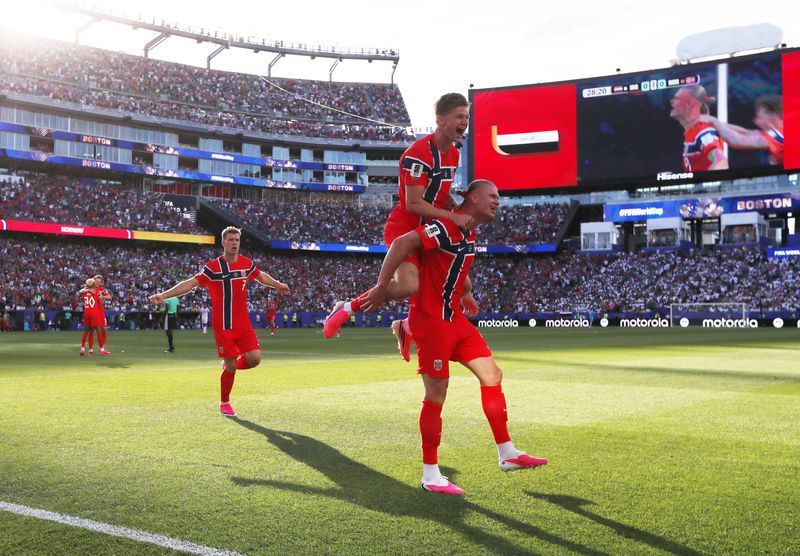
Erling Haaland announced his World Cup credentials in dominant fashion, netting twice in the opening half as Norway steamrolled Iraq 4-1 on Tuesday, delivering an emphatic declaration of intent in the tournament's group stage. The towering striker's double underscored why he carries the aspirations of an entire nation into football's greatest competition, a burden he bore with the kind of clinical finishing that has defined his meteoric rise through European football's elite leagues.
The 23-year-old's brace extended a remarkable streak of finding the back of the net on major debuts. Since emerging as one of world football's most lethal finishers, Haaland has scored in his first competitive appearance for virtually every significant club and competition he has entered—from the Bundesliga to the Premier League to the Champions League, and now the World Cup finals. That record speaks to a rare combination of athleticism, positioning, and composure that separates the exceptional from the merely very good at international level, where defences are typically better organised and time on the ball is more precious.
Norway's path to victory, however, revealed underlying vulnerabilities that coach Stale Solbakken must address before facing stronger opponents. The Scandinavian side's overall control of the match proved far less convincing than the scoreline suggested, with technical deficiencies—misplaced passes and loose possession—recurring throughout the ninety minutes. Iraq mounted genuine resistance, particularly when they struck back through Aymen Hussein's equaliser, a moment that exposed defensive lapses and a concerning susceptibility to basic counterattacking football. That a team from one of Europe's strongest football federations could look so disjointed suggests deeper structural issues beyond having one world-class attacker.
Haaland's first goal epitomised poacher's instinct at its purest. After David Moller Wolfe delivered a precise cross into the box, the striker was exactly where defenders feared he would be, converting with the certainty of someone accustomed to clinical finishing. The second demonstrated different dimensions of his game—aggressive pressing forced Iraq's defence into a critical error when a hurried back-pass fell short, and Haaland's intervention blocked the goalkeeper's clearance attempt directly into the net. These were not fortunate moments but the product of constant movement and relentless pressure on possession.
The tactical framework constructed by Solbakken places enormous emphasis on creating opportunities for Haaland to exploit. As Norwegian Prime Minister Jonas Gahr Stoere observed on the eve of the match, individual brilliance must be harnessed within a collective system, and Norway's gameplan essentially revolves around positioning their talismanic forward to finish what teammates create. Yet midfield orchestrator and captain Martin Odegaard—typically the creative fulcrum of the Norwegian attack—failed to impose his authority on proceedings, remaining unusually peripheral in areas where his vision and technical quality should have been dominant. When Haaland is not directly terrorising defences, Norway's attacking structure loses coherence.
This return to the World Cup represented an emotional milestone for Norwegian football, which had waited 28 years since the 1998 tournament in France for another appearance. The extended absence meant an entire generation of supporters had never witnessed their national team at the sport's most prestigious competition, making this opening victory feel far more significant than three group-stage points ordinarily would. The combination of emotional release and genuine concern about future opponents produced complex reactions, even amid celebration.
Haaland himself remained characteristically understated in triumph, deflecting attention from individual performance toward collective outcome. Known for his privacy and preference to communicate through action rather than words, he nonetheless recognised the broader context of Norway's absence from the global stage. His comment about hoping countrymen were celebrating back home reflected genuine connection to something far larger than personal achievement, an awareness that his performances carry weight beyond statistical records.
The opening group-stage standings placed Norway atop their pool with three points, though France's earlier 3-1 victory over Senegal meant the defending champions held superior goal difference in reserve. That dynamic shifts dramatically as the tournament progresses, and Haaland himself warned that substantially improved performances would be required in subsequent matches. Defensive solidity and midfield cohesion cannot be papered over indefinitely by individual excellence, regardless of how devastating that excellence may be in specific moments.
For Southeast Asian viewers and Malaysian audiences particularly, Haaland's performance offers instructive lessons about the difference between elite-level finishing and complete team functionality. Norwegian football's investment in developing one exceptional talent has borne fruit, yet the tournament's format ensures that even the world's finest strikers require competent support systems. As Malaysia continues developing its own footballing pathway through regional competitions and international exposure, understanding how even gifted players can be rendered less effective by systemic weaknesses provides valuable perspective on the comprehensive nature of football development at the highest levels.