President Prabowo Subianto's ambitious free nutritious meal programme, designed to combat childhood stunting across Indonesia, is facing a critical moment as beneficiaries themselves are signalling they would rather abandon the assistance than continue receiving substandard food. The position marks an unusual reversal from typical welfare dynamics, with mothers and carers becoming vocal critics demanding either comprehensive reform or suspension of the initiative. The sentiment reflects deepening frustration over the quality of meals being distributed and raises fundamental questions about the programme's operational efficiency despite its substantial financial commitment.
The crisis of confidence came sharply into focus when Nesti Nagari, a 29-year-old mother from Kediri in East Java, posted photographs on social media showing the meal her eight-month-old child was supposed to receive. The food appeared as an unidentifiable clump of white paste, prompting her to feed it to her chickens instead. The post resonated widely, accumulating more than 11,000 likes and sparking broader conversations about what beneficiaries are actually receiving under the scheme. Nagari subsequently decided to reject the meals entirely, explaining that she possesses the means and capability to provide adequate nutrition for her child and would rather see the government redirect resources elsewhere. Her willingness to forgo support stood in stark contrast to the programme's intended purpose of assisting vulnerable families.
Similar quality concerns have emerged from across the country's major urban centres. Diah Farika, a breastfeeding mother in Semarang, Central Java, enrolled in the programme since May, documented a consistent decline in meal standards over time. Her photographs revealed unripe oranges and portions she considered inadequate for nutritional purposes. When she raised these issues with the nutrition fulfillment service unit responsible for meal preparation, her complaints were dismissed. Like Nagari, Farika expressed support for temporarily halting the programme, arguing that suspension would allow the National Nutrition Agency to conduct comprehensive inspections of all kitchen facilities nationwide. She emphasised that while the programme's concept is sound, its success depends entirely on the operational standards maintained by individual service units.
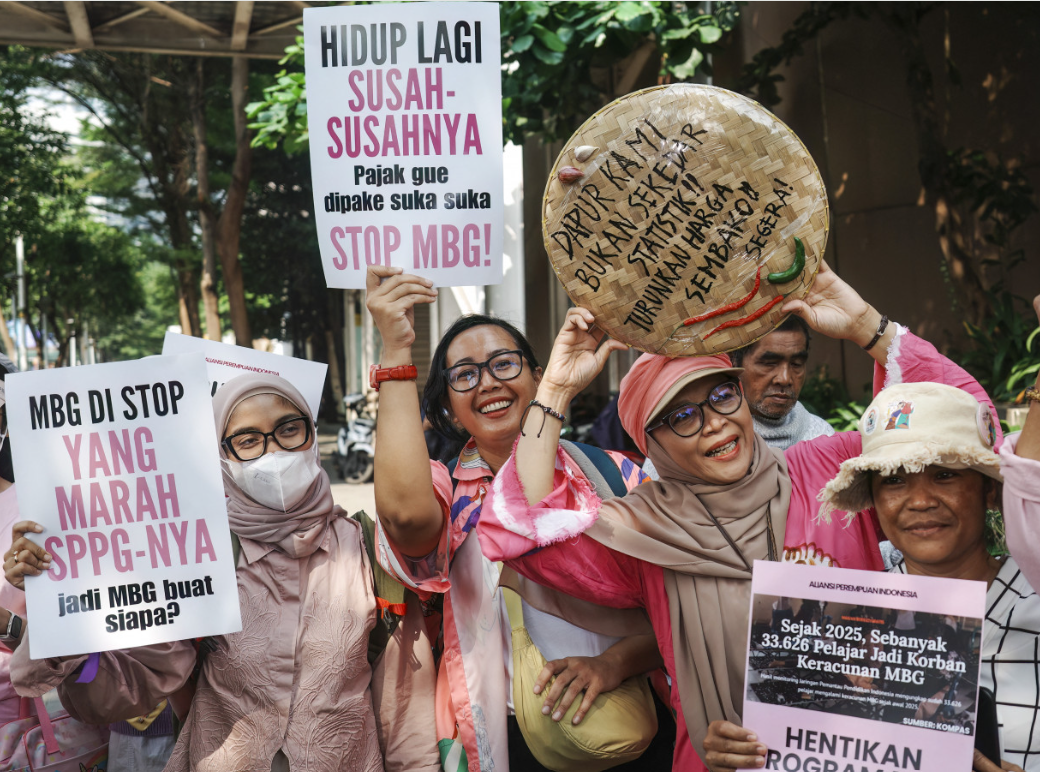
The beneficiaries' concerns have extended beyond social media complaints to organised public action. On Thursday, dozens of women and rights activists affiliated with the Indonesian Women's Alliance staged a demonstration in Central Jakarta, demanding that the government halt and thoroughly review the entire initiative. These protests underscore how widespread dissatisfaction has become among the demographic the programme was designed to protect. Civil society involvement signals that quality concerns have transcended individual frustrations to become a matter of public policy debate.
Parallel to beneficiary concerns, investors and programme operators have begun voicing anxieties about the scheme's sustainability. A group of investors recently visited the National Nutrition Agency offices seeking assurances about the programme's future after having committed hundreds of billions of rupiah to constructing meal preparation facilities. The existing network comprises approximately 27,000 kitchens distributed across Indonesia. The investors' concerns intensified following a corruption scandal involving former agency leaders, which prompted the newly installed leadership to freeze further expansion of the kitchen network. Several service units reported temporary closures in early June due to delayed funding, though some subsequently resumed operations.
The mounting difficulties have visibly eroded public confidence in the initiative. MBG Watch, an independent oversight platform established by civil society organisations, has documented the accumulating problems and their impact on community trust. Isnawati Hidayah, a policy researcher at the Center of Economic and Law Studies and one of MBG Watch's founders, pointed out that the escalating controversies have prompted parents and the broader public to question whether the enormous budget allocation is generating genuine benefits or merely enriching particular stakeholders.
The financial dimensions of the controversy cannot be overlooked. The 2026 budget allocation was initially set at Rp 335 trillion before being reduced to Rp 268 trillion as part of government efficiency measures following intense public scrutiny. The original budgetary commitment attracted criticism both regarding the programme's overall cost and its implications for competing priorities such as education and healthcare. Beneficiaries including Nagari explicitly called for redirecting these substantial resources toward other urgent national needs. The budgetary pressure reflects broader questions about resource allocation in a developing economy where multiple competing demands exist for limited public funds.
A critical finding from civil society research has revealed that the programme's beneficiary targeting may be fundamentally flawed. A study conducted by the Center of Economic and Law Studies estimated that approximately 34 per cent of current recipients, roughly 61 million children and pregnant women, do not belong among Indonesia's most vulnerable populations. This segment includes households that are already economically secure or possess adequate nutritional access. The inclusion of ineligible beneficiaries represents both a misallocation of resources and potentially a distraction from reaching those with the most acute need for government intervention.
In response to mounting criticism, the National Nutrition Agency has initiated a refocusing strategy aimed at narrowing the beneficiary pool. As of last week, officials had removed 76 schools across Java from the programme, affecting more than 39,000 recipients identified as capable of meeting their nutritional needs without government assistance. Deputy head Agustina Arumsari stated during a televised briefing that this recalibration represents an effort to concentrate support on Indonesian citizens most genuinely requiring government intervention. The agency characterised the shift as part of a broader effectiveness drive.
The National Nutrition Agency has also introduced cost-containment measures designed to improve operational efficiency. These include eliminating daily incentive payments to kitchen facilities during periods when they are not actively preparing meals, as well as conducting systematic evaluations of underperforming kitchen operators. Such measures suggest agency acknowledgment that existing operational standards require substantial correction. However, whether these adjustments will address the fundamental quality concerns raised by beneficiaries themselves remains uncertain.
For Malaysia and other Southeast Asian countries monitoring Indonesia's approach, the free meal programme presents both cautionary lessons and implementation considerations. The initiative demonstrates that even well-intentioned large-scale nutrition programmes require rigorous quality control mechanisms and accurate beneficiary targeting from inception. The willingness of programme beneficiaries to reject assistance rather than accept substandard provision reflects changing expectations across the region regarding public service standards. As Indonesia proceeds with reform efforts, the outcomes may inform policy decisions elsewhere in Southeast Asia where similar nutritional support initiatives are under development or consideration.
The programme's trajectory will depend significantly on whether the National Nutrition Agency can implement reforms quickly enough to restore beneficiary confidence. Mothers' explicit statements that they would support suspension or termination if it enabled proper evaluation suggests that programme legitimacy now depends on demonstrable quality improvements rather than budgetary scale. The agency faces the dual challenge of maintaining operational continuity while addressing the fundamental implementation failures that have triggered this unusual situation where those meant to benefit are questioning the programme's value proposition.