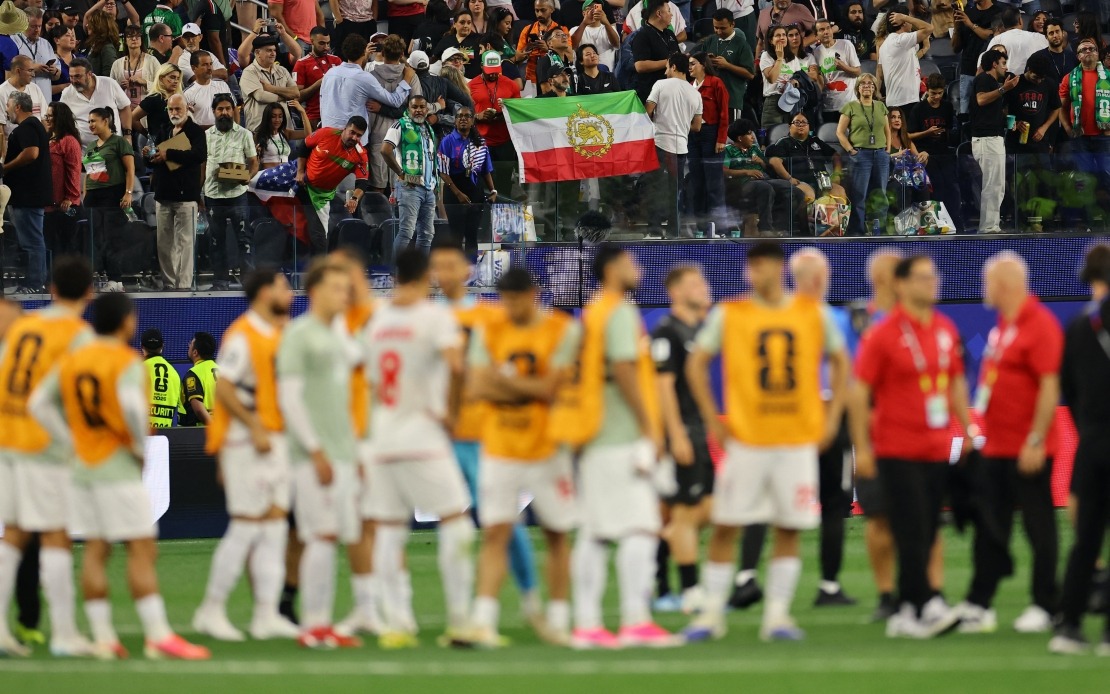
Iran's national football team manager has levelled accusations that his squad endured unusual operational constraints during the World Cup, claiming they were instructed to vacate their Los Angeles accommodation shortly after their opening fixture against New Zealand on Monday evening. Amir Ghalenoei characterised the Iranian contingent as the "most repressed team in the whole World Cup," alleging that immediate relocation orders disrupted planned recovery protocols and inflicted considerable fatigue on his players through extended air travel.
The coaching staff had arranged to remain in the California city overnight to conduct recovery sessions and physiotherapy following competitive exertion, a standard practice in international football tournaments. Instead, Ghalenoei stated that officials communicated departure instructions immediately upon the final whistle, forcing the team into urgent preparations for departure. This abrupt change of plans raised eyebrows within the Iranian delegation, which questioned the timing and justification for such disruptive orders during a tournament where managing player welfare proves critical.
Ghalenoei's frustration stemmed partly from the cumulative effect of long-haul flights compounded by the forced relocation. The Iranian contingent had already undergone considerable travel logistics prior to the tournament, having initially planned to establish their training base in Tucson, Arizona. However, visa complications and logistical obstacles prompted a shift to Tijuana, Mexico, in late May—itself an indication that the Iranian team's participation involved navigating bureaucratic complications not typically affecting other World Cup delegations.
While the head coach refrained from explicitly naming who issued the departure directive, the context suggested frustration extending beyond purely sporting considerations. Team captain Mehdi Taremi referenced FIFA President Gianni Infantino's visit to the Iranian dressing room following Monday's match, noting that while the FIFA chief likely intended supportive gestures, broader geopolitical dimensions underlay the situation. Taremi's comments carried unmistakable implication regarding the historically fraught relationship between the United States and Iran, alluding to tensions that extend far beyond the football pitch.
Taremi's measured but pointed statement—"For sure, he wants to try to help us, but it's about other things, too. Everyone knows it"—acknowledged the elephant in the room without requiring explicit elaboration. The captain's assertion that "you know where we are" signalled awareness among observers that Cold War-era antagonisms and contemporary diplomatic friction inevitably colour any interaction between Iranian representatives and American hosts, particularly within an officially neutral sporting environment. The timing proved especially sensitive given prevailing international developments affecting bilateral relations.
The situation reflected deeper complexities confronting Iran's participation in World Cup tournaments hosted by or involving Western nations. Teams representing nations with strained diplomatic relationships with tournament hosts frequently encounter procedural impediments, security considerations, and administrative hurdles that their counterparts avoid. For the Iranian squad, the forced relocation represented a tangible manifestation of these structural inequalities, translating abstract geopolitical tension into concrete disadvantage affecting tournament preparation and player conditioning.
From a competitive perspective, the enforced travel schedule potentially compromised Iran's ability to optimise recovery between matches—a factor that accumulates significance as tournaments progress. Modern football's physical demands mean that proper recuperation, massage therapy, ice baths, and psychological rest directly influence subsequent performance. Denying Iranian players these standard recovery amenities, particularly in a high-stakes opening match, created measurable competitive disadvantage alongside the symbolic message conveyed by such restrictions.
The relocation narrative also underscores how geopolitical dimensions infiltrate ostensibly neutral sporting competitions. While FIFA operates under principles of political neutrality and equal treatment, the practical reality frequently diverges from stated ideals. Host nations' security apparatus, visa authorities, and diplomatic concerns frequently create friction points for delegations from countries bearing historical antagonisms with their hosts. Iran's experience demonstrates how competitive sport becomes entangled with matters of statecraft, sovereignty, and international relations that transcend footballing considerations.
For Malaysian and Southeast Asian observers, the Iranian situation resonates with broader questions about how international sporting bodies navigate geopolitical sensitivities. The region hosts nations maintaining diverse diplomatic relationships with major world powers, and similar tensions occasionally surface regarding visa processing, training base allocations, and logistical support. The Iranian case study provides instructive precedent for considering how tournament organisers balance official neutrality with practical complications arising from bilateral diplomatic histories.
The forced relocation also raises questions about competitive fairness that international sporting governance bodies increasingly confront. If accusations hold merit, they suggest systematic disadvantaging of particular delegations based on nationality rather than sporting considerations—a violation of basic sporting principles. Such practices undermine tournament integrity and tournament organisers' credibility, particularly when claimed by senior coaching staff with no apparent motive for fabrication.
As the World Cup progressed, these contextual factors proved relevant to understanding Iran's competitive trajectory. The team's opening match performance and subsequent fixtures occurred within a framework where operational disadvantages preceded kickoff. Whether such constraints materially affected results remains debatable, but the cumulative fatigue and psychological burden of navigating bureaucratic obstacles while preparing for tournament football could plausibly influence team morale and conditioning.