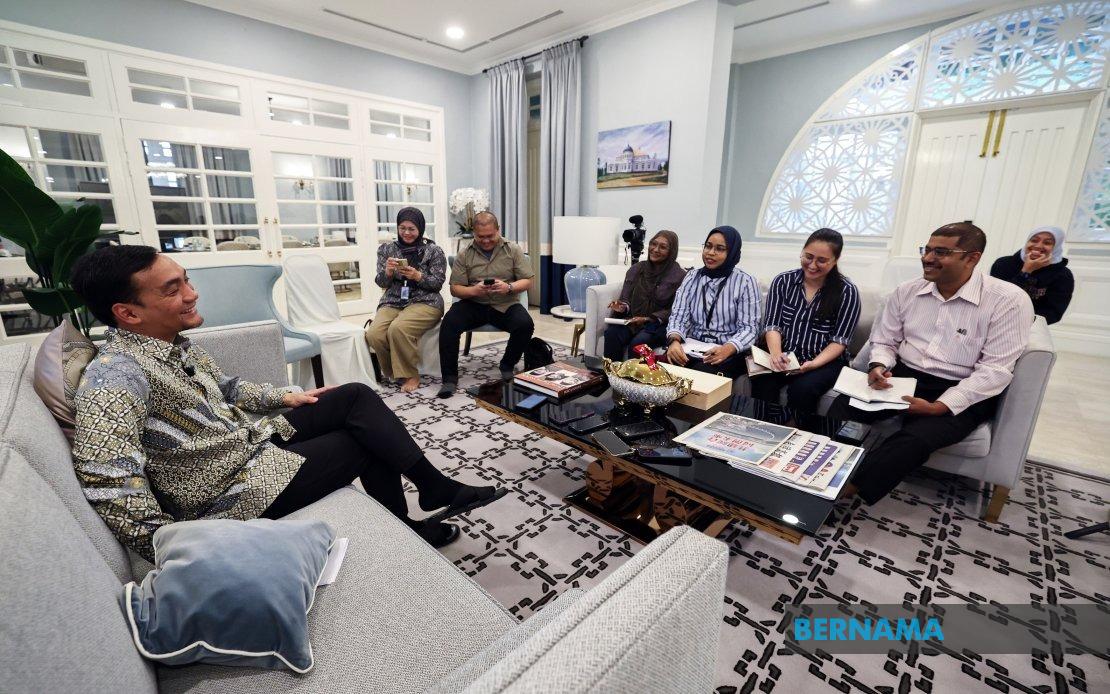
Johor Barisan Nasional chairman Datuk Onn Hafiz Ghazi has appealed to party members overlooked in the candidate selection process for the upcoming state election to sustain their dedication to the coalition's broader agenda. Speaking during a media interview at his official residence in Saujana, the Johor Menteri Besar emphasised that exclusion from the ballot does not represent a final judgment on party members' value or future prospects within the organisation.
Onn Hafiz framed the candidate selection setback as a temporary circumstance rather than a definitive career endpoint. He outlined multiple pathways for members to contribute meaningfully to the party beyond contesting state assembly seats, including potential roles as Members of Parliament and positions within the party's administrative machinery. This messaging appears designed to retain supporter morale during a sensitive phase of internal party dynamics, particularly important in a state where competition for candidacies remains fierce.
The Menteri Besar revealed that the candidate selection process has reached approximately 80 per cent completion, though final confirmation remains contingent upon candidates formally receiving their appointment letters. He cautioned that even at this advanced stage, circumstances can shift, noting that historical precedent exists for previously issued appointments to be rescinded. This caveat underscores the fluid nature of internal party decision-making and suggests that some uncertainty persists even within the BN hierarchy regarding final slate composition.
Regarding selection criteria, Onn Hafiz outlined a framework emphasising professional diversity, inclusivity across age groups, and deep community rootedness. Candidates must demonstrate established presence and acceptance within their respective constituencies, reflecting what the BN president has termed the WALI principle—denoting candidates who are winnable, acceptable, and likeable to voters. Notably, Onn Hafiz de-emphasised age as a determining factor, asserting that capacity to serve communities supersedes generational considerations. This stance appears calibrated to manage expectations among younger aspirants while defending selections of more senior candidates.
The selection process operates through a collaborative approval mechanism rather than centralised unilateral decision-making. Final endorsement requires clearance from BN chairman and UMNO president Datuk Seri Dr Ahmad Zahid Hamidi alongside other senior party leadership. This distribution of authority, while potentially diffusing individual accountability, also reflects the complex internal power structures within Malaysia's largest coalition.
Onn Hafiz identified young voters and first-time voters as disproportionately influential demographic segments in determining electoral outcomes. He cited demographic data indicating that voters under 40 represent between 20 and 40 per cent of Johor's population, thereby constituting a pivotal voting bloc. The Menteri Besar suggested that BN's elected representatives have successfully engaged with this demographic and recognise the electoral significance of youth participation.
Voter participation constitutes another strategic emphasis for the outgoing administration. Onn Hafiz issued a direct appeal to all Johoreans, specifically including those employed in Singapore, to exercise their franchise in the July 11 election. He framed democratic legitimacy as directly proportional to voter turnout, suggesting that higher participation rates translate into improved representation quality for the state. This messaging reflects BN's interest in mobilising its supporter base whilst projecting confidence in electoral mathematics.
The Menteri Besar positioned his administration's track record as the foundation for continued governance. He asserted that his government has conscientiously delivered upon its obligations to state residents and expressed readiness to pursue enhanced performance should voters grant another mandate. This forward-looking framing attempts to reframe the election as endorsement of continuity rather than a competitive contest.
The state election timeline establishes nomination day on June 27, with early voting scheduled for July 7 and general polling on July 11. This compressed electoral calendar compresses the campaign period, providing limited time for candidate introductions and positioning. For grassroots BN operatives, whether selected or not, the accelerated timeline demands immediate mobilisation across constituencies. The compressed campaign period may particularly disadvantage parties still resolving internal candidate disputes, as public attention and campaign infrastructure require immediate deployment rather than gradual ramping.
Onn Hafiz's remarks collectively constitute a calibrated party management exercise addressing the inevitable disappointments accompanying competitive candidate selection processes. By acknowledging non-selection whilst simultaneously reframing it as temporary and offering alternative contribution pathways, the Menteri Besar attempts to preserve internal cohesion during a potentially fractious phase. For BN's broader electoral prospects, retaining committed participation from disappointed members remains crucial to ground-level campaign effectiveness across Johor's 56 state constituencies.