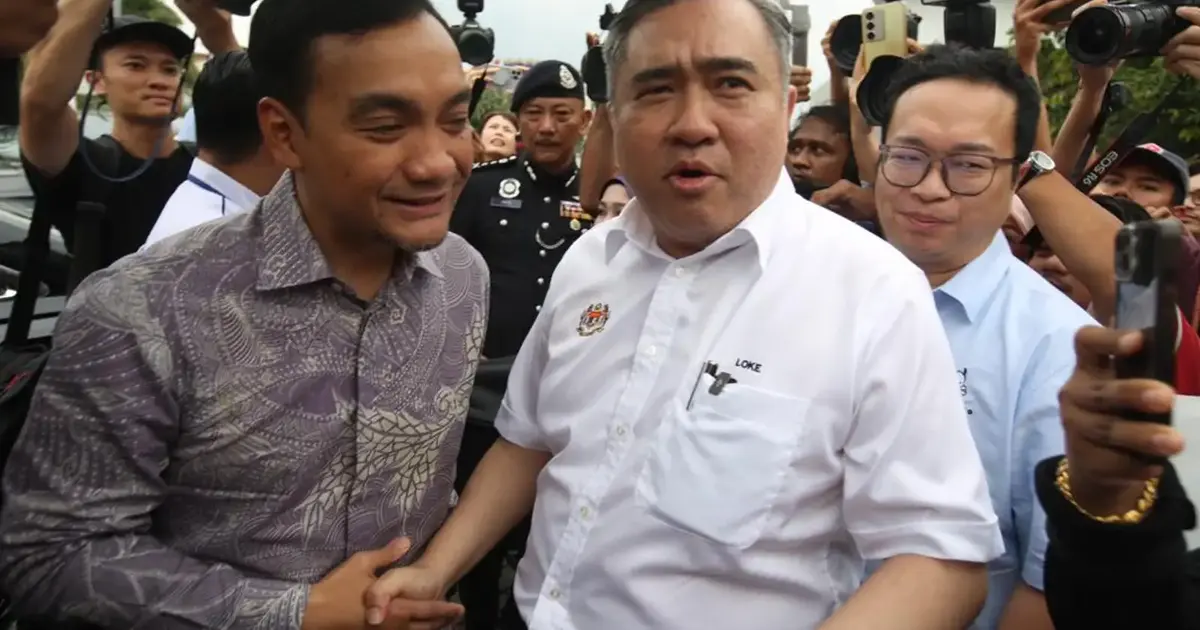
The first face-to-face engagement between Transport Minister Anthony Loke and Johor Menteri Besar Onn Hafiz Azamat since their recent online dispute unfolded with careful civility, though subtle undercurrents hinted at persisting friction between the two officials. The pair attended a transport ministry event in Johor, where despite courteous interactions, Onn Hafiz found occasion to land a pointed remark directed at the DAP leader during his public remarks.
During his speech at the gathering, Onn Hafiz alluded to the last-minute nature of his invitation to the function, suggesting he had been compelled to shuffle his official calendar to accommodate the event. The comment, while ostensibly a logistical observation, carried undertones that reflected the strained relationship between the two leaders following their recent social media exchange.
The online disagreement between Loke and Onn Hafiz had drawn public attention in preceding weeks, with both figures exchanging critical commentary through digital platforms. Such disputes, while common in Malaysian politics, underscore the competitive dynamics within the ruling coalition, particularly between federal and state-level administrations that represent different political entities within the broader government structure.
For Malaysian observers, the interaction illustrated how political relationships operate at multiple levels simultaneously. On the surface, officials maintain the courtesies demanded by government protocol and the necessity of administrative cooperation. Beneath this veneer, genuine policy disagreements and partisan differences persist, occasionally manifesting through pointed remarks and subtle jabs rather than overt confrontation.
The transport ministry's decision to conduct an official event in Johor reflects the federal government's continued engagement with state administrations, regardless of internal political complexities. Such interactions are essential for coordinating policies affecting crucial infrastructure, particularly transportation networks that transcend state boundaries and require seamless collaboration between different levels of governance.
Onn Hafiz's reference to schedule reorganisation carried implications about coordination between federal and state offices. Effective governance demands that transport ministry initiatives align with state-level priorities and the Menteri Besar's availability, yet the last-minute nature of the invitation suggests potential friction in advance planning or communication between the two administrations. This logistical friction often reflects deeper disagreements about priorities or resource allocation.
For the broader Malaysian context, such episodes highlight tensions within coalition governments where partners nominally support a shared agenda yet harbour distinct interests. The Johor state administration, under Onn Hafiz's leadership, operates within a complex political landscape where local priorities may diverge from federal initiatives. Transportation policy, encompassing urban mobility, intercity connections, and economic infrastructure, represents a domain where federal and state interests frequently intersect and occasionally conflict.
The cordiality maintained during the event, despite underlying tensions, demonstrates that Malaysian political culture still privileges formal politeness and institutional respect, even when relationships are strained. Neither Loke nor Onn Hafiz abandoned diplomatic conventions or escalated their disagreement into public acrimony at an official function. This restraint reflects understanding that maintaining functional relationships is essential for delivering services to citizens, regardless of partisan differences.
The incident also reveals how social media has become a venue for Malaysian political figures to engage in disputes that might previously have remained confined to private channels or closed-door negotiations. The translation of disagreements onto public platforms amplifies visibility and potentially hardens positions, making subsequent face-to-face interactions more delicate.
Looking forward, the tenor of this encounter suggests both leaders recognise the necessity of maintaining working relationships despite their differences. The transport ministry's operations in Johor, including potential projects and policy implementations, require cooperation between federal and state authorities. Neither official can afford complete estrangement without compromising effectiveness in serving constituents.
The subtle nature of Onn Hafiz's remark demonstrates how Malaysian political discourse often operates through indirection and implication rather than direct confrontation. International observers sometimes find this communication style opaque, yet it serves a function within Malaysian political culture by preserving the possibility of reconciliation and future cooperation while allowing officials to register dissatisfaction.
Regionally, such dynamics reflect broader patterns across Southeast Asian democracies, where coalition governments frequently navigate tensions between constituent parties and between federal and regional authorities. Malaysia's experience offers lessons about managing these relationships while maintaining governmental functionality and public service delivery.
As Loke and Onn Hafiz navigate their professional relationship, the broader implications extend to how the federal government implements policies affecting Johor and how the state administration engages with national initiatives. Both officials represent significant constituencies and wield considerable influence within their respective political spheres. Their ability to work constructively, despite disagreements, ultimately determines the effectiveness of governance structures serving Malaysia's second-largest state.