Across Malaysia today, communities gathered to observe Maal Hijrah 1448H/2026, the Islamic New Year, with nationwide celebrations underscoring a unifying message: that hijrah—the concept of positive migration or transformation—serves as a powerful framework for national progress, ethical leadership and enhanced Islamic solidarity. The observance, structured around the theme "MADANI Dihayati, Ummah Diberkati" (MADANI Lived, Ummah Blessed), wove together spiritual enrichment with civic recognition, positioning the occasion not merely as a religious milestone but as a moment for collective reflection on governance and social responsibility.
The ceremonial centrepiece in Kuala Lumpur drew substantial attendance, with approximately 5,000 participants gathering for spiritual programmes that encompassed Quranic recitations, scholarly lectures and a formal awards presentation. This format—blending devotional activity with institutional recognition—reflects a deliberate strategy to embed religious observance within conversations about national development and community welfare. The presence of Deputy Prime Minister Datuk Seri Fadillah Yusof and Minister in the Prime Minister's Department (Religious Affairs) Dr Zulkifli Hasan signalled the government's investment in framing the Islamic calendar's renewal as integral to Malaysia's broader policy agenda, particularly the MADANI (Madani, Rakyat, Agama, Negara, Integriti) framework that emphasises the intersection of religiosity and good governance.
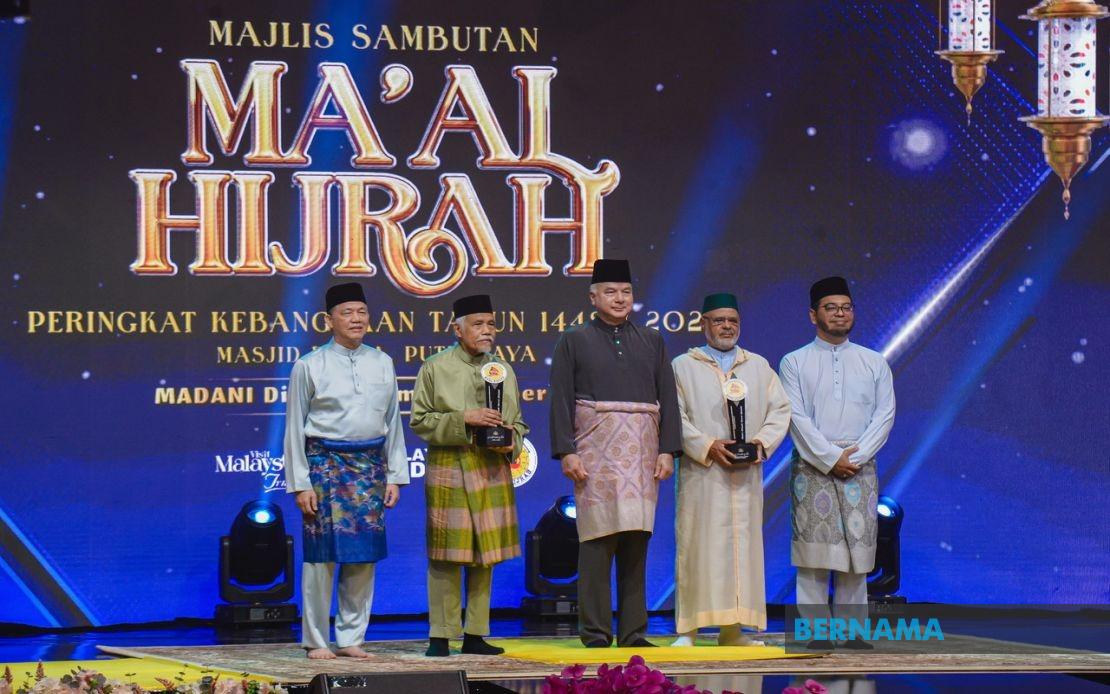
The most visible element of the celebration involved the conferral of national and international honours recognising exemplary contributions to Islamic scholarship and community leadership. Sultan Nazrin, who holds the additional title of Sultan of Perak, presented the National Tokoh Maal Hijrah Award to International Islamic University Malaysia (IIUM) rector Prof Emeritus Datuk Dr Osman Bakar, acknowledging his decades of bridging Islamic intellectual tradition with contemporary academic inquiry. In parallel recognition of international Islamic thought, Dr Ahmad Al-Raysuni, a prominent Moroccan jurisprudence scholar, received the International Tokoh Maal Hijrah Award, reflecting Malaysia's positioning as a hub of transnational Islamic dialogue and scholarship.
Parallel festivities in Sabah, attended by approximately 1,000 guests, extended the honour system to community figures whose contributions, whilst perhaps less internationally visible, reflect the lived practice of Islamic values at grassroots levels. Community activist Datuk Ag Sharin Alimin, drawing on his background as a former director of the Sabah Islamic Religious Affairs Department, was recognised in the male category for bridging religious institutional work with grassroots community mobilisation. The female category honour went to Datuk Masnah Matsalleh, a former deputy state secretary, highlighting the celebration's conscious inclusion of women's leadership roles in both public administration and religious life—a dimension that reflects evolving understandings of Islamic participation in governance.
Perhaps most poignantly, Ahmad Samsuri presented the Tokoh Maal Hijrah Award to Jusoh @ Muda Ismail, a 95-year-old Quranic teacher whose career spanned decades of direct instruction in memorisation and recitation of Islam's foundational text. As an adopted student and successor to Tuan Guru Haji Mat Lintar, a revered scholar in his own right, Ismail embodies an intergenerational transmission of Islamic knowledge that predates formal institutional structures and continues to anchor Islamic practice in personal mentorship and familial networks. His recognition underscores that the celebration's vision of leadership extends beyond governmental and academic spheres to encompass the unsung practitioners who sustain Islamic learning within communities.
The thematic emphasis on hijrah as a pathway to positive transformation carries particular resonance in Southeast Asia, where Muslim-majority nations navigate the simultaneous demands of religious authenticity, modernisation and inclusive governance. Hijrah, classically understood as Prophet Muhammad's migration from Mecca to Medina, has been reinterpreted in contemporary Islamic discourse as metaphorical migration toward spiritual and social improvement. Malaysia's adoption of this framing aligns with regional trends wherein Islamic observance is increasingly articulated as compatible with—indeed, essential to—national development, institutional integrity and social cohesion. This positioning contrasts with older narratives that portrayed religious commitment as potentially isolationist or oppositional to state authority.
The scale and structure of these celebrations reflect the infrastructure that Malaysia has developed for managing religious diversity and celebrating Islamic occasions within a constitutionally secular but Islamically-conscious state. The involvement of royal patronage, ministerial presence and institutional award mechanisms demonstrates how Islamic observances have been integrated into the apparatus of statecraft without displacing the secular constitutional framework. For Malaysian readers and policymakers, this represents a particular achievement: the capacity to honour religious tradition and scholarship whilst maintaining institutional pluralism.
For the broader Islamic world, Malaysia's Maal Hijrah 1448H celebrations model an approach to Islamic renewal that emphasises leadership quality, scholarly rigour and community cohesion rather than ideological confrontation or institutional paralysis. By centering the celebration on themes of positive transformation and united purpose, rather than on conflict or remediation of past grievances, the occasion projects an image of Islam in Malaysia as forward-looking, intellectually engaged and committed to civilisational advancement. The international recognition of Dr Ahmad Al-Raysuni extends this projection beyond national boundaries, positioning Malaysia as a node in a transnational network of Islamic thought and practice.
Moving forward, the sustained ceremonial and institutional investment in Maal Hijrah observances suggests that religious occasions will continue to function as platforms for articulating national values, honouring institutional and community leaders, and reinforcing narratives of inclusive Islamic participation in public life. For Malaysian communities and Southeast Asian observers, these celebrations offer both a reaffirmation of Islamic identity and an implicit argument about the possibilities of religious commitment within pluralistic, modern nation-states.