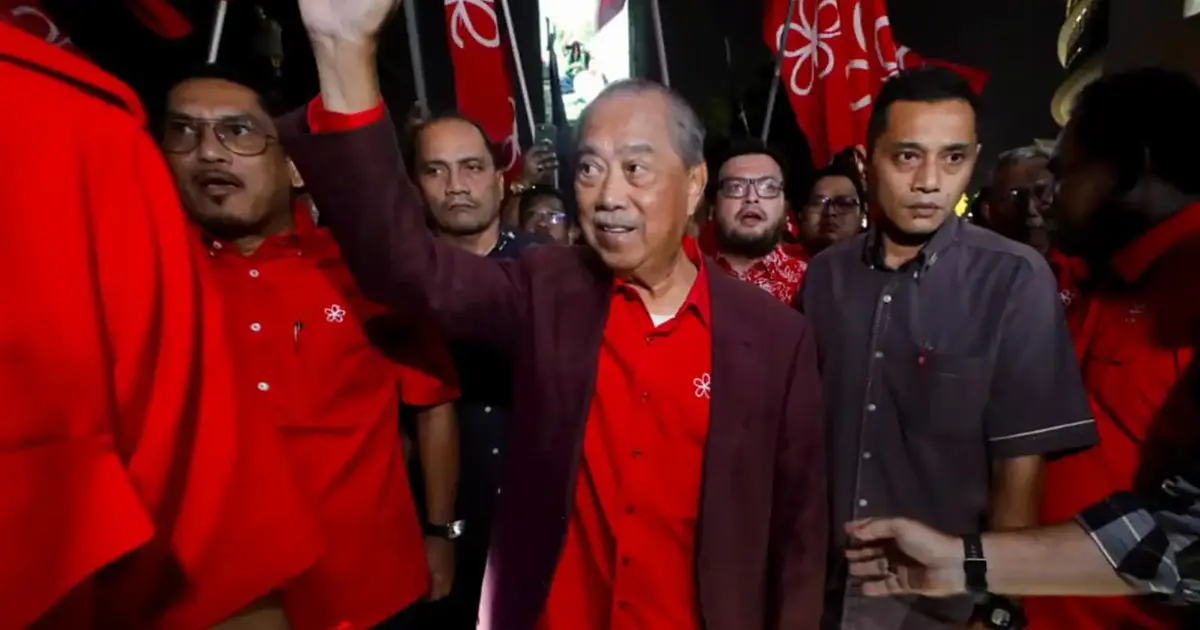
Muhyiddin Yassin demonstrated sustained grassroots backing when over 200 supporters gathered to publicly affirm their confidence in the Bersatu chair ahead of a significant party gathering that will shape the movement's electoral strategy and coalition positioning. The rally underscores the continued loyalty Muhyiddin commands within the party machine, coming at a moment when Bersatu faces critical decisions about its electoral prospects and political partnerships in the coming months.
The gathering served as a show of strength within Bersatu's internal dynamics, particularly relevant as the party prepares to navigate complex negotiations and strategic planning. The turnout reflects Muhyiddin's enduring appeal among party members and grassroots activists, even as Bersatu confronts multiple concurrent political challenges at state and national levels. The open demonstration of support signals that Muhyiddin retains considerable organisational capacity and personal loyalty within his party structure.
The forthcoming party meeting carries substantial weight for Bersatu's near-term future. Among its principal agenda items will be intensive preparations for the upcoming state elections in Johor and Negeri Sembilan, two regions where electoral performance carries implications for the party's overall viability and influence within Malaysia's political landscape. These contests will provide crucial indicators of Bersatu's ability to mobilise voters independently and to convert its national profile into tangible electoral gains at the state level.
Equally significant will be the meeting's examination of Bersatu's relationship with PAS, its current coalition partner. The state of this partnership directly affects Bersatu's strategic options, resource allocation, and political messaging across multiple constituencies. Any reassessment of this alliance could reshape the political arithmetic in several states and influence broader coalition negotiations. The trajectory of the Bersatu-PAS relationship remains one of Malaysia's more volatile political variables, capable of sudden shifts that ripple across the political system.
For Malaysian observers, Bersatu's positioning remains consequential despite the party's relatively recent formation. As a splinter movement from UMNO led by Muhyiddin, Bersatu has positioned itself as an alternative Malay-Muslim political force, capable of drawing votes and members from both UMNO and PAS depending on political circumstances. The party's performance in upcoming state elections will indicate whether it has consolidated itself as a lasting feature of Malaysia's political ecology or remains primarily dependent on Muhyiddin's personal appeal.
The strategic importance of Johor particularly cannot be overstated. Malaysia's largest state by population, Johor has historically served as a bellwether for national political trends. An Bersatu electoral breakthrough in Johor would substantially elevate the party's national profile and influence, while disappointing results could undermine its claims to be a significant independent political force. Negeri Sembilan, while smaller, carries its own symbolic and practical importance for state-level governance and federal coalition mathematics.
The question of PAS collaboration also reflects deeper tensions within Malaysia's Malay-Muslim political space. Both Bersatu and PAS compete for overlapping voter constituencies, yet strategic logic often pushes them toward cooperation rather than direct confrontation. The meeting's examination of this relationship suggests potential friction points may have emerged, or alternatively, that both parties seek to clarify terms and expectations ahead of intensive campaigning. How Bersatu and PAS navigate their relationship will substantially influence electoral prospects in states where their vote bases overlap.
Muhyiddin's ability to command the rally turnout demonstrates his continued relevance within Bersatu's ecosystem, yet leadership in Malaysian political parties typically extends beyond personal popularity to encompass effective governance, coalition management, and electoral delivery. The rally thus represents one element of Bersatu's broader positioning, important symbolically but only one factor among many determining the party's trajectory.
The timing of the meeting and the rally highlights the accelerating pace of Malaysia's political calendar. State elections represent substantive contests with real stakes for governance and resource distribution, and parties cannot afford extended periods of internal uncertainty or strategic drift. Bersatu's need to move from rally and rhetoric to concrete electoral preparation underscores the compressed timeframe within which political parties must operate in Malaysia's contemporary environment.
For Southeast Asian observers, Bersatu's situation illustrates broader patterns of political party dynamics across the region, where newer parties frequently struggle to institutionalise themselves beyond their founding leadership and initial electoral cycles. The coming state elections will provide important data about whether Bersatu has achieved such institutionalisation or remains predominantly dependent on Muhyiddin's personal brand and organisational capacity. The meeting's outcomes will reveal much about the party's internal confidence and strategic clarity as it confronts its most significant electoral tests since Muhyiddin's 2021 departure from the Prime Minister's office.