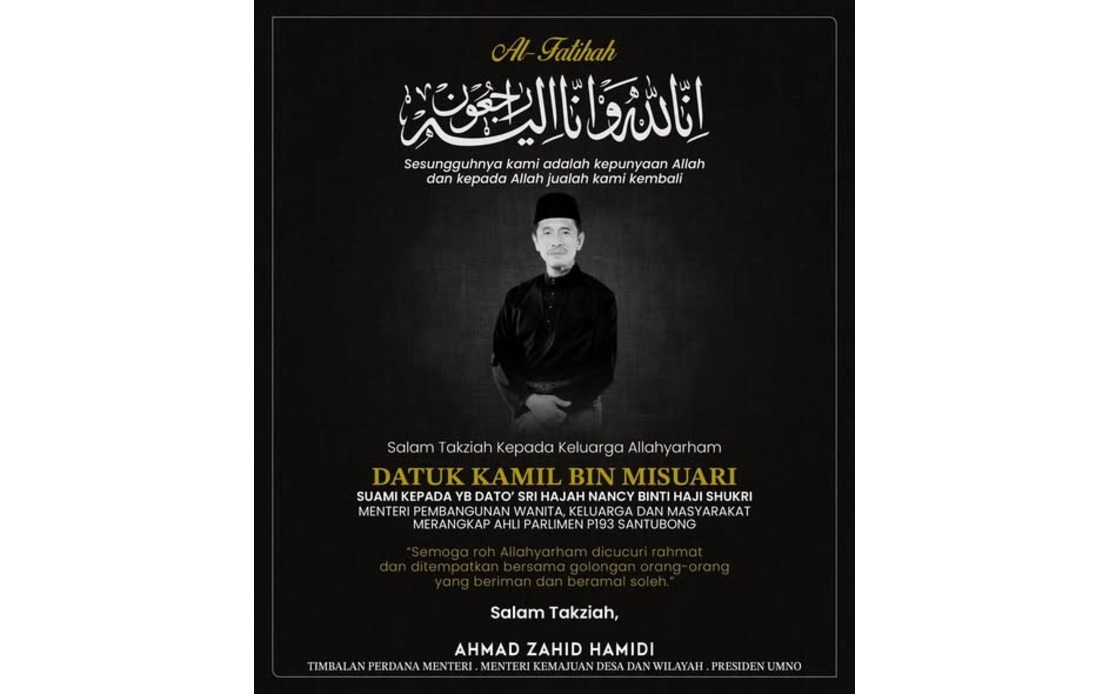
The Malaysian government has rallied around Women, Family and Community Development Minister Datuk Seri Nancy Shukri in the wake of her husband Datuk Kamil Misuari's death on June 18. Senior cabinet figures across different ministries have publicly voiced their support for the grieving minister and her immediate family, reflecting the traditions of collective compassion within Malaysia's political establishment during times of personal loss.
Deputy Prime Minister Datuk Seri Dr Ahmad Zahid Hamidi was among the first to offer formal condolences, characterizing the loss of a lifelong spouse as a severe emotional and spiritual trial. In his statement posted on social media, he invoked Islamic prayers for the deceased, asking for divine forgiveness of his transgressions and placement among God's righteous servants. He simultaneously extended wishes that Nancy and her extended family would discover the fortitude necessary to navigate their period of mourning.
Home Minister Datuk Seri Saifuddin Nasution Ismail similarly conveyed sympathy to the bereaved family, emphasizing hopes that they would receive the inner resilience required during this challenging transition. His public message centered on traditional Islamic supplications for mercy toward the departed and requests for divine ease in the family's circumstances. Such expressions of ministerial support carry particular weight in Malaysian political culture, where the formal acknowledgment of personal tragedy by senior government colleagues serves both personal and institutional functions.
Communications Minister Datuk Fahmi Fadzil added his voice to the chorus of condolences, praying for Nancy and her relatives to be granted strength and steadfastness as they confronted their profound sorrow. His formulation emphasized spiritual resilience alongside emotional endurance, reflecting the intertwining of religious and personal sentiment common in Malaysian official statements during periods of mourning. The consistency of messaging across these statements underscores the importance placed on institutional acknowledgment of personal hardship within government circles.
Agriculture and Food Security Minister Datuk Seri Mohamad Sabu articulated prayers for the family's fortitude, invoking concepts of patience and perseverance that resonate deeply within Islamic and Malaysian cultural frameworks. His statement incorporated detailed supplications for divine mercy toward Datuk Kamil Misuari's soul, reflecting the spiritual dimensions that characterize such official expressions of sympathy. The breadth of ministerial participation across diverse cabinet portfolios suggests the personal standing of Nancy Shukri within government and the value placed on maintaining collegial bonds during personal crises.
Human Resources Minister Datuk Seri R. Ramanan brought his own perspective to the condolences, acknowledging the universal difficulty inherent in losing a cherished family member, thereby bridging personal sentiment with formal expression. Minister in the Prime Minister's Department (Sabah and Sarawak Affairs) Datuk Mustapha Sakmud similarly framed the loss as a profound spiritual and emotional examination, requesting divine assistance for the grieving household.
Datuk Kamil Misuari, who was 65 years old, had been married to Nancy for nearly four decades, having wed in 1985. Their union produced three children, making the loss significant not only for the immediate couple but for an extended family structure now navigating bereavement. The stability of their long-term partnership lends particular poignancy to public expressions of sympathy, as observers recognize both the depth of marital connection and the disruption caused by such a loss in later life.
The timeline for funeral arrangements reflects the cultural and religious practices observed within Malaysian Muslim communities, with Datuk Kamil Misuari's mortal remains scheduled for transport to Kuching and subsequent interment at Samariang Muslim Cemetery. This geographically-specific arrangement suggests either family origins or long-standing residential connections in Sarawak, adding a regional dimension to what might otherwise appear as a purely national-level event.
Nancy Shukri's ministerial position as head of the Women, Family and Community Development portfolio carries particular resonance given the nature of her personal loss. Her ministry focuses on matters of family cohesion, women's welfare, and community structures—concerns that become acutely personal when ministry leaders themselves experience disruption to their own family units. The convergence of her professional responsibilities with her private grief likely influenced the prominence afforded to public expressions of support, as colleagues recognized both her individual humanity and her institutional role.
The coordinated expression of sympathy from multiple cabinet members across ideological and portfolio lines demonstrates the non-partisan character of compassion within Malaysia's political structures. Whether from the Ministry of Home Affairs, Communications, Agriculture, Human Resources, or the Prime Minister's Department, the consistent messaging and genuine tone of condolences reflects established protocols for ministerial engagement during personal tragedy while maintaining authentic emotional resonance.
For Malaysian readers observing these exchanges, they illustrate the intersection of personal loss and public service, highlighting the reality that senior government figures navigate both their professional obligations and private sorrows. The detailed religious invocations embedded within each ministerial statement also underscore the centrality of Islamic faith within Malaysia's political culture, particularly during significant life events. The breadth of official acknowledgment accorded to Nancy Shukri's loss speaks to her standing within government circles and the value placed on displaying institutional solidarity during periods of personal difficulty.