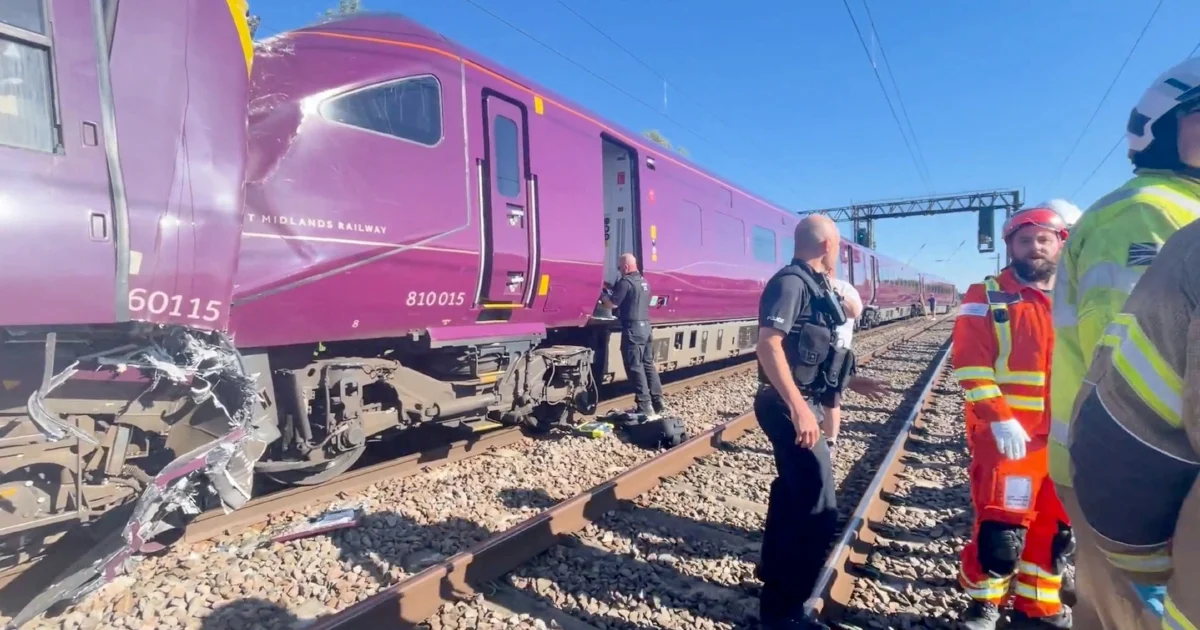
A major railway accident unfolded north of London on Friday when two passenger trains came together in a high-impact collision, according to reports from UK emergency services. The incident has resulted in one confirmed fatality, while a significant number of other passengers sustained injuries ranging from minor to severe. Among the wounded, emergency medical personnel have classified 11 individuals as suffering "very serious" injuries, requiring immediate and intensive care at regional hospitals.
The crash occurred during regular passenger operations on what appears to have been a busy commuter or intercity route serving the London metropolitan area and surrounding regions. Emergency response teams mobilised quickly to the scene following the collision, deploying multiple ambulances, rescue vehicles, and specialised personnel to manage the immediate aftermath. Initial reports suggest the operational scale of the emergency response reflects the severity of the impact and the number of casualties requiring medical intervention.
Investigators and railway safety officials will now begin determining the precise circumstances leading to the two trains converging. Such incidents typically trigger comprehensive examinations of signalling systems, train control measures, driver communications, and track conditions. The British railway network, despite being one of Europe's busiest and oldest, has maintained relatively strong safety records in recent decades, making significant collision events comparatively rare. The investigation outcomes may inform broader discussion about railway safety protocols across the UK and potentially influence transport safety discussions internationally.
For Malaysian readers, this incident underscores the critical importance of robust rail safety frameworks—an issue of particular relevance given Malaysia's own expanding railway network and ongoing development of integrated public transport systems across the Klang Valley and other metropolitan areas. The accident demonstrates how even established transport infrastructure networks can experience serious incidents, highlighting the need for continuous investment in maintenance, modernisation of signalling systems, and operator training programmes.
The collision also raises questions about the pressures facing rail operators and the spacing of train services during peak hours. Crowded timetables and operational demands can sometimes create narrow margins for error in train control and coordination. Rail authorities throughout Southeast Asia, including Malaysia, often grapple with balancing the need to maximise service frequency—essential for economic efficiency and public convenience—against maintaining adequate safety margins between services.
UK rail transport carries millions of passengers weekly across its extensive network serving England, Scotland, Wales, and Northern Ireland. The incident occurred on what are typically busy routes, suggesting the potential for substantial passenger numbers to have been affected. Beyond the immediate human toll, such incidents disrupt services across regional networks, affecting commuters, businesses reliant on rail freight, and the broader transport ecosystem.
Emergency response protocols in the UK are generally well-established, with dedicated railway accident units and trained personnel stationed across the network. However, the scale of casualties in this incident demonstrates how quickly a collision can overwhelm even well-prepared emergency systems. Hospitals across the region would have activated major incident procedures to manage the influx of injured passengers, coordinating resource allocation and specialist care.
The incident will likely receive significant attention from transport safety bodies, the rail industry, and policymakers concerned with passenger protection. In Malaysia, where railway development remains a priority for economic growth and urban congestion relief, incidents abroad often serve as cautionary examples. The government's expansion of the Light Rail Transit system, suburban railway networks, and planned high-speed rail corridors all depend fundamentally on safety systems performing as designed.
Family and friends of those affected will now await updates on the condition of hospitalised passengers, while investigating authorities begin what is typically a lengthy process of evidence gathering and technical analysis. Such accidents, while statistically rare on modern railways, create ripple effects throughout transport networks and reinforce ongoing conversations about whether sufficient resources are devoted to rail safety infrastructure, particularly during peak operational periods.
The incident serves as a reminder that despite technological advances in train control systems and safety protocols, human factors and mechanical reliability remain critical variables in transport safety. For Malaysia's expanding railways and the region's growing dependence on rail for economic and social mobility, this event abroad carries lessons about the ongoing need for vigilance, investment, and commitment to safety excellence across all aspects of railway operations.

%22%2F%3E%3C%2Fpattern%3E%3C%2Fdefs%3E%3Crect%20width%3D%22100%25%22%20height%3D%22100%25%22%20fill%3D%22url(%23ph23zzwg)%22%2F%3E%3Crect%20width%3D%22100%25%22%20height%3D%22100%25%22%20fill%3D%22url(%23ph23zzwp)%22%2F%3E%3Ctext%20x%3D%2250%25%22%20y%3D%2250%25%22%20text-anchor%3D%22middle%22%20dominant-baseline%3D%22central%22%20fill%3D%22rgba(255%2C255%2C255%2C0.95)%22%20font-family%3D%22Georgia%2C%20'Times%20New%20Roman'%2C%20serif%22%20font-weight%3D%22700%22%20font-size%3D%22226%22%20letter-spacing%3D%22-0.02em%22%3EPenang%3C%2Ftext%3E%3C%2Fsvg%3E)