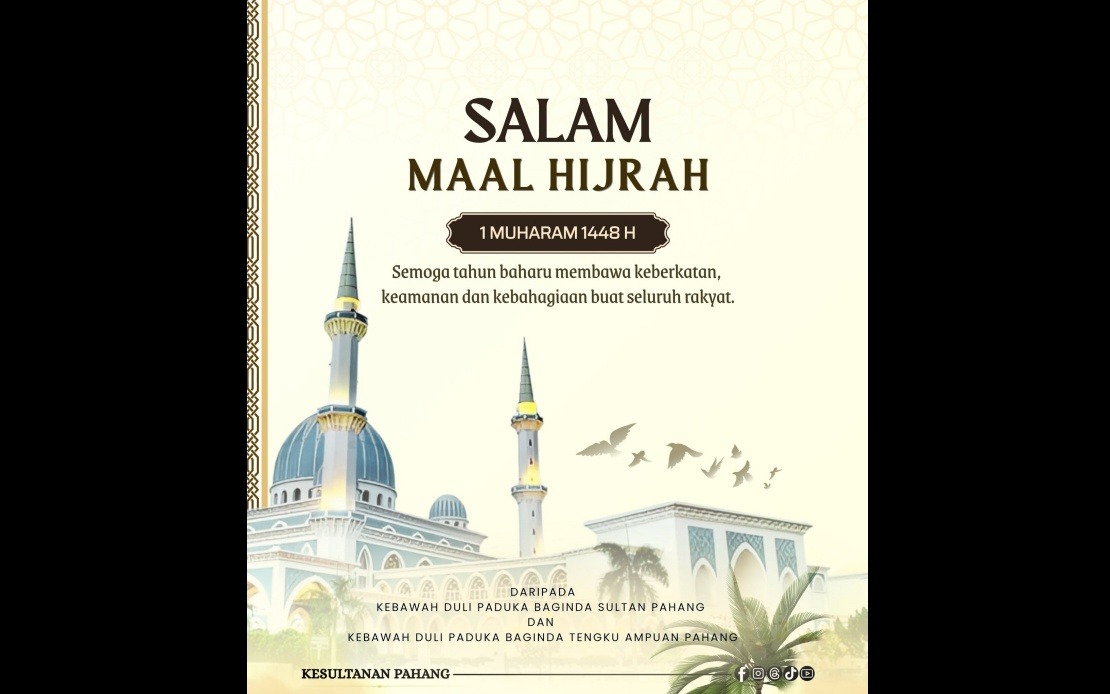
The Sultan of Pahang, Al-Sultan Abdullah Ri'ayatuddin Al-Mustafa Billah Shah, and the Tengku Ampuan of Pahang, Tunku Azizah Aminah Maimunah Iskandariah, have shared their Maal Hijrah 1448H wishes with the Muslim population across the state. Through an official announcement on the Kesultanan Pahang's social media platform, the royal couple conveyed their hopes that the commencement of the Islamic new year would usher in a period marked by divine blessings, tranquillity and widespread contentment among all residents of Pahang.
Maal Hijrah, observed annually on 1 Muharram in the Islamic calendar, commemorates Prophet Muhammad's migration from Mecca to Medina—a pivotal moment that fundamentally shaped the early Islamic community. For Muslims worldwide, including those in Malaysia, the occasion presents a meaningful opportunity for spiritual reflection and personal renewal. The timing of this year's observance in mid-June underscores the multicultural nature of Malaysia's public observances, where Islamic celebrations are acknowledged across the country's diverse population.
Beyond the symbolic well-wishes, Pahang Menteri Besar Datuk Seri Wan Rosdy Wan Ismail elaborated on the deeper spiritual and civic significance of the occasion in his own message. The state administrator characterised Maal Hijrah as a threshold moment—a time when the faithful are particularly encouraged to reassess their personal commitments and strengthen their relationship with Islamic principles. This framing connects individual spiritual growth with broader communal aspirations, suggesting that personal renewal can contribute to the strengthening of society as a whole.
The Menteri Besar's message specifically highlighted the importance of intensifying charitable activities during the new Islamic year. In Islamic tradition, Muharram carries particular spiritual weight, and Wan Rosdy's emphasis on increasing acts of benevolence reflects a conscious effort to channel this spiritual momentum towards tangible social good. For a state like Pahang, where economic disparities and rural development remain ongoing priorities, encouraging heightened charitable engagement can complement government efforts to address social needs and strengthen community bonds across different segments of the population.
A central theme running through the leadership's messages is the concept of drawing inspiration from the Prophet's own example of positive change. The Menteri Besar explicitly invoked the spirit of Hijrah as a call for purposeful transformation—not merely introspection, but concrete action directed towards self-improvement and collective advancement. This interpretation positions Maal Hijrah beyond its historical and religious dimensions as a catalyst for contemporary social progress, relevant to Pahang's developmental objectives and the aspirations of its diverse citizenry.
The emphasis on strengthening unity holds particular resonance in Malaysia's current context. As a nation navigating complex social, economic and political dynamics, messages promoting cohesion and shared purpose from state-level leadership carry weight beyond their immediate religious context. Pahang, as one of Malaysia's larger states with significant rural areas and growing urban centres, faces the perennial challenge of fostering inclusive development that benefits all communities. Leadership statements that underscore values of integrity and collective commitment contribute to the broader national conversation about building a more cohesive society.
The call to enhance commitment to state development merges spiritual observation with pragmatic governance concerns. By framing contributions to Pahang's progress as an extension of Islamic values, Wan Rosdy attempts to forge a connection between religious obligation and civic responsibility. This approach recognises that for many Pahang residents, their faith and their identity as state citizens are deeply intertwined, and that appeals to both dimensions simultaneously can be more mobilising than sectional messaging.
The religious leadership's invocation of divine mercy and protection speaks to a broader pattern of seeking spiritual guidance during periods of uncertainty or transition. Whether reflecting current economic challenges, health concerns stemming from the pandemic era, or structural changes reshaping Malaysian society, such appeals acknowledge the role of faith in helping communities navigate difficult circumstances. For Pahang, a state with significant agricultural and traditional sectors alongside growing manufacturing and service industries, such messages may resonate particularly strongly among populations experiencing rapid social change.
The timing and mode of these Maal Hijrah messages—through official social media channels—reflect the modernisation of how Malaysia's traditional institutions communicate with the public. Rather than relying solely on formal ceremonies or print media, the palace and state administration now leverage digital platforms to reach broader audiences instantaneously. This approach democratises access to official messages and demonstrates awareness among leadership of contemporary communication patterns, particularly among younger demographics increasingly consuming news and official communications through online channels.
For Malaysian Muslims generally and Pahang residents specifically, such state-level affirmations of Islamic observance serve multiple functions. They provide official recognition of an important religious occasion, offer a framework for understanding its relevance to contemporary life, and reinforce the role of Islamic values in the nation's governance and identity. The messages also signal continuity—that despite ongoing changes in Malaysian society and politics, observance of Islamic traditions remains central to state institutions and leadership.
Looking forward, the emphasis on renewed resolutions and strengthened commitment embedded in these greetings sets a tone for the coming Islamic year. Whether such exhortations translate into measurable changes in charitable giving, community engagement, or personal religious practice remains to be seen. Nevertheless, the consistent messaging from both the palace and state administration suggests a coordinated effort to frame Maal Hijrah not merely as a historical commemoration, but as a dynamic occasion with ongoing relevance to Pahang's development, social cohesion and the spiritual wellbeing of its Muslim population.