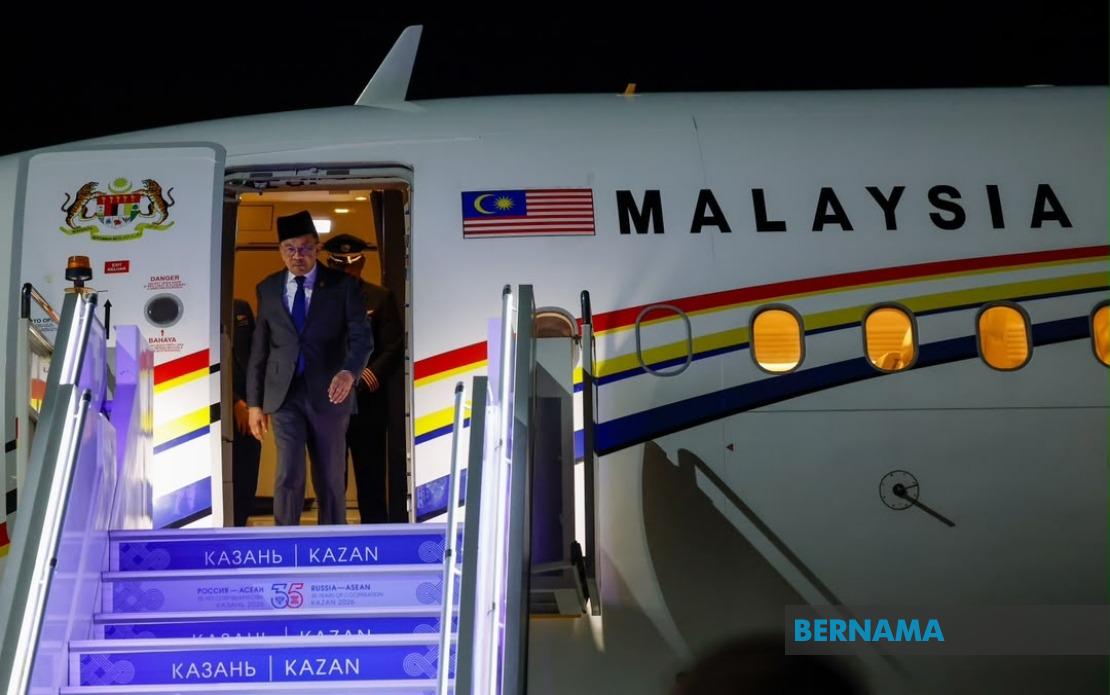
Prime Minister Datuk Seri Anwar Ibrahim touched down in Kazan on Monday evening to participate in a two-day ASEAN-Russia Commemorative Summit, underscoring Malaysia's deepening engagement with Moscow during a period of significant geopolitical shifts. The Malaysian delegation arrived at Kazan International Airport at 10.20 pm local time, with Anwar accompanied by several senior cabinet ministers including Minister of Investment, Trade and Industry Datuk Seri Johari Abdul Ghani and Minister of Economy Akmal Nasrullah Mohd Nasir, along with representatives from the Prime Minister's Office and the Foreign Ministry. The high-level delegation composition signals the strategic importance Kuala Lumpur places on this engagement with Russia and its wider ASEAN partners.
The summit itself marks a significant milestone in the diplomatic calendar, commemorating three-and-a-half decades since ASEAN and Russia established formal relations in Kuala Lumpur in 1991. This gathering represents a moment for both sides to evaluate the trajectory of their partnership while laying groundwork for future collaboration. The occasion carries particular weight given the current international environment, where traditional alliances are being reassessed and regional powers are seeking to diversify their diplomatic and economic partnerships. For Southeast Asia, engagement with Russia offers an alternative perspective on global affairs and an avenue for addressing shared concerns ranging from energy security to trade dynamics.
The scope of discussions at the summit extends across multiple dimensions of bilateral and regional cooperation. Trade and investment remain central topics, with both ASEAN and Russia seeking to expand commercial ties despite various international pressures. Energy cooperation ranks prominently on the agenda, reflecting ASEAN's substantial energy demands and Russia's significant role as a global supplier. Food security—a critical concern for the region given population growth and climate vulnerabilities—is also expected to feature prominently in deliberations. Additionally, the agenda encompasses digital economy advancement, scientific and technological collaboration, cultural exchanges, educational partnerships, and people-to-people engagement, suggesting a comprehensive approach to strengthening ties across multiple sectors.
The summit is anticipated to produce four substantive outcome documents that will shape cooperation frameworks for the coming years. The Kazan Declaration on the 35th Anniversary of ASEAN-Russia Relations will serve as a political statement affirming both sides' commitment to the partnership. Complementing this will be a Joint Statement on Energy Cooperation and another on Cultural Cooperation, reflecting the breadth of engagement. Most significantly, the Comprehensive Plan of Action to Implement the ASEAN-Russia Strategic Partnership 2026-2030 will provide a detailed roadmap for practical initiatives across priority areas. These documents collectively aim to create a more resilient, forward-looking partnership equipped to address emerging challenges in an increasingly complex international landscape.
For Malaysia specifically, participation in this summit reflects a deliberate strategy to strengthen ASEAN's external relations and maintain its centrality in regional affairs. In an environment where external powers compete for influence across Southeast Asia, Malaysia's active engagement with Russia demonstrates the country's commitment to balancing diverse relationships rather than aligning exclusively with any single bloc. This approach aligns with ASEAN's founding principle of strategic autonomy and non-alignment, allowing the region to benefit from partnerships with multiple dialogue partners while maintaining collective cohesion. Such positioning becomes increasingly valuable as global competition intensifies over spheres of influence in Asia-Pacific.
During his stay in Kazan, Anwar is scheduled to engage with Russian President Vladimir Putin, signalling the diplomatic importance attached to bilateral relations between Malaysia and Russia. These high-level discussions will likely touch upon areas of mutual interest including trade expansion, investment opportunities, agricultural cooperation, educational exchanges, aerospace collaboration, and energy partnerships. Beyond bilateral meetings, the Prime Minister will also convene with ASEAN counterparts to address issues of mutual concern, potentially ranging from regional security matters to economic resilience strategies. Such multilateral engagement at summits provides invaluable opportunities for consensus-building on regional priorities and coordinating positions on global issues.
This trip to Kazan constitutes Anwar's third visit to Russia since he assumed the office of Prime Minister in November 2022, demonstrating consistent prioritisation of Russian engagement at the highest levels. His inaugural Russian visit in September 2024 focused on economic forum participation in Vladivostok, providing a platform for outlining Malaysia's development vision to Russian business and political circles. This was followed by an official visit to Moscow in May 2025, where substantive discussions with Putin covered an impressive range of cooperation areas including commerce, agriculture, aerospace, and energy. The pattern of these visits illustrates Malaysia's systematic approach to deepening the Russia relationship beyond ceremonial exchanges toward substantive partnership development.
Among Anwar's priority areas for the summit are advocacy for dialogue and peaceful resolution of conflicts, reflecting Malaysia's traditional role as a voice for moderation and diplomacy in regional and global forums. Supporting economic resilience has taken heightened urgency given ongoing economic uncertainties affecting developing nations, with regional cooperation mechanisms offering potential solutions for mutual prosperity. Energy and food security advancement addresses fundamental challenges facing Southeast Asia, where rapid development and population growth create escalating demand pressures. Deepening people-to-people links through educational, cultural, and tourism initiatives helps build societal foundations for long-term partnerships that transcend government cycles and political changes.
The timing of this summit carries additional significance given the evolving dynamics of Southeast Asian foreign relations. As major powers intensify their strategic competition across the Indo-Pacific region, ASEAN nations are increasingly conscious of the need to manage multiple partnerships without becoming entangled in zero-sum rivalries. Russia's engagement with the region, while subject to various international constraints, offers ASEAN room for manoeuvre and provides a counterweight to other external influences. Malaysia's participation and leadership in advancing ASEAN-Russia cooperation thus serves both immediate partnership goals and the longer-term objective of maintaining Southeast Asian autonomy in navigating great power competition.
The Foreign Ministry statement characterising Malaysia's participation as demonstrating commitment to ASEAN Centrality reflects official understanding that the region's interests are best served through unified positioning and diversified partnerships. By hosting and actively engaging with Russia through ASEAN frameworks, Southeast Asia reinforces its role as a consequential regional actor rather than a passive recipient of external policies. This approach requires careful diplomacy, particularly given broader geopolitical tensions, but remains essential for preserving the region's agency and strategic flexibility. The various cooperation domains outlined in the summit agenda—spanning economics, energy, science, culture, and education—provide multiple channels through which partnership can deepen regardless of broader political circumstances.