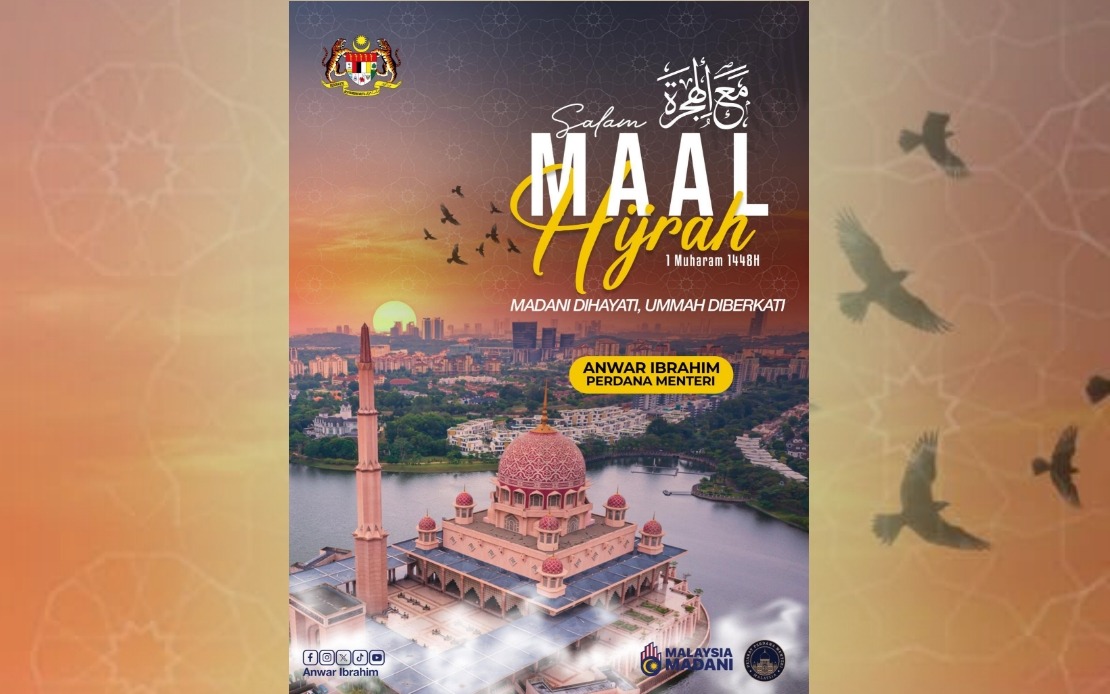
Prime Minister Datuk Seri Anwar Ibrahim has framed Malaysia's ongoing transformation as an extension of the Islamic principle of Hijrah, arguing that meaningful change requires the active cooperation of diverse communities across the nation working toward shared goals. In remarks commemorating Maal Hijrah 1448H, the Prime Minister drew parallels between the Prophet Muhammad SAW's migration to Madinah and contemporary efforts to reshape Malaysian institutions around pillars of justice, accountability, prosperity and security. This reframing positions the government's reform narrative within a religious and historical context that carries significant resonance for Muslim-majority Malaysia, whilst simultaneously emphasizing the inclusive nature of the undertaking.
The historical parallel Anwar invoked carries substantial weight in Islamic tradition and Malaysian political discourse. The Hijrah, which marks the Prophet's departure from Mecca and the establishment of the first Islamic state in Madinah, represents far more than a physical migration in Islamic thought. It symbolizes a fundamental break with corruption and injustice, the creation of a social contract based on shared values, and the foundation of a civilization that functioned according to principles of equity and mutual accountability. By invoking this precedent, Anwar positioned Malaysia's reform journey as one that transcends narrow political interests and aligns with deeper spiritual and civilizational imperatives, thereby lending moral weight to the government's policy agenda.
What distinguishes Anwar's articulation is his explicit rejection of top-down or unilateral approaches to reform. The Prime Minister stressed that historical success during the Hijrah era depended not on the actions of a single leader, but on the coordinated efforts of diverse groups within the early Muslim community. He specifically highlighted the contributions of youth figures such as Saidina Ali Abi Talib, women including Asma Abu Bakar, and numerous other companions whose organizational efforts and personal sacrifices proved indispensable to the success of the enterprise. This historical reference carries contemporary implications for Malaysia, subtly underscoring the need for intergenerational participation, the active role of women in transformation, and recognition of contributions from across civil society rather than concentration of credit among political elites.
The Prime Minister's emphasis on consensus reflects awareness of Malaysia's complex religious, ethnic and political landscape. Unlike nations with greater homogeneity, Malaysian reforms must navigate the concerns and interests of multiple communities, including religious minorities, indigenous populations, and secular constituencies alongside Muslim-majority segments. By anchoring the reform agenda in a universally recognized Islamic principle whilst simultaneously insisting on the necessity of broad-based agreement, Anwar attempted to create intellectual and moral space for inclusive policymaking. The requirement for consensus effectively becomes a structural brake against majoritarian overreach, even as it invokes Islamic authority.
Critically, Anwar distanced the reform project from what he characterized as empty rhetoric and symbolic gestures. He explicitly stated that success will not emerge through slogans or individual heroic effort, but only through sustained collective work marked by patience and mutual commitment. This formulation potentially addresses criticism from reform advocates who argue that the government has announced ambitious agendas without delivering proportionate institutional change. By defining success as gradual, collective achievement rather than rapid transformation driven by executive fiat, the Prime Minister may be establishing more realistic expectations whilst simultaneously suggesting that accountability for progress belongs not to government alone but to society at large.
The government's choice of theme for the 2026 National Maal Hijrah Celebration—"MADANI Dihayati, Ummah Diberkati" (MADANI Embraced, The Ummah Blessed)—further illustrates the intentional linking of the Hijrah concept to the government's policy framework. MADANI, which stands for Malaysia Agreement for Dignity and Prosperity, represents the government's overarching reform philosophy. By explicitly connecting this framework to the Hijrah narrative and the establishment of Madinah as a just state, the government positions its development agenda as an extension of Islamic historical precedent. This rhetorical strategy serves multiple functions: it provides religious legitimacy for secular policy reforms, it frames economic and institutional development as spiritual endeavor, and it positions Malaysia within a broader Islamic civilizational narrative.
For Malaysian policymakers and observers, Anwar's framing raises important questions about implementation. The invocation of consensus and unity, whilst rhetorically powerful, confronts practical challenges in a plural democracy where fundamental disagreements persist regarding governance approaches, religious authority, and resource distribution. The gap between aspirational rhetoric centered on collective effort and the actual mechanics of legislative compromise and institutional reform remains substantial. Anwar's message implicitly acknowledges this tension by emphasizing patience as a prerequisite for success, recognizing that transforming entrenched systems according to principles of equity and accountability requires sustained commitment beyond electoral cycles.
Regionally, Anwar's positioning of Malaysian reform within the Hijrah framework carries implications for how Malaysia presents itself within Southeast Asia and the broader Muslim world. By emphasizing that transformation rooted in Islamic principles need not be exclusionary or majoritarian, but rather depends upon cooperation with diverse constituencies, Malaysia offers a model potentially relevant to other Muslim-majority or multi-religious societies undertaking institutional reform. This approach contrasts with reform narratives that mobilize religious sentiment to entrench particular group interests, instead using religious tradition to argue for inclusivity and accountability.
The theological dimension of Anwar's remarks, particularly his reference to verse 100 of Surah An-Nisa regarding divine reward for those who migrate in God's path, introduces a spiritual dimension to the practical work of governance and reform. By characterizing Hijrah as embodying sacrifice, struggle, brotherhood and unity-building, Anwar redefines the vocabulary of political transformation. No longer is reform primarily a matter of technical policy adjustment or power rearrangement; rather, it becomes a spiritual practice through which citizens fulfill religious obligations whilst simultaneously rebuilding their society. This framing potentially mobilizes different sources of motivation and commitment than purely secular appeals to economic efficiency or institutional effectiveness, tapping into deeper wells of meaning and purpose that resonate across Malaysia's Muslim population whilst maintaining space for secular and pluralist concerns.