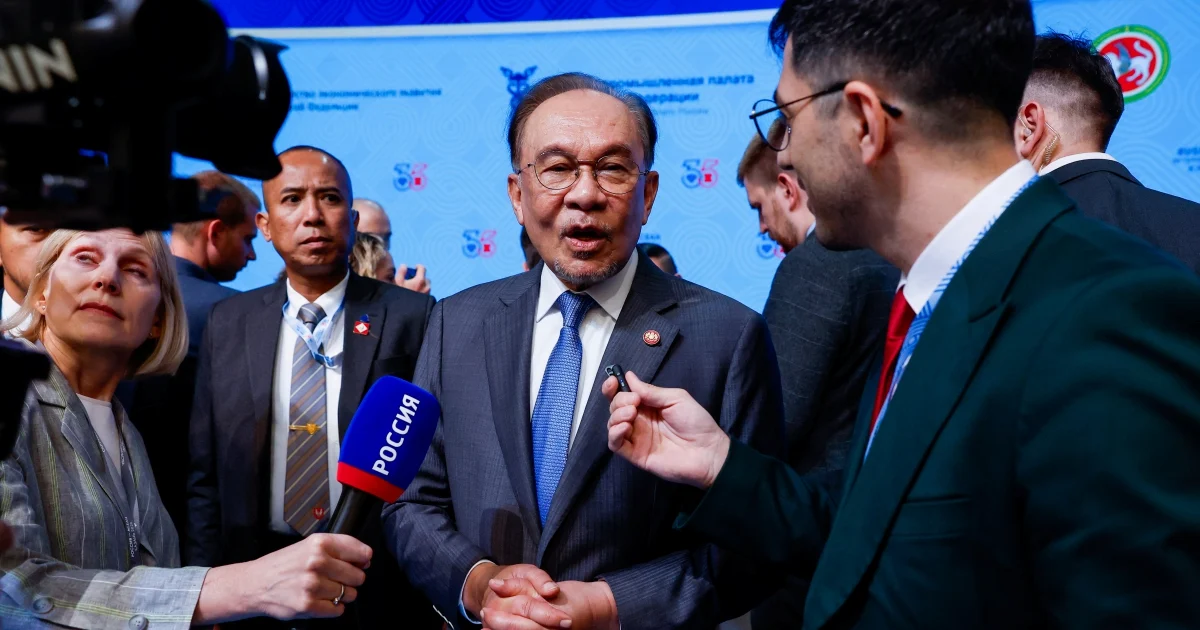
Prime Minister Datuk Seri Anwar Ibrahim has articulated a personal appreciation for Russian musical traditions and literary works, underscoring the significance of cultural diplomacy in contemporary international relations. Speaking in Kazan, Malaysia's leader positioned artistic and intellectual exchange as equally consequential to trade and investment frameworks in fortifying connections between nations. The remarks reflect a broader diplomatic philosophy that transcends purely transactional economic engagement, recognizing that sustained international partnerships rest upon deeper cultural foundations and mutual understanding.
Anwar's comments arrive at a moment when Malaysia seeks to diversify its diplomatic relationships and deepen engagement with major global powers. Russia remains an important strategic partner for Southeast Asia, particularly in energy security and geopolitical balancing. By highlighting his personal resonance with Russian cultural production, the Prime Minister signals Malaysia's commitment to a multifaceted relationship that encompasses more than commerce and political negotiation. This cultural dimension proves especially relevant given Malaysia's own rich artistic heritage and its positioning as a cultural bridge within Southeast Asia.
The emphasis on cultural exchange reflects international best practices in statecraft, wherein governments increasingly recognize that soft power and cultural diplomacy yield substantial diplomatic dividends. When leaders articulate genuine appreciation for another nation's contributions to world culture, they simultaneously validate the people and society behind those achievements. For Malaysian audiences, Anwar's remarks demonstrate a worldview that values intellectual curiosity and cross-cultural appreciation as legitimate expressions of national interest, not merely ornamental gestures.
Russian literature occupies a distinctive place in global intellectual history, with towering figures such as Dostoevsky, Tolstoy, and Chekhov shaping philosophical and artistic discourse across centuries. The country's musical tradition similarly commands worldwide admiration, from classical composers to contemporary artists. Anwar's invocation of these cultural achievements suggests an engagement with Russia's broader contributions to human civilization, positioning the relationship within a framework of shared values and mutual respect for intellectual achievement.
For Malaysia, cultivating cultural ties with Russia assumes particular importance given the nation's strategic location and role as a champion of South-South cooperation. As Southeast Asian nations navigate complex geopolitical landscapes, cultural partnerships provide alternative channels for relationship-building that carry less political baggage than conventional diplomatic channels. Anwar's willingness to publicly acknowledge his personal enjoyment of Russian artistic traditions normalizes cultural engagement as a legitimate component of statecraft, encouraging similar initiatives across government and civil society.
The Prime Minister's comments also carry significance for Malaysia's domestic cultural policy and international cultural positioning. By highlighting his engagement with non-Western cultural traditions at the highest political level, Anwar reinforces the legitimacy of intellectual and artistic pursuits in national discourse. This proves particularly valuable in societies where economic considerations sometimes overshadow cultural investments. His remarks implicitly argue that a nation's soft power derives not merely from its commercial strength or military capabilities but from its cultural contributions and the respect its heritage commands internationally.
Bilateral relations between Malaysia and Russia encompass numerous domains beyond culture, including energy cooperation, defence partnerships, and trade. However, the most durable and meaningful partnerships typically rest upon foundations of mutual understanding and genuine appreciation between peoples and leaders. By articulating his personal connection to Russian culture, Anwar contributes to building such foundations, demonstrating that Malaysia approaches the relationship as a civilizational engagement rather than a purely pragmatic transaction.
For Southeast Asian observers, Anwar's positioning of cultural exchange alongside economic cooperation models an approach that might strengthen regional cohesion as well. At a time when ASEAN members grapple with internal tensions and external pressures, emphasizing shared cultural values and cross-border artistic appreciation could reinforce community identity and solidarity. The Prime Minister's remarks suggest that Malaysia views cultural diplomacy as a sophisticated instrument for achieving strategic objectives while maintaining the authentic human connections that distinguish enduring partnerships from transactional arrangements.
The statement also reflects Malaysia's complicated relationship with Western-centric narratives that often marginalise non-Western intellectual and artistic traditions. By celebrating Russian contributions to global culture, Anwar acknowledges civilizational achievements that fall outside the Western canon, supporting a more pluralistic vision of human cultural production. This approach resonates with Malaysia's historical position as a nation bridging Islamic, Asian, and global intellectual traditions, capable of drawing inspiration and wisdom from multiple civilizational sources.
Moving forward, such cultural diplomacy initiatives warrant expansion across Malaysia's foreign policy apparatus. Educational exchanges, literary festivals, and collaborative artistic projects could operationalize the philosophy articulated by Anwar, transforming abstract appreciation into concrete institutional relationships. These mechanisms would provide Malaysian and Russian citizens with opportunities for direct engagement, fostering people-to-people connections that ultimately prove more resilient and meaningful than government-to-government relations alone.