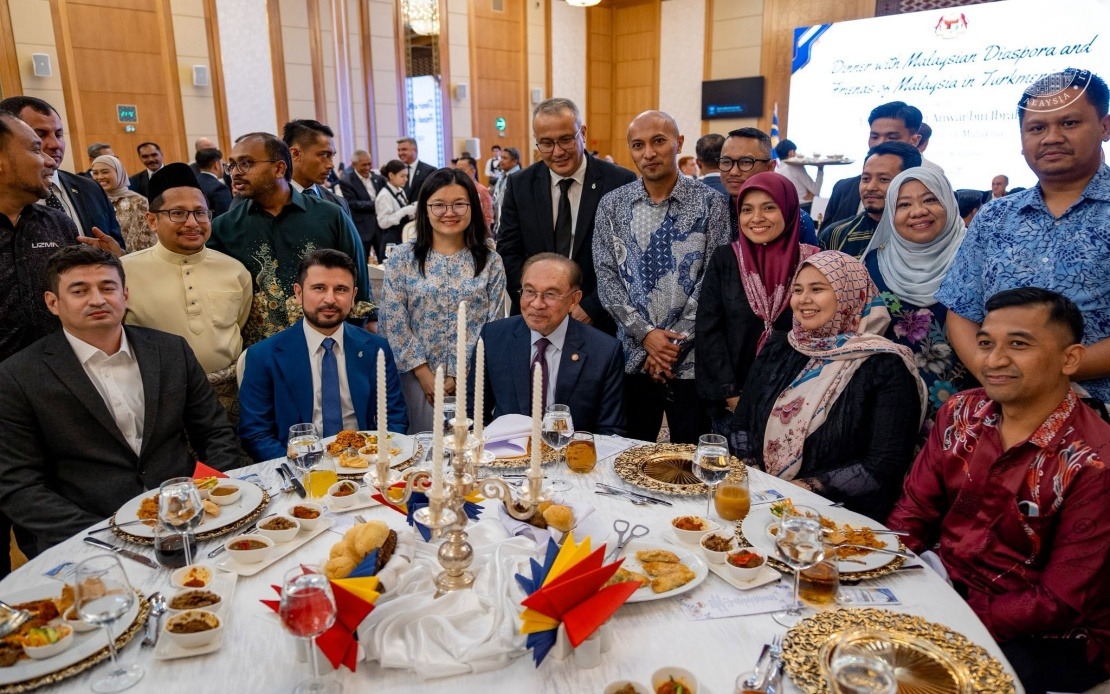
Prime Minister Datuk Seri Anwar Ibrahim used his official visit to Turkmenistan to engage directly with the Malaysian community in Ashgabat, underscoring the MADANI Government's broader strategy of maintaining substantive connections with citizens living and working overseas. The encounter provided an opportunity for the Prime Minister to reinforce government messaging about national priorities and to acknowledge the role played by Malaysians abroad in shaping the country's international standing. This engagement reflects a deliberate diplomatic approach that treats the diaspora not merely as distant constituents but as active participants in Malaysia's global positioning.
During the meeting, Anwar articulated a central theme of his administration's outreach efforts: the importance of maintaining emotional and informational bonds between overseas Malaysians and their homeland. He encouraged members of the diaspora community to remain updated on the nation's development trajectory and to sustain their psychological and cultural connection to Malaysia despite geographic distance. This messaging resonates with broader Southeast Asian patterns, where governments increasingly recognise that diaspora communities represent significant economic, cultural, and diplomatic assets. The government's explicit framing of these connections as mutually beneficial rather than one-directional reflects contemporary thinking about diaspora engagement in the region.
Anwar characterised Malaysians abroad as unofficial ambassadors tasked with advancing the nation's reputation and interests through their personal and professional networks. This conceptualisation elevates diaspora engagement beyond ceremonial interaction to a strategic framework where expatriate Malaysians become vectors for soft power projection. By acknowledging their conscious efforts to enhance Malaysia's image and expand international networks, the Prime Minister positioned diaspora members as integral to the country's long-term development and diplomatic objectives. For many Southeast Asian nations, this recognition of diaspora agency represents an evolution in how governments approach citizens living overseas.
The Ashgabat gathering took place within the context of Anwar's first official visit to Turkmenistan, a nation with which Malaysia seeks to deepen bilateral relations. This timing demonstrates how diaspora engagement has been integrated into broader foreign policy operations, with community meetings forming part of a comprehensive diplomatic visit rather than serving as separate engagements. The inclusion of diaspora interaction alongside official government talks suggests a holistic approach to bilateral relations that acknowledges multiple channels of people-to-people connection alongside formal state-to-state negotiations.
Anwar provided context for the Turkmenistan visit by emphasising that Malaysian interests in the Central Asian nation extend well beyond narrowly defined commercial considerations. While trade, investment, and economic cooperation remain important pillars of the bilateral relationship, the Prime Minister identified friendship expansion, enhanced mutual understanding, and identification of emerging cooperation areas as equally significant objectives. This framing acknowledges that Malaysia's engagement with Central Asia reflects its broader regional and global positioning strategy, particularly as Southeast Asian nations seek to diversify their international partnerships and reduce dependence on traditional Western and Asian powers.
The visit itself represented a reciprocal diplomatic gesture following Turkmenistan President Serdar Berdimuhamedov's official visit to Malaysia in December 2024. This pattern of high-level visits between the two nations signals a deliberate effort to elevate bilateral relations from historical minimalism to meaningful engagement. For Malaysia, expanding connections with Central Asian states serves multiple strategic purposes: it diversifies the country's international network, provides access to emerging markets and investment opportunities, and strengthens Malaysia's positioning within broader regional architecture discussions. The inclusion of diaspora engagement in this diplomatic sequence demonstrates how governments now weave together multiple relationship-building mechanisms.
The two-day official visit to Ashgabat, Turkmenistan's capital, allowed Anwar to conduct substantive bilateral discussions with his Turkmen counterpart while simultaneously maintaining and activating connections with Malaysian expatriates. This dual-track engagement reflects modern diplomatic practice, where visits to foreign countries increasingly incorporate multiple stakeholder interactions rather than limiting engagement to official government structures. The Malaysian community in Ashgabat, though geographically distant and potentially small in absolute numbers, received direct attention from the nation's highest political office, a gesture that carries symbolic weight beyond its immediate practical implications.
The diaspora's reported warmth and enthusiasm, as captured in Anwar's social media account, underscores the emotional dimensions of diaspora engagement that governments increasingly recognise and cultivate. The Prime Minister's observation that the gathering felt like a Kuala Lumpur assembly despite the Central Asian setting illustrates how diaspora communities maintain strong affective connections to their homeland even after extended overseas residence. This emotional architecture, carefully nurtured through official recognition and engagement, strengthens the diaspora's willingness to advocate for Malaysia within their host societies and contributes to sustained identification with national interests and values.
For Malaysian readers and policymakers, Anwar's approach to diaspora engagement reflects a recognition that globalised economic and professional mobility means that millions of Malaysian citizens and former citizens operate across international borders. Rather than viewing this mobility as a loss or drain, the government increasingly frames diaspora communities as extensions of Malaysia's influence and presence worldwide. This reframing has implications for how Malaysia positions itself in competitive regional contexts, particularly in attracting talent and maintaining influence in emerging markets and diplomatic forums across Asia, the Middle East, and beyond.
The emphasis on keeping diaspora members informed about national development initiatives also suggests that the government views overseas Malaysians as potential investors, business partners, and sources of expertise who might contribute to domestic projects. By maintaining communication channels and fostering a sense of continued belonging, the government cultivates conditions under which diaspora members might redirect their resources, skills, and networks toward Malaysian development objectives. This represents a pragmatic recognition of how globalised capitalism and professional mobility create opportunities for nations to mobilise geographically dispersed populations as economic and social assets.
Looking forward, Anwar's engagement with the Ashgabat diaspora community likely signals an intensified effort by the MADANI Government to systematise and expand diaspora engagement across multiple geographic locations. Southeast Asian governments increasingly recognise that structured diaspora programmes yield returns through remittances, investment, knowledge transfer, and diplomatic support. Malaysia's approach, particularly as it develops deeper relationships with Central Asian and Middle Eastern nations where significant Malaysian communities reside, positions the country to compete effectively for diaspora engagement against regional rivals and to leverage these communities for broader foreign policy objectives.
The confluence of Anwar's visit to Turkmenistan and his intentional engagement with Malaysian expatriates demonstrates an integrated diplomatic strategy that recognises no meaningful separation between bilateral state relations and diaspora outreach. By treating diaspora communities as valued partners in Malaysia's international endeavours rather than as peripheral populations, the government signals a sophisticated understanding of contemporary global dynamics. For Malaysia and other Southeast Asian nations navigating an increasingly multipolar world, such diaspora-inclusive diplomacy may prove essential to sustaining influence and advancing national interests across diverse regional and global contexts.