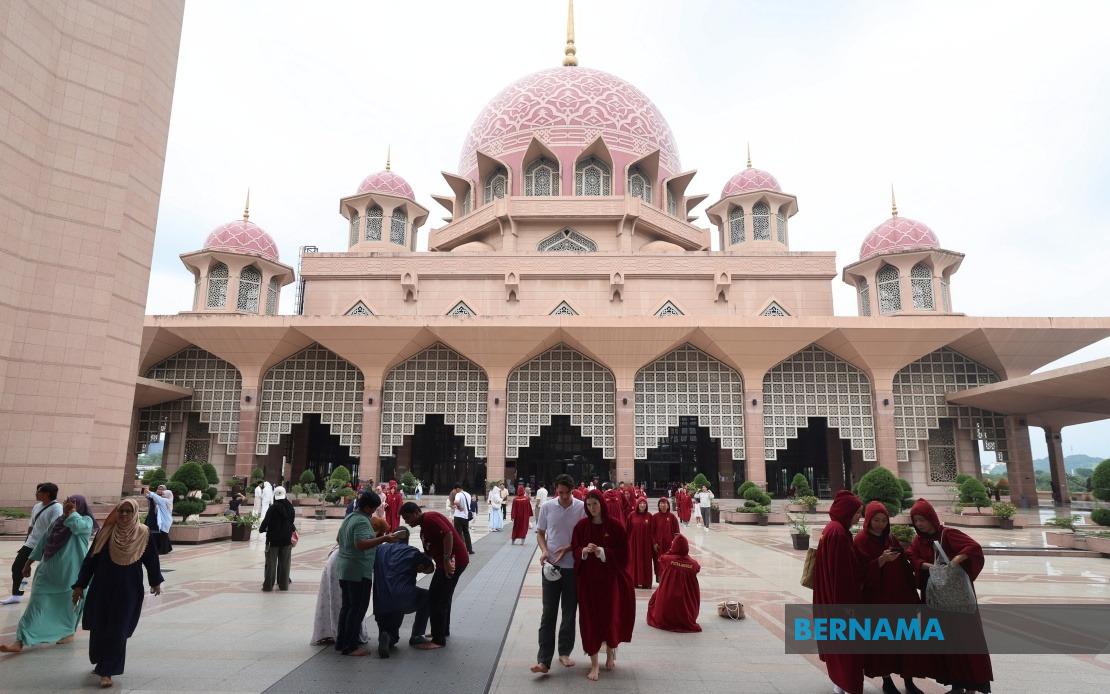
Putrajaya's Putra Mosque is set to accommodate roughly 5,000 attendees for the National Maal Hijrah 1448H/2026M celebration this morning, marking a significant gathering that blends religious observance with governmental ceremony. The occasion will be graced by Sultan of Perak Sultan Nazrin Shah, who serves as the principal officiator, underscoring the formal and ceremonial importance assigned to this Islamic calendar event across Malaysia's corridors of power.
The guest list reflects the breadth of Malaysia's leadership structure and international diplomatic presence. Alongside the Sultan, both Deputy Prime Ministers Datuk Seri Ahmad Zahid Hamidi and Datuk Seri Fadillah Yusof will attend, accompanied by Cabinet ministers, foreign representatives, departmental heads, and senior bureaucrats. This composition demonstrates how Maal Hijrah, the Islamic New Year commemorating the Prophet Muhammad's migration to Medina, transcends purely religious significance to become a national observance integrating political, cultural, and diplomatic dimensions within Malaysian governance.
The ceremonial centrepiece will feature the Sultan's address to assembled guests, positioning the royal perspective as central to the celebration's messaging and tone. Following this keynote intervention, the National and International Tokoh Maal Hijrah Awards will be presented, recognising individuals whose achievements span multiple dimensions of Islamic thought and practice. These accolades target figures demonstrating exceptional scholarly depth within their fields, exemplary moral standing in both public and private conduct, and demonstrable advancement of Islamic civilisation across both domestic and transnational contexts. The dual designation—national and international—reflects Malaysia's positioning as a bridge between Muslim-majority Southeast Asia and the broader global Islamic community.
The Department of Islamic Development Malaysia, known as JAKIM, curated this year's thematic direction to reconnect modern Muslim consciousness with the spiritual essence of Hijrah itself. Rather than treating the historical migration as a distant historical episode, the institutional framing encourages contemporary Muslims to internalise Hijrah's transformative potential as applicable to contemporary circumstances. This interpretive approach recontextualises a seventh-century event as a philosophical template for navigating twenty-first-century challenges, from personal spiritual development to community-level institutional reform.
Covering the period immediately preceding the main celebration, organisers introduced the Tausiyyah @ Maal Hijrah programme at Putra Mosque yesterday, signalling an expanded scope beyond ceremonial formalities. This preliminary session concentrated on tadabbur—a Quranic hermeneutical practice involving deep contemplative engagement with scriptural passages rather than superficial reading. Distinguished qari, professional Quranic reciters trained in classical melodic and phonetic traditions, delivered portions of the holy text, but the programme's pedagogical thrust extended beyond aesthetic appreciation of recitation quality. Participants received structured guidance in extracting wisdom, extracting practical guidance, and identifying contemporary applications of Quranic teachings within quotidian existence. This educational component transforms the celebration from passive ceremonial attendance into active interpretive engagement with Islamic sources.
The programmatic architecture extends beyond the main celebration date through a secondary lecture series. Tomorrow, the National and International Tokoh Maal Hijrah Lecture 1448H/2026 will convene at the Putrajaya Islamic Complex Auditorium beginning at 9 am, providing a platform where award recipients share intellectual contributions and experiential insights with broader audiences. This continuation strategy acknowledges that honour and recognition carry obligations toward knowledge dissemination, transforming individual achievement into collective enlightenment.
For Malaysian observers, Maal Hijrah celebrations hold particular resonance as a predominantly Muslim-majority nation's official marking of the Islamic calendar, even as Malaysia's constitutional framework maintains secular governance structures. The participation of the highest political authorities—the Sultan and Deputy Prime Ministers—reflects this delicate equilibrium whereby Islam occupies constitutionally entrenched status within Malaysia's identity whilst remaining institutionally distinct from executive, legislative, and judicial functions. This public ceremonial engagement reinforces Islamic identity as central to national character without transgressing secular governance principles.
Regionally, such celebrations exemplify how Southeast Asian Muslim societies—Malaysia, Indonesia, Brunei—maintain distinct Islamic observances whilst navigating plural societies and competing modernities. The emphasis on award presentation, scholarly engagement, and international participation signals Malaysia's aspiration toward intellectual leadership within Southeast Asian and global Islamic discourse. By recognising both domestic and international figures advancing Islamic knowledge and practice, Malaysia positions itself as custodian of Islam's pluralistic intellectual traditions rather than sectarian narrowness.
The thematic emphasis on Hijrah as catalyst for positive change carries implicit resonances for contemporary Muslim contemplation of migration, displacement, and communal transformation. Whether intentional or incidental, the framing invites reflection on how Muslims navigate epochal challenges—from climate displacement to technological disruption to geopolitical upheaval—through spiritual and intellectual resources mobilised by Hijrah's paradigmatic example. This interpretive generosity permits the ancient historical event to speak across centuries and continents to varied Muslim experiences.