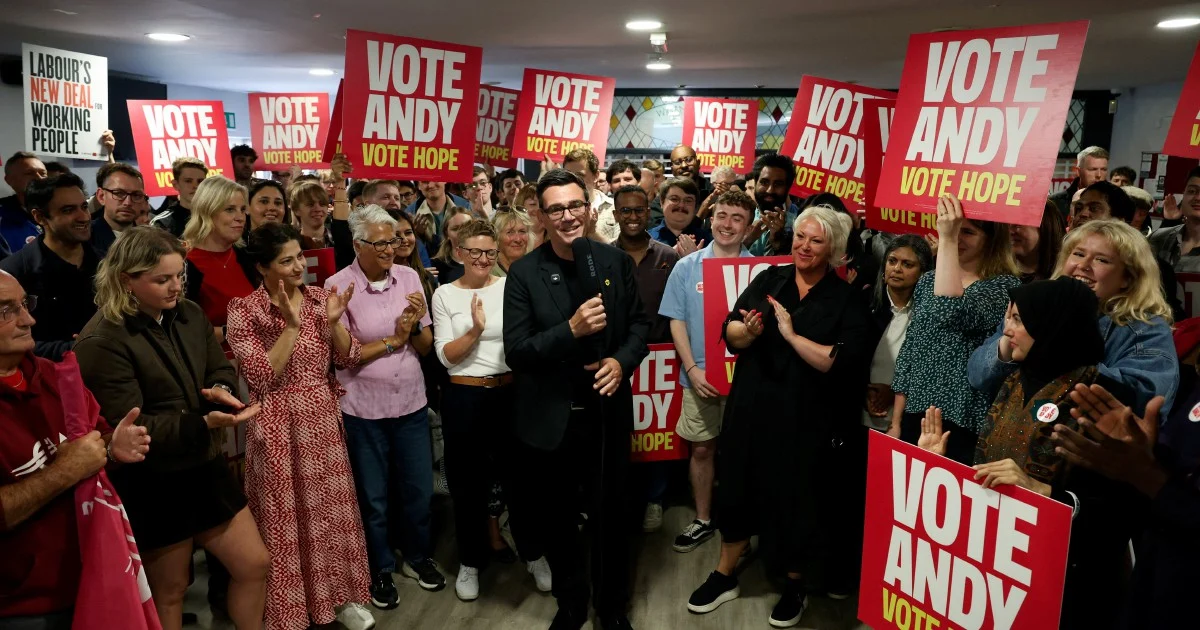
The mathematics of British electoral politics are working in Andy Burnham's favour as Thursday's general election approaches, though perhaps not in the way he might have hoped. The Labour MP's capacity to challenge Prime Minister Keir Starmer for the country's top job appears substantially strengthened by internal fractures within the populist right-wing movement, where rival factions are cannibalising each other's support rather than presenting a unified conservative alternative.
Burnham's securing of the Makerfield seat represents more than a personal triumph; it signals a broader pattern reshaping the British political landscape. The constituency, which he has represented since switching from Manchester politics, would provide the parliamentary foundation necessary for any serious leadership challenge to Starmer. Yet his improved prospects stem significantly from circumstances beyond his direct control. The splintering of right-wing populist movements into competing organisations has fundamentally altered the electoral dynamics that voters face across numerous constituencies.
This fragmentation matters enormously for understanding contemporary British politics. When conservative and right-leaning populist voters distribute their support across multiple parties rather than concentrating their votes behind a single standard-bearer, the vote share becomes scattered. In first-past-the-post electoral systems like Britain's, such division translates directly into lost parliamentary seats and diminished overall influence. The consequence benefits Labour candidates in marginal constituencies where the combined right-wing vote, had it been unified, might have threatened Labour's hold.
Burnham's political positioning has long reflected an ambition extending beyond his Manchester base. His previous runs for Labour leadership, though unsuccessful, established him as a significant figure within the party hierarchy with both grassroots appeal and establishment credibility. Now, with the right-wing opposition fragmenting, his path toward challenging Starmer appears less obstructed by parliamentary arithmetic. A strong showing in Makerfield, multiplied across dozens of similar constituencies nationwide where similar dynamics operate, creates the numerical foundation for credible internal challenge to the sitting prime minister.
The broader context involves the evolution of British right-wing politics over the past decade. The rise of populist movements, initially consolidated around figures and organisations that had moved beyond traditional Conservative Party frameworks, created both opportunities and vulnerabilities. When such movements subsequently fractured, those vulnerabilities became apparent. Different factions pursued distinct strategies, different leaders pursued competing visions, and the voter base that had once seemed monolithic now faced genuine choices between rival representatives of similar political impulses.
For Malaysian and Southeast Asian observers, these dynamics offer instructive parallels regarding how opposition fragmentation fundamentally alters government stability and succession planning. When ruling coalitions face weakened opposition due to internal divisions rather than superior popular mandate, questions about long-term legitimacy and democratic health inevitably surface. Burnham's strengthened position, ironically, depends not on winning ideological arguments but on his opponents failing to coordinate effectively.
The Makerfield result will carry particular significance given historical context. The constituency has traditionally reflected broader working-class sentiment and economic anxiety within the English regions. Burnham's labour roots and regional emphasis have consistently resonated there. However, his margin of victory and the performance of rival candidates will signal whether his ascendancy reflects genuine voter preference for his leadership qualities or merely benefits from structural divisions among his opponents.
This distinction matters for Burnham's longer-term viability as a challenger to Starmer. If his improved position stems primarily from right-wing fragmentation, subsequent consolidation of that fractured opposition could substantially alter his prospects. Conversely, if Makerfield voters actively choose Burnham and his political vision, demonstrating enthusiasm beyond mere opposition to others, such support would provide stronger ammunition for any leadership challenge he might later launch.
The Thursday election results will therefore illuminate not just Burnham's personal trajectory but the deeper structural realities of contemporary British politics. A Labour victory delivered partly through opposition disunity raises questions about the durability of that government's mandate and whether internal tensions might eventually surface as the political cycle progresses. For Burnham, the path toward challenging Starmer becomes clearer not because he has made a compelling case for alternative leadership, but because the competition for opposition status has become hopelessly crowded.
Starmer's government, conversely, benefits from this right-wing disarray. With working-class constituencies like Makerfield remaining solidly within Labour's electoral coalition, and with right-wing competitors dividing rather than conquering, the government's numerical position in parliament strengthens. Yet this advantage carries hidden costs. Governments elected without facing a unified, coherent alternative opposition sometimes struggle with internal discipline and long-term direction. Burnham's potential emergence as an internal challenger suggests that even substantial electoral victories can harbour subsequent instability if the prime minister fails to maintain party unity.
The ramifications extend beyond personal ambitions or party management. British electoral patterns increasingly reflect regional divergence, with different areas of the country responding to fundamentally different political appeals. Right-wing populist movements have previously exploited such divisions effectively. When those movements fracture, the map of political competition shifts dramatically. Understanding where and how such fractures occur becomes essential for predicting which candidates, like Burnham, find their prospects strengthened through circumstances somewhat beyond their control.