The Royal Malaysian Air Force marked its 68th anniversary by unveiling an ambitious expansion of its air defence infrastructure, with Chief of Air Force General Tan Sri Muhamad Norazlan Aris announcing the deployment of sophisticated radar systems across multiple strategic locations. The initiative represents a significant step forward in modernising the nation's airspace monitoring capabilities, addressing long-standing vulnerabilities that have concerned military planners for years. This modernisation drive comes at a particularly sensitive moment, as regional tensions continue to rise and maritime security challenges multiply across Southeast Asian waters.
The radar installations will be distributed across four geographically significant sites chosen for their strategic importance to national security. Bintulu in Sarawak will receive an air defence radar, while similar systems are being positioned at Bukit Puteri in Terengganu and Bukit Lunchu in Johor. These three terrestrial locations form part of a broader network designed to create overlapping coverage of Malaysian airspace. Additionally, an air surveillance radar is being established on Pulau Layang-Layang, located in the contested waters of the South China Sea, extending Malaysia's detection capabilities further into offshore regions and demonstrating the country's commitment to maintaining visibility over its maritime boundaries.
According to General Tan Sri Muhamad Norazlan Aris, these installations serve a critical function in the nation's defence architecture by enabling early warning detection and eliminating critical gaps in surveillance coverage. The air force chief emphasised that comprehensive airspace monitoring is essential for identifying potential threats before they pose immediate danger to populated areas or vital infrastructure. The radar network will allow the RMAF to maintain continuous situational awareness across the country's airspace, a capability that previous generations of air defenders could only dream of achieving. This enhanced detection capability addresses vulnerabilities that have become increasingly apparent as air traffic patterns have evolved and threats have become more sophisticated.
The radar projects form the cornerstone of phase one within the RMAF Capability Development Plan 2055, an ambitious long-term strategy that acknowledges the rapidly shifting nature of modern military challenges. Rather than pursuing ad hoc modernisation, the air force has opted for a comprehensive framework that anticipates technological advancement and evolving security threats across the next three decades. This forward-looking approach reflects a mature understanding that today's acquisitions must remain relevant and effective for years to come, requiring careful alignment with broader strategic objectives. The CAP55 framework positions the RMAF to evolve in tandem with technological progress while maintaining operational relevance against emerging threats.
General Tan Sri Muhamad Norazlan Aris drew explicit connections between Malaysia's investment in enhanced surveillance and the volatile security environment emerging in West Asia, where ongoing regional conflicts have demonstrated the catastrophic consequences of unpreparedness. The disruptions affecting the Strait of Hormuz have rippled far beyond the Middle East, creating supply chain vulnerabilities and market instability that extend into Malaysia's own economic sphere. For a trading nation that depends heavily on international commerce, such disruptions represent an indirect but significant threat to national prosperity and stability.
The air force chief highlighted how the instability affecting Middle Eastern sea lanes carries profound implications for Malaysian economic interests and regional security architecture. Disruptions to energy supplies and international commerce flowing through the Strait of Hormuz demonstrate how distant geopolitical crises can rapidly transform into local economic challenges. Malaysia's position as a maritime trading hub makes it particularly vulnerable to any disruption of the sea lines of communication that carry the nation's exports and imports. This economic interdependence has transformed global security concerns into distinctly Malaysian security imperatives.
For Malaysia specifically, the security of strategic waterways assumes paramount importance given the nation's geographic position and economic model. The Strait of Malacca and the South China Sea serve as vital conduits for Malaysian trade, connecting the country to markets throughout Asia, Europe, and beyond. Any disruption to these crucial passages would immediately threaten employment, government revenue, and living standards across the nation. This reality underscores why the air force must maintain constant vigilance over these regions and possess the technological capabilities to detect and respond to emerging threats before they materialise into actual disruptions. The radar installations on Pulau Layang-Layang and at coastal locations directly support this vital monitoring function.
Beyond the technical radar deployments, General Tan Sri Muhamad Norazlan Aris used the anniversary occasion to recognise outstanding service and commitment within the air force's ranks. Seventeen personnel received medals and commendation certificates in recognition of their contributions to operational readiness and professional excellence. These individual recognitions serve an important function within military organisations, acknowledging that institutional success ultimately depends upon sustained dedication from personnel at all levels. The ceremony brought together current serving members alongside former air force chiefs, creating an intergenerational gathering that reinforced continuity within the institution.
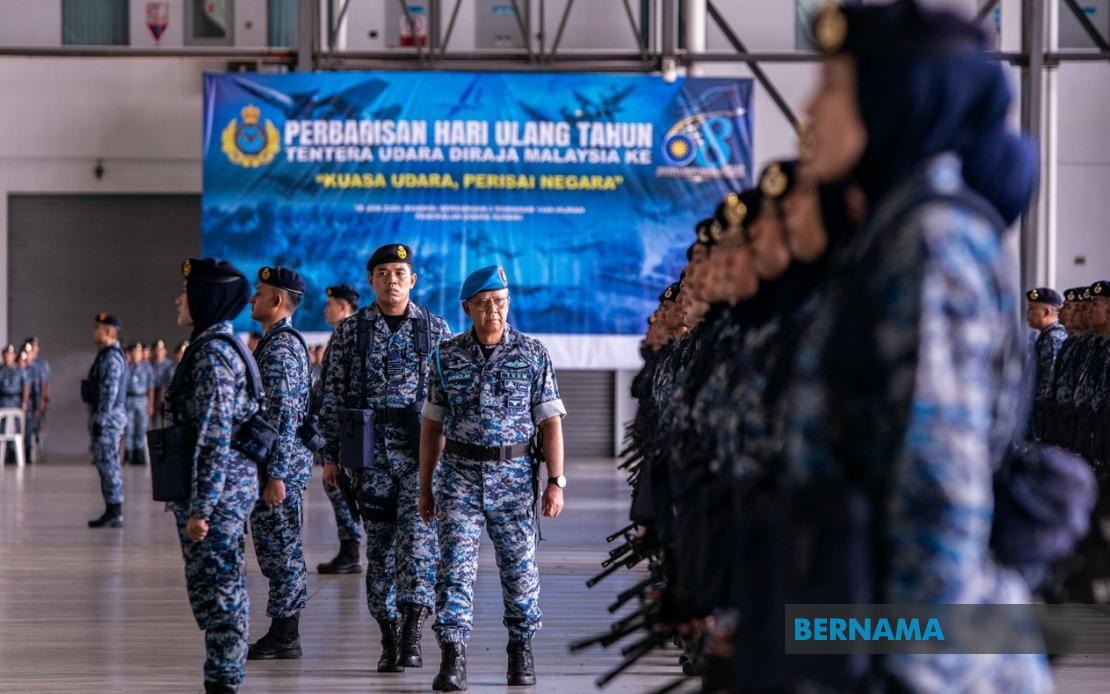
The anniversary parade itself showcased the breadth and diversity of the RMAF's operational capabilities through a formation involving sixteen officers and 272 personnel organised into four distinct flights. The parade featured the Special Forces unit known as PASKAU, the Ground Defence Force called HANDAU, the Women's Composite Flight, and the Multi-Trade Composite Flight. This composition reflects the air force's evolution toward more inclusive and diversified force structures, moving beyond traditional fighter pilot stereotypes to encompass the full spectrum of modern military operations. The public display of institutional strength and capability served an important morale function while demonstrating to the broader population that the air force comprises professionals dedicated to national defence.
The parade's theme, "Kuasa Udara, Perisai Negara" (Air Power, the Nation's Shield), encapsulates the RMAF's self-conception as a fundamental pillar of Malaysian national security. This symbolic framing acknowledges that in an era of transnational threats, sophisticated aircraft operations, and complex airspace management, air power has become inseparable from territorial integrity and national defence. The theme also resonates with ongoing discussions about how Malaysia can maintain strategic autonomy and protect its interests amid great power competition and regional instability.
The timing of these capability announcements during the anniversary parade demonstrates strategic communication by the military leadership, using a high-profile institutional occasion to signal commitment to modernisation and enhanced readiness. By anchoring new equipment deployments within a multi-decade capability plan and explicitly connecting these investments to observable regional security challenges, military leaders have framed defence spending not as luxury expenditure but as essential national investment. This narrative construction addresses legitimate public questions about military budgets by demonstrating concrete links between defence capability improvements and protection of Malaysian economic and security interests.