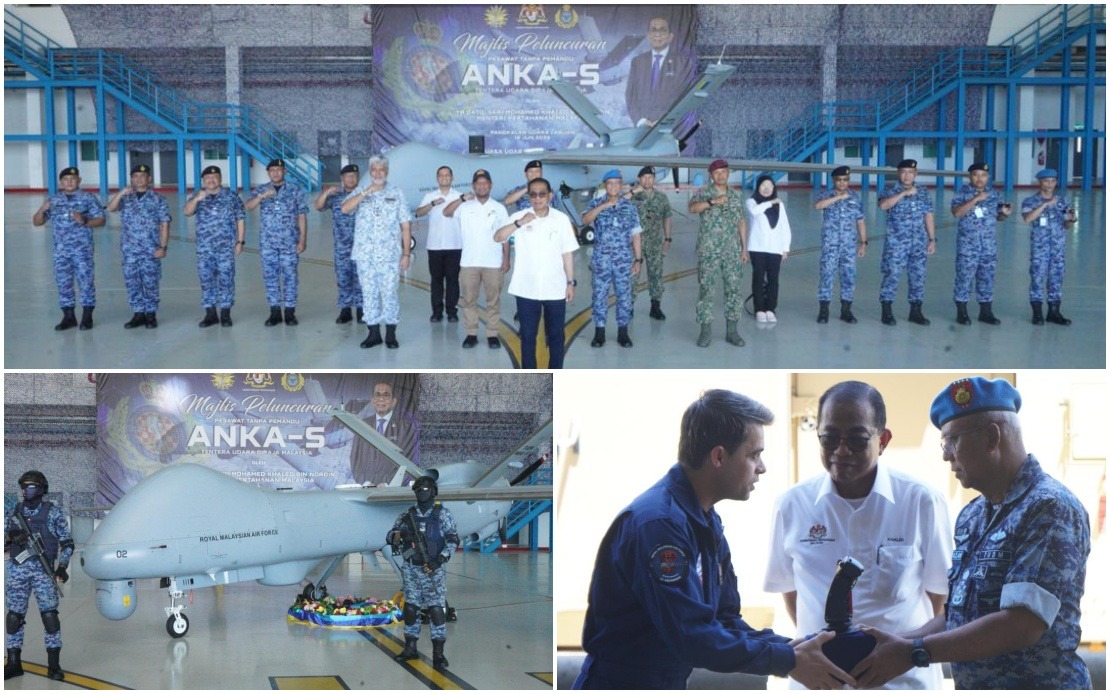
Malaysia has taken a decisive step to enhance its surveillance capacity in one of the world's most strategically important waterways with the operational deployment of the ANKA-S Unmanned Aircraft System at the Royal Malaysian Air Force base in Labuan. Defence Minister Datuk Seri Mohamed Khaled Nordin declared the launch a watershed moment for the nation's defence posture, signalling that Malaysia now possesses technological capabilities previously unavailable for monitoring its vast maritime zones and protecting its sovereignty in the contested South China Sea.
The acquisition represents a substantial financial commitment, with three ANKA-S aircraft secured at a total cost of RM423.8 million, encompassing the aircraft themselves, ground control infrastructure, and a two-year personnel training programme. This expenditure reflects the government's determination to close a critical gap in Malaysia's operational surveillance architecture—a gap that had constrained the nation's ability to respond swiftly and effectively to maritime intrusions and maintain continuous awareness of activities across its maritime claimed areas. The Medium Altitude Long Endurance designation captures the aircraft's primary operational advantage: the capacity to remain airborne for more than 24 hours while cruising at altitudes reaching 30,000 feet, enabling persistent coverage that crewed aircraft cannot economically sustain.
The deployment to Labuan Air Base positions No. 11 Squadron to exercise enhanced dominion over the South China Sea approaches to Malaysia's east coast and the wider region where Chinese, Vietnamese, Filipino, and other claimants maintain competing territorial assertions. For Malaysian defence planners, the ANKA-S addresses a longstanding operational dilemma: how to maintain constant vigilance across extensive maritime spaces without incurring the staggering fuel and maintenance costs associated with deploying fighter jets or dedicated naval vessels on routine patrol missions. The unmanned system promises to redirect scarce military assets toward higher-value operations while the drones shoulder routine surveillance responsibilities.
The aircraft's sensor suite enables precise identification and tracking of vessel characteristics—a capability that transforms reactive patrols into targeted, intelligence-driven responses. Rather than maintaining expensive surface and air assets circling vast ocean expanses in hope of detecting intruders, Malaysian forces can now position assets directly to confirmed incursion locations based on ANKA-S reconnaissance data. This operational efficiency translates to significant cost savings and enhanced effectiveness, permitting the Air Force and Navy to concentrate their fighter and patrol ship fleets on missions requiring kinetic capability or presence at specific coordinates identified through prior surveillance.
A notable aspect of Malaysia's approach lies in the deliberate decision not to weaponise the ANKA-S platform despite its technical capability to carry ordnance. Defence Minister Mohamed Khaled explained this choice as a calculated diplomatic signal, communicating to the international community and regional neighbours that Malaysia's defence posture remains fundamentally defensive and non-threatening. This restraint carries particular significance given regional tensions over maritime claims and China's increasing military presence in the South China Sea. By deploying advanced surveillance capacity while explicitly foregoing armed variants, Malaysia positions itself as a security consumer rather than an aggressor, a distinction that matters in the diplomatic arithmetic of Southeast Asian geopolitics where perceptions of militarisation can trigger concerning escalation cycles.
The government's willingness to invest substantially in surveillance infrastructure rather than offensive capabilities reflects broader strategic thinking about Malaysia's role in maintaining regional stability. The ANKA-S system allows Malaysian authorities to gather detailed information about maritime activities—from fishing vessel movements to potential security threats—without projecting an image of military expansion that could provoke counterbalancing responses from other powers. This approach aligns with Malaysia's longstanding preference for diplomatic resolution of territorial disputes and reliance on international law frameworks, even while acknowledging the necessity of robust national defence capabilities.
The operational significance extends beyond the South China Sea to Malaysia's broader maritime domain. The system can conduct continuous intelligence, surveillance and reconnaissance missions across the nation's exclusive economic zone and beyond, providing planners with information essential to resource management, fisheries enforcement, and counter-piracy operations. The Data Exploitation Centre established alongside the ANKA-S deployment represents an investment in analytical capacity to convert raw surveillance data into actionable intelligence, requiring trained personnel capable of interpreting sensor feeds and identifying patterns relevant to maritime security.
Malaysia's three-aircraft initial deployment appears designed as a proof-of-concept establishment, with Defence Ministry officials acknowledging serious consideration of a second-phase acquisition comprising three additional systems. Should this expansion proceed through the government's national development planning framework, Malaysia would operate six ANKA-S aircraft—sufficient to maintain near-continuous coverage of critical maritime zones with appropriate rotation schedules for maintenance and crew rest. Such expansion would position Malaysia's unmanned surveillance capacity alongside those of more developed regional militaries, narrowing a capability gap that has long constrained Malaysian security planners' options.
The presence of senior military leadership at the Labuan launch—including Chief of Navy Admiral Tan Sri Dr Zulhelmy Ithnain, Chief of Air Force General Tan Sri Muhamad Norazlan Aris, and Joint Forces Commander Lieutenant General Datuk Tengku Muhammad Fauzi Tengku Ibrahim—underscored the system's importance to integrated defence planning. The ANKA-S enters service at a moment when regional navies and air forces increasingly rely on unmanned systems to extend their reach and improve situational awareness. For Malaysia, the technology represents not merely an upgrade to existing capabilities but a fundamental shift toward technology-dependent security arrangements that require sustained investment in training, maintenance infrastructure, and data management systems.
The ANKA-S deployment also carries implications for Malaysia's defence industry and technological self-sufficiency ambitions. While the aircraft represents a foreign acquisition rather than a domestically developed platform, the ground support infrastructure, personnel training, and operational doctrine development create opportunities for Malaysian companies and defence technicians to build expertise in unmanned system operations. Over time, Malaysia may develop indigenous capabilities in sensor integration, data processing, and tactical application of unmanned systems—areas where regional powers like Indonesia and Thailand are also investing.
From a maritime security perspective, the system's arrival signals Malaysia's commitment to enhancing compliance monitoring and fisheries management across its territorial waters and exclusive economic zone. The ability to track vessel movements continuously assists authorities in combating illegal, unreported, and unregulated fishing—a persistent problem affecting Southeast Asian nations and their regional cooperation mechanisms. Additionally, the surveillance capability strengthens Malaysia's hand in documenting potential incursions or activities by foreign vessels in Malaysian waters, creating an evidentiary record that supports diplomatic protests and strengthens Malaysia's legal position in disputes involving maritime boundary interpretation.
The investment in ANKA-S technology reflects recognition among Malaysian defence planners that future maritime security challenges will require persistent, continuous surveillance rather than episodic patrols. The system's deployment at Labuan positions the RMAF to transition from reactive maritime security operations toward more proactive, intelligence-informed approaches. As Malaysia continues navigating complex regional dynamics involving great-power competition in the South China Sea and managing its own maritime interests, the ANKA-S represents a prudent modernisation choice that enhances capabilities while maintaining strategic restraint and signalling commitment to stability.