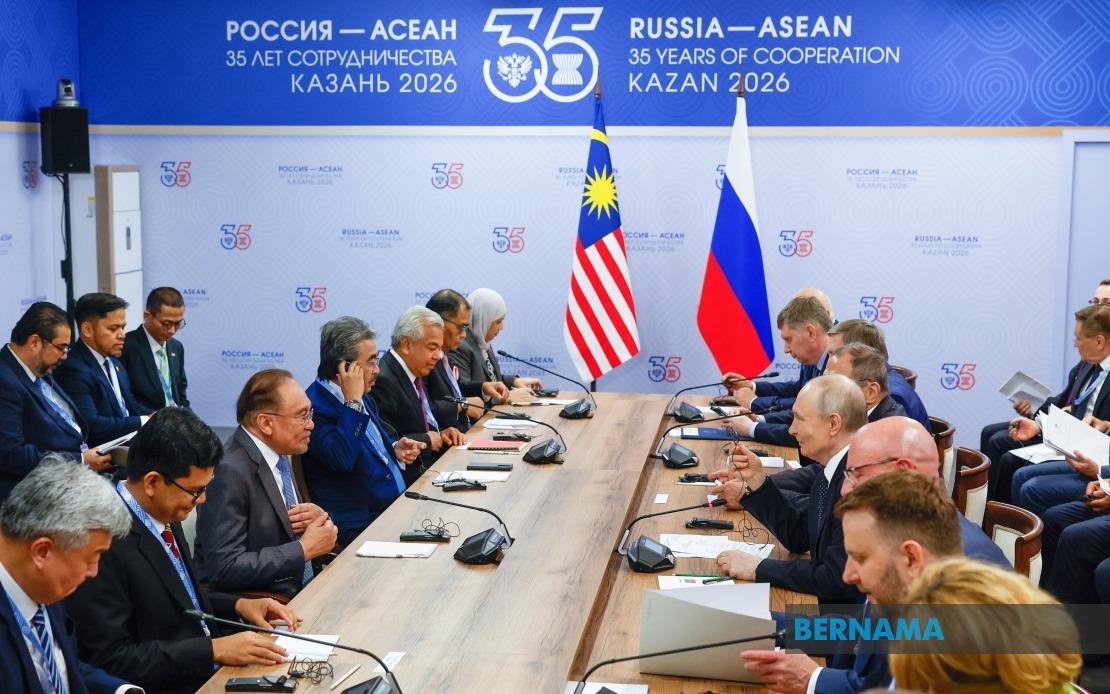
Russian President Vladimir Putin and Malaysian Prime Minister Datuk Seri Anwar Ibrahim have reaffirmed their nations' commitment to expanding cooperation, with both leaders emphasizing the strength of their bilateral relationship during discussions on the sidelines of the ASEAN-Russia Commemorative Summit in Kazan. The high-level engagement underscores Moscow and Kuala Lumpur's determination to leverage their established diplomatic foundation as they prepare for a significant milestone next year, marking six decades of formal relations between the two countries.
During their meeting, Putin highlighted the substantial progress achieved through decades of official cooperation, framing the forthcoming 60th anniversary as a natural juncture to accelerate joint initiatives across multiple sectors. The Russian leader emphasized that both nations possess considerable positive momentum in their engagement, having consistently maintained institutional dialogue mechanisms that facilitate coordinated policy implementation. Putin's remarks reflected Moscow's broader strategic interest in strengthening its position within Southeast Asia, a region of growing geopolitical significance as regional powers navigate evolving global dynamics.
The practical architecture supporting bilateral ties remains robust. Regular diplomatic contacts flow through dedicated government channels, while an intergovernmental commission focused on economic, scientific, technical and cultural cooperation serves as the primary vehicle for executing collaborative projects. This institutional framework, Putin noted, provides the operational foundation necessary for translating political will into tangible outcomes across diverse spheres of mutual interest. The existence of such formal mechanisms suggests both countries have embedded their partnership within lasting structures rather than relying solely on personal relationships between leaders.
Trade performance has emerged as a particularly promising indicator of deepening economic integration. The bilateral commercial relationship expanded by 12.9 per cent during 2025, demonstrating sustained momentum in merchandise exchanges despite global economic uncertainties. For Malaysia, this growth trajectory reflects successful diversification of trading partners and the country's continued attractiveness as a commercial hub. The expansion also signals that Russian sanctions and Western restrictions have not substantially impeded Moscow's ability to conduct commerce with Southeast Asian nations, a development that carries implications for the region's economic independence and its capacity to maintain balanced relationships among major powers.
Putin articulated Russia's commitment to widening cooperation beyond conventional trade metrics, identifying education, science, technology, tourism and cultural exchange as priority areas for future collaboration. These sectors represent avenues through which bilateral ties acquire deeper societal resonance, extending partnerships beyond government-to-government interactions into broader people-to-people networks. Enhanced academic exchanges, research collaborations and tourism flows would strengthen mutual understanding while generating economic benefits for businesses and professionals in both countries. For Malaysia, such engagement potentially opens doors to advanced Russian expertise in specific technological and scientific domains while providing Russian enterprises access to Southeast Asian market opportunities.
Malaysia's historical role in anchoring Russia's engagement with Southeast Asia carries particular significance within this partnership framework. Putin underscored his appreciation for Malaysia's support in developing the strategic partnership between Russia and ASEAN, specifically noting that the inaugural Russia-ASEAN summit convened in Malaysia in 2005. That inaugural gathering established the diplomatic precedent upon which contemporary relations rest. Moreover, Malaysia's chairmanship of ASEAN during the previous year positioned the country as a key regional interlocutor, a status Putin explicitly acknowledged and welcomed as conducive to maintaining and strengthening Russia's ties with the wider Southeast Asian community.
The symbolic importance of the forthcoming 60th anniversary extends beyond ceremonial recognition. For Malaysia, this milestone represents an opportunity to reaffirm its non-aligned orientation and its capacity to maintain substantive relationships with multiple global actors. For Russia, it constitutes acknowledgment that despite geopolitical tensions elsewhere, Moscow retains meaningful partnerships within Southeast Asia based on mutual respect and consideration of respective national interests. Putin's invocation of these principles—mutual respect and regard for national interests—suggests both countries view their relationship through a lens of pragmatic cooperation rather than ideological alignment or strategic subordination.
Putin's personal remarks to Anwar, including his recollection of previous meetings in Malaysia and his conveyance of best wishes to His Majesty Sultan Ibrahim, King of Malaysia, underscored the personalized dimension of bilateral engagement. Such gestures, while appearing ceremonial, carry diplomatic weight by demonstrating that high-level relationships extend beyond immediate political officeholders to encompass broader national leadership structures. This multi-layered approach to relationship-building suggests sustained commitment to stability and continuity in Russia-Malaysia ties regardless of future changes in specific government personnel.
The timing of this high-level engagement carries strategic implications for Southeast Asian geopolitics. As global powers increasingly compete for influence within the region, Malaysia's demonstrated ability to maintain productive relationships with Russia while preserving its broader ASEAN commitments and other partnerships reflects the country's sophisticated diplomatic balancing act. The region continues to resist exclusive alignment with any single power bloc, and Malaysia's approach exemplifies this broader Southeast Asian preference for hedging and maintaining diverse international relationships. For Moscow, successful cultivation of partnerships like that with Malaysia provides counterweight to Western containment efforts while demonstrating that Russia retains economic and diplomatic relevance in Asia despite sanctions and isolation measures.
Looking ahead to 2026, both countries appear positioned to utilize the 60th anniversary as a framework for announcing new initiatives or formalizing previously discussed cooperative arrangements. The established momentum in trade relationships, combined with political commitment at the highest levels, suggests tangible outcomes are plausible. Enhanced cooperation in energy sectors, infrastructure projects or technological partnerships could materialize as concrete manifestations of deepened ties. For Malaysian policymakers and business communities, such developments could unlock new economic opportunities while reinforcing the country's strategic autonomy in navigating great power competition.
The broader context of Russia-Southeast Asia relations deserves consideration alongside this bilateral partnership. While Russia's economic footprint in Southeast Asia remains smaller than that of Western powers or major Asian economies, Moscow has consistently prioritized maintaining diplomatic presence and cultural influence throughout the region. Malaysia, as a Muslim-majority ASEAN member with significant economic capacity and regional influence, represents a particularly valuable partner within this framework. The success of the Russia-Malaysia relationship provides a potential model for Moscow's broader Southeast Asian engagement strategy, suggesting that pragmatic, non-ideological approaches to partnership can generate sustained cooperation even amid global tensions.