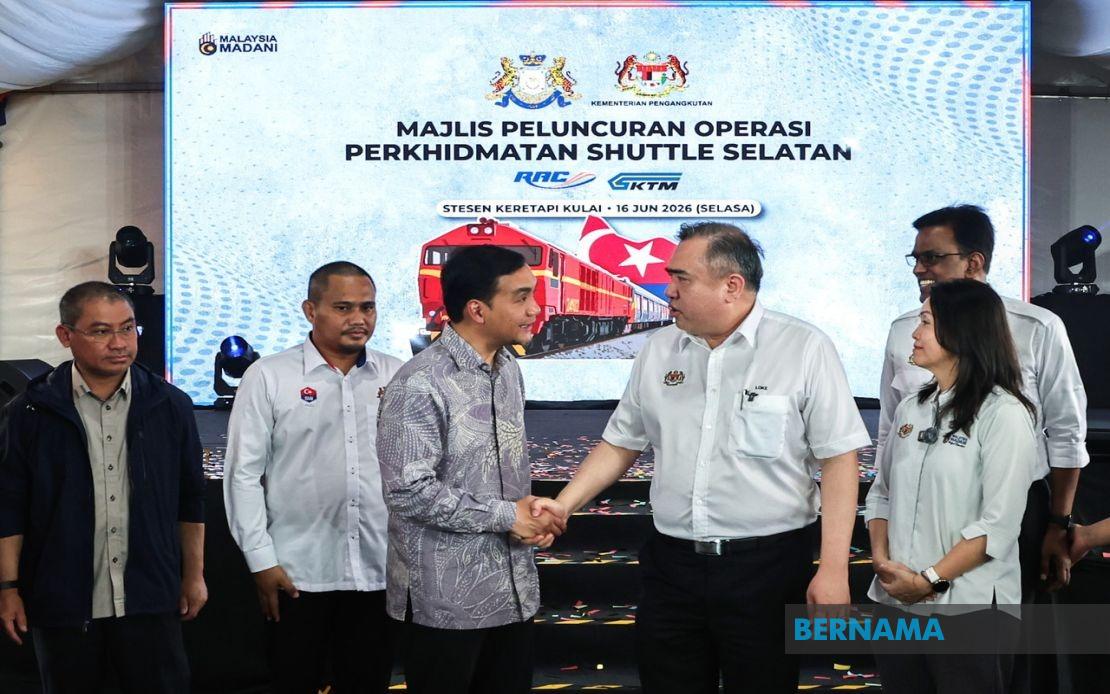
The Shuttle Selatan service officially commenced operations today at Kulai KTM station, marking a significant step in expanding public transport infrastructure across Johor's key urban and industrial centres. Transport Minister Anthony Loke unveiled the initiative at a formal ceremony attended by Johor Menteri Besar Datuk Onn Hafiz Ghazi and state officials, emphasizing the service's role in connecting Kulai, JB Sentral and Pasir Gudang to serve an estimated population exceeding two million.
The newly launched shuttle operates across two foundational routes designed to address immediate connectivity needs within the region. The Kulai-JB Sentral corridor represents the primary trunk route, while the Kempas Baru-Pasir Gudang service targets the eastern industrial zones. This phased approach allows operators to establish reliable service standards before scaling operations, a strategic consideration given the density and diversity of demand across Johor's sprawling metropolitan areas.
Ambitious expansion plans signal the government's confidence in the service's potential to reshape commuter patterns across southern Johor. Future developmental stages envision extending connectivity from Paloh through Kulai, with intermediate stops at Kluang, Renggam and Layang-Layang stations. These proposed extensions would create a more comprehensive network serving smaller towns and villages currently underserved by conventional public transport, potentially unlocking economic opportunities in lower-density areas.
Three additional stations remain on the drawing board: Taman Daya, Bandar Baru Sri Alam and Pasir Putih. Their integration into the network reflects deliberate urban planning aimed at ensuring equitable access to rail-based transit across socioeconomically diverse communities. Strategic placement in residential zones addresses the chronic first-and-last-mile connectivity challenge that has historically deterred Malaysians from embracing public transport over personal vehicles.
Travel times on both established routes position Shuttle Selatan as a competitive alternative to road-based commuting. The Kulai-JB Sentral journey, covering approximately 40 minutes, significantly reduces transit duration compared to private vehicle navigation through congested urban corridors. The Kempas Baru-Pasir Gudang segment, requiring 40 to 45 minutes, similarly compresses journey times while eliminating parking complications and fuel costs associated with personal vehicle use.
Comprehensive supporting infrastructure demonstrates meticulous planning to overcome adoption barriers. Feeder bus services, coordinated Bas.My route integration, dedicated shuttle connections at Kempas Baru and park-and-ride facilities at AEON Bandar Dato' Onn create a seamlessly integrated ecosystem encouraging modal shifts toward public transport. This multimodal approach acknowledges that fixed-route rail services alone cannot resolve the complex spatial distribution challenges inherent in sprawling Southeast Asian cities.
Incentive mechanisms directly target behavioural change among commuters accustomed to private vehicle dependency. The government distributed 3,000 Commuter MADANI Shuttle Selatan cards free to Johor residents, providing unlimited travel access during specified periods on RM50 subsidized cards. The Railway Assets Corporation's allocation of over RM150,000 as seed funding signals genuine governmental commitment to public transport transformation rather than mere rhetorical posturing.
Johor's rapid economic expansion provides compelling context for this transit investment. As one of Malaysia's fastest-growing states, Johor's industrial, logistics, port, education and trade sectors increasingly demand efficient worker mobility. The state's expanding manufacturing complexes in Pasir Gudang, emerging knowledge centres and international business operations generate substantial commuter flows that existing transport infrastructure struggles to accommodate. Shuttle Selatan directly addresses these sectoral demands while potentially reducing congestion on highways serving Port Klang's competitors.
Connectivity between residential clusters, commercial centres and industrial zones represents the stated strategic objective underlying service design. This triangular connectivity pattern acknowledges that genuine transit transformation requires links between where people live, work and conduct commerce. Previous Malaysian transport initiatives often fragmented these relationships, resulting in underutilized infrastructure unable to serve authentic mobility needs. Shuttle Selatan's routing deliberately bridges these traditionally disconnected urban functions.
Implementation reflects organizational collaboration between the Ministry of Transport, Keretapi Tanah Melayu Berhad (KTMB) and the Railway Assets Corporation (RAC). This coordinated approach distributes operational responsibilities across entities possessing complementary expertise, reducing implementation risk while ensuring sustainable long-term service provision. Such institutional alignment remains essential given Malaysia's checkered history with public transport initiatives abandoned following initial political enthusiasm.
For Malaysian commuters and businesses, Shuttle Selatan's emergence signals gradual transit ecosystem maturation in secondary metropolitan regions. As Southeast Asia's urban centres proliferate beyond traditional cores, supporting quality public transport becomes economically essential. Johor's position as a regional growth engine intensifies these requirements, making reliable shuttle services prerequisites for attracting quality employment and investment.
The service's success or failure will substantially influence future Malaysian transport policy approaches. Successful Shuttle Selatan operations could justify expanded rail-shuttle networks in other rapidly developing Malaysian states, potentially transforming commuter expectations and behaviour. Conversely, operational challenges or disappointing ridership would reinforce prevailing automobile-centric transport patterns, perpetuating congestion and environmental degradation across Malaysian urban centres. The initiative thus transcends Johor's boundaries, establishing precedent implications for national transport sustainability.