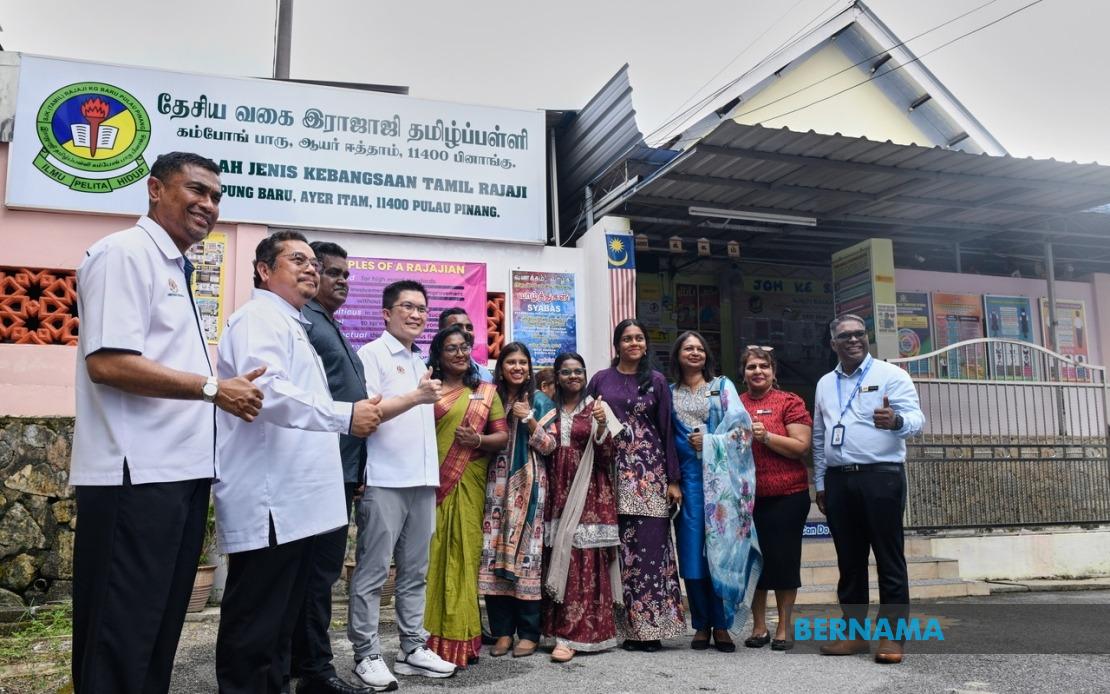
The Education Ministry has cleared the way for a comprehensive overhaul of SJKT Rajaji in George Town, greenlighting an RM8 million construction project that will see the long-established Tamil school relocate to purpose-built facilities in Farlim. Deputy Education Minister Wong Kah Woh made the announcement in George Town on June 15, presenting the formal approval letter to school administrators and state officials, marking a pivotal moment for an institution that has served the Tamil community for over seven decades despite operating in inadequate premises.
The 76-year-old school's current location has become increasingly problematic, with enrolment of roughly 100 pupils straining facilities never designed for modern educational standards. Space constraints have made it difficult for teachers to deliver comprehensive instruction, while the aging infrastructure presents maintenance challenges that divert resources away from pedagogical investment. The relocation represents far more than a simple change of address; it symbolises a commitment to providing Tamil-medium education with dignified, functional learning environments comparable to those available at other school types in the country.
The new site, a 2.3-acre parcel in Farlim about 500 metres from SJKT Rajaji's current location, was identified and set aside by the Penang state government back in 2022. This strategic site selection keeps the school within the existing community while providing ample room for expansion and modern amenities. The school's board of governors submitted a formal relocation application to the Education Ministry last year, which underwent careful review to ensure all coordination with Penang's local authorities and land administration offices proceeded smoothly before final approval was granted.
Construction timelines suggest a development period of approximately 18 months, positioning SJKT Rajaji to commence operations at its new premises no later than the 2029 academic session. This schedule provides sufficient runway for comprehensive planning, procurement, and execution while allowing the existing student cohort and their parents time to prepare for the transition. The phased approach also permits ongoing dialogue with the school community about specific facility requirements and pedagogical considerations that should inform the building's final design and operational layout.
A particularly noteworthy aspect of this project is its financing mechanism. Rather than relying exclusively on government appropriations, the RM8 million construction cost will be entirely underwritten by a private developer as part of its corporate social responsibility programme. This partnership model demonstrates how the private sector can meaningfully contribute to educational infrastructure without imposing additional strain on public finances. For a resource-conscious state like Penang, which manages competing priorities across multiple sectors, such collaborative arrangements amplify the impact of limited government budgets.
State Housing and Environment Committee chairman and Penang Tamil Schools Special Committee chairman Datuk Seri S. Sundarajoo underscored that SJKT Rajaji's revitalisation forms part of a broader programme to strengthen Tamil-medium education across Penang. The state currently operates 28 Tamil national-type schools, several of which are simultaneously undergoing developmental initiatives ranging from securing permanent land tenure to implementing staged improvement projects. This coordinated approach suggests sustained policy commitment rather than ad-hoc interventions, creating momentum for systemic enhancement across the sector.
The wider context reveals accelerating activity in Tamil school infrastructure development. Sundarajoo indicated that at least three SJKT projects will see groundbreaking ceremonies this year, while several others including SJKT Sungai Bakap and SJKT Juru are being revived from earlier planning stages. This bundling of initiatives suggests economies of scale in procurement, design oversight, and construction management, potentially yielding better value than isolated projects. Simultaneous development also generates institutional learning and knowledge transfer among school administrators navigating similar expansion or relocation processes.
For Malaysian Tamil communities, educational infrastructure quality carries symbolic and practical significance. Tamil-medium schools have historically faced infrastructure disadvantages relative to Malay and English-medium counterparts, a pattern reflected in ageing buildings, undersized facilities, and deferred maintenance. Approval of modern, adequately resourced buildings signals government recognition of Tamil education's legitimacy and importance within Malaysia's multilingual, multicultural educational ecosystem. SJKT Rajaji's transformation contributes to narrowing infrastructural disparities that have sometimes disadvantaged minority-language educational options.
The SJKT Rajaji approval also reflects changing governmental attitudes toward public-private partnerships in education infrastructure. Rather than viewing private sector involvement with suspicion, policymakers increasingly recognise that developer-funded projects can accelerate improvements while freeing public resources for recurrent operational costs, teacher training, and curriculum development. As long as such partnerships maintain clear public interest safeguards and avoid privatisation of educational delivery, they represent pragmatic mechanisms for addressing infrastructure deficits in resource-constrained environments.
The 500-metre relocation distance proves strategically important, preserving community continuity while enabling purpose-built design. Unlike schools that relocate to distant industrial zones or new township peripheries, SJKT Rajaji will remain embedded within its established catchment area. Existing pupils and their families face minimal transportation adjustments, and the school can continue serving its traditional community. This proximity also facilitates transition management, allowing staff and students to visit the construction site, observe progress, and maintain psychological connection to their institution throughout the move.
Looking forward, successful completion of SJKT Rajaji's relocation by 2029 will establish a template for addressing similar infrastructure challenges elsewhere in Penang's Tamil school network. The project demonstrates feasibility of combining government approval processes, developer funding, community engagement, and state-level coordination into coherent improvement initiatives. Other states with comparable Tamil school infrastructure backlogs may observe this implementation model with interest, particularly regarding how public-private collaboration structures can be configured to benefit educational institutions while respecting governance principles and community stakeholder interests.
The approval letter presentation also reflects broader recognition within Malaysia's education bureaucracy that minority-language school systems merit parity in infrastructure investment and administrative attention. SJKT Rajaji's seven-decade history, modest pupil population, and historical facility constraints might have prompted bureaucratic inertia in less progressive administrations. Instead, the Education Ministry's proactive engagement signals that demographic size does not excuse educational quality compromises. This principle, consistently applied across Malaysia's Tamil, Chinese, and indigenous education systems, strengthens the constitutional guarantees of mother-tongue educational access enshrined in the Federal Constitution.