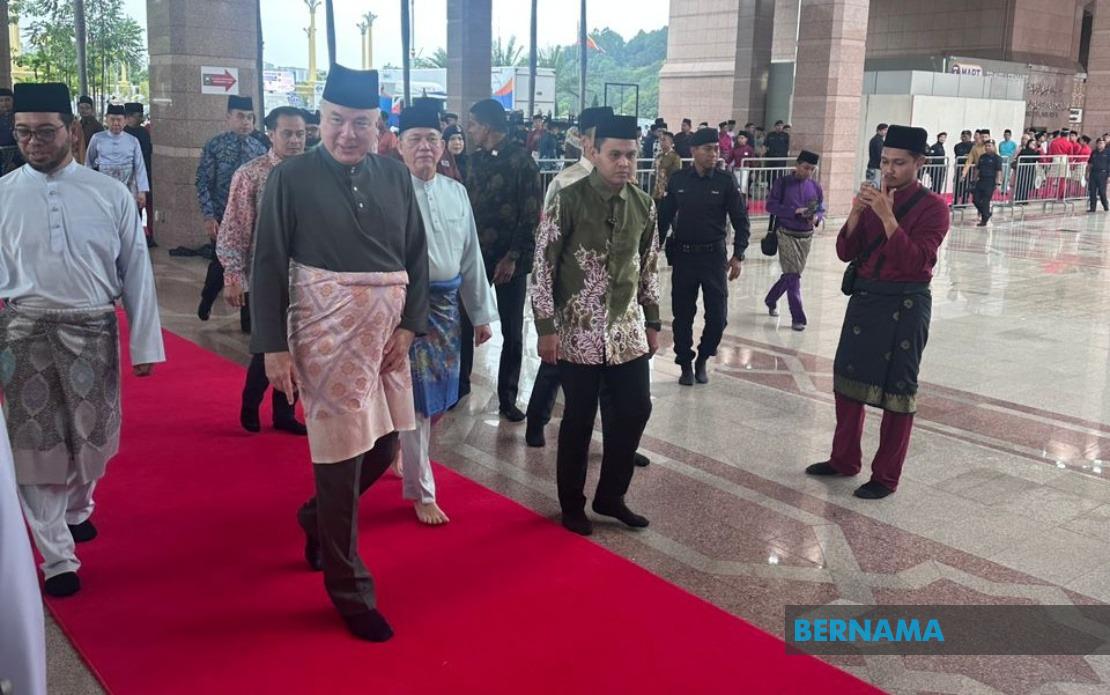
The Deputy Yang di-Pertuan Agong Sultan Nazrin Shah issued a stern warning to the nation's leadership during the National Level Maal Hijrah 1448 Celebration in Putrajaya, condemning the tendency of political leaders to prioritise impulsive action and emotional reaction over measured judgment. Speaking before an audience of approximately 5,000 at the Putra Mosque, His Royal Highness underscored the peril that befalls any country whose stewards abandon reasoned deliberation in favour of personal impulse and reckless haste, cautioning that the true cost of such governance ultimately falls upon ordinary citizens who bear the consequences of poor choices made without forethought.
The Sultan's intervention carries particular significance for Malaysia's political climate. His emphasis on the dangers of leadership untethered from careful consideration speaks directly to recurring concerns about the quality of decision-making at the highest levels of government. When leaders act without adequate consultation, fail to weigh competing interests, or allow personal grievance to override institutional responsibility, the stability and prosperity of entire sectors—from the economy to social cohesion—become hostage to individual temperament rather than grounded in rational policy.
Sultan Nazrin drew explicit parallels between contemporary governance challenges and lessons embedded in the Islamic calendar's most pivotal event. The Hijrah, undertaken by Prophet Muhammad PBUH and his followers in the year 622 CE, represented not a spontaneous flight but a meticulously planned migration executed with strategic precision. The Prophet's decision to appoint Abdullah bin Uraiqit, a non-Muslim guide, as navigator for the journey illustrated a crucial principle: competence and integrity transcend sectarian boundaries. This historical example carries modern application for Malaysian leaders, suggesting that national advancement depends less upon ideological uniformity than upon assembling talented individuals of genuine expertise and proven reliability, regardless of their background or personal beliefs.
The principle of strategic planning that Sultan Nazrin drew from the Hijrah narrative offers a counterweight to the reactive, crisis-driven governance that frequently characterises contemporary politics across Southeast Asia. Malaysia's own development trajectory has alternated between periods of coherent long-term vision and episodes of muddled, short-term tactical manoeuvring. The Sultan's reminder that greatness emerges not from complacency about past accomplishments but from extracting actionable lessons for future advancement speaks to a national tendency toward self-congratulation that can obscure genuine challenges requiring sustained, intelligent effort.
Equally significant was His Royal Highness's lament over the erosion of sacrifice within Malaysian society and the broader Muslim community. The Sultan articulated a distinction between genuine sacrifice—the willingness to subordinate personal comfort and immediate self-interest to collective welfare—and its rhetorical performance, which has become increasingly prevalent. This observation resonates deeply with critiques of Malaysian civic life, where political leaders frequently invoke the language of national sacrifice while pursuing policies that consolidate private advantage. The Sultan's call to rekindle authentic commitment to sacrifice as a foundational value rather than a ceremonial platitude challenges the nation to examine whether its institutions and leaders genuinely embody the principles they publicly espouse.
The Sultan also grounded his message in the example of the Medina Charter, the foundational social contract that bound together the diverse populations of seventh-century Medina under shared principles of justice and mutual respect. The explicit invocation of this precedent reflects an understanding that Malaysian national cohesion depends fundamentally upon the willingness of citizens to cooperate across religious, ethnic, and cultural divides, provided that governance remains fair and impartial. In a country as pluralistic as Malaysia, where tensions periodically surface between different communities, the reminder that diversity need not preclude harmony when anchored in just administration provides essential ballast against those who argue that national progress requires enforced uniformity.
Sultan Nazrin's characterisation of Maal Hijrah as an occasion for rigorous self-examination rather than mere calendar commemoration or nostalgic reflection offers a rebuke to ceremonial politics. Too often, national celebrations become occasions for rhetorical flourish divorced from substantive reflection on institutional shortcomings or policy failures. The Sultan's framing suggests that genuine observance of significant historical and religious events demands uncomfortable honesty about present inadequacies, a willingness to acknowledge heedlessness and drift, and concrete commitment to course correction. For Malaysian leaders and citizens alike, this represents an invitation to move beyond comfortable ritual toward the harder work of systemic self-assessment.
The presence of Deputy Prime Minister Datuk Seri Fadillah Yusof and Minister Zulkifli Hasan at the event underscores the political significance of the Sultan's remarks. These interventions by the monarchy on matters of governance quality and leadership character carry weight precisely because the constitutional monarchy stands somewhat apart from the partisan fray. When the Deputy Yang di-Pertuan Agong speaks to the character of national leadership, the message carries an authority that partisan political voices cannot replicate. This provides Malaysian citizens with an independent institutional voice articulating standards against which executive performance can be measured.
For Southeast Asia more broadly, Sultan Nazrin's warnings about impulsive leadership resonate across borders. The region has witnessed numerous instances where hasty political decisions, driven by factional interest or personal animosity rather than strategic foresight, have destabilised economies, fractured social bonds, and undermined institutional capacity. Malaysia's own experience with periodic governance crises driven by political upheaval offers cautionary examples. The Sultan's insistence that leaders cultivate calmness, openness, and cautiousness in decision-making provides a template applicable across the region for evaluating whether political systems are generating the quality of stewardship that complex, diverse, developing nations require.
The Sultan's emphasis on unity as a foundational strength, rather than an outcome to be engineered through coercion or conformity, addresses one of Malaysia's most enduring governance challenges. The nation's constitutional settlement has always rested upon negotiated consensus among diverse communities, each with legitimate interests and aspirations. When political leaders interpret their mandate as a licence to advance sectional interests at others' expense, or when they deploy divisive rhetoric to consolidate factional support, they undermine the collaborative premises upon which Malaysian stability depends. The Medina Charter example, with its demonstration that justice and wise governance can unite people of different faiths and backgrounds, suggests that Malaysia's path forward depends upon leaders willing to subordinate partisan advantage to the broader national interest.
Moving forward, the Sultan's address at the Maal Hijrah celebration establishes a benchmark against which Malaysian political performance can be assessed. The call for leaders to embrace wisdom over impulse, to prioritise informed deliberation over reactive decision-making, to cultivate sacrifice as a lived value rather than a slogan, and to anchor governance in principles of justice and inclusion applies with equal force whether the immediate audience comprises cabinet ministers, parliamentary leaders, or provincial administrators. These standards are neither narrowly religious nor uniquely Malaysian; they represent timeless principles of effective, ethical governance that transcend borders and traditions.