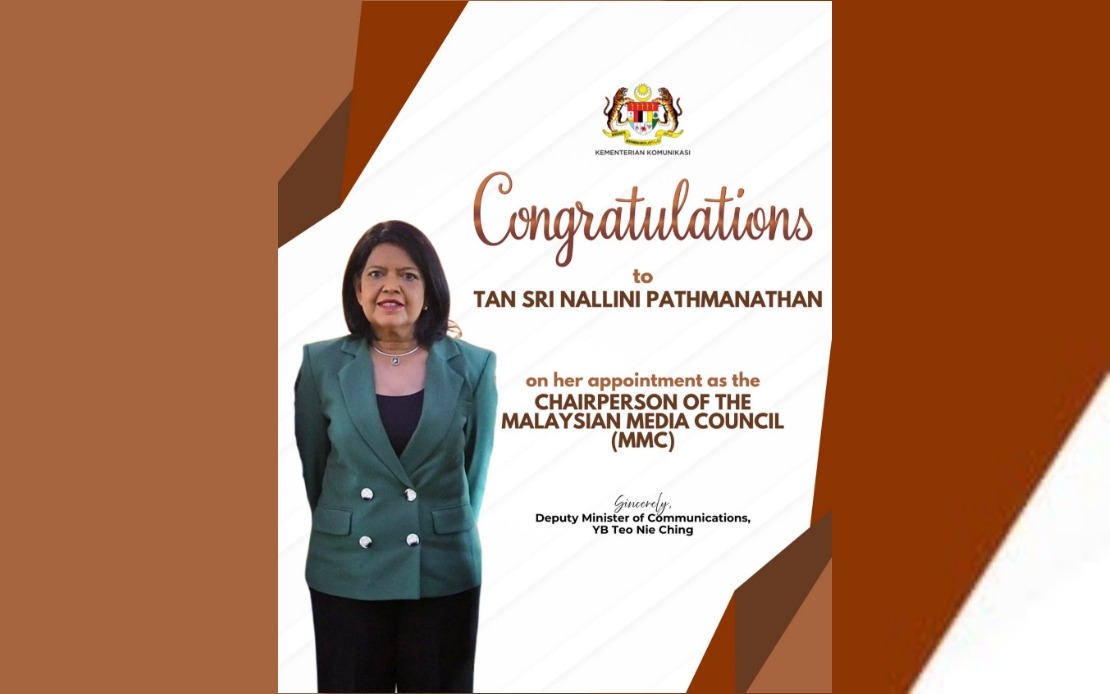
Deputy Communications Minister Teo Nie Ching has expressed full confidence in former Federal Court judge Tan Sri Nallini Pathmanathan's capacity to guide the Malaysian Media Council (MMC), drawing particular attention to her judicial legacy on matters touching media independence and constitutional protections. The endorsement carries weight within government circles, as Teo highlighted Nallini's track record of principled decision-making on the bench and her demonstrated commitment to interpreting law in ways that protect fundamental freedoms.
In remarks shared via social media, Teo characterised Nallini as a jurist whom she deeply respects, emphasising that her tenure in the Federal Court reflected both intellectual sophistication and compassionate reasoning. This assessment signals political backing for the newly appointed chairperson as the MMC begins operations under its statutory framework, established through the Malaysian Media Council Act 2025—legislation representing the culmination of five decades of sustained industry advocacy and policy reform discussions.
Teo specifically referenced Nallini's dissenting opinion in a high-profile constitutional case concerning citizenship rights for a child born to a Malaysian father and a foreign mother. In that 4-3 decision, Nallini articulated a purposive and human-centred approach to reading the Constitution's citizenship provisions, challenging the majority's narrower interpretation. This judgment exemplified the judicial philosophy that Teo believes will serve the MMC well: an openness to flexible legal reasoning grounded in real-world consequences rather than rigid textual formalism.
Equally significant was Nallini's dissenting judgment in a landmark case involving online journalism and digital media regulation. She ruled that an online news portal should not bear legal responsibility for comments posted by readers on its platform—a stance that protected editorial independence and recognised the practical distinctions between editorial content and user-generated material. That ruling carries particular relevance today as Malaysia's media landscape grapples with the intersection of traditional journalism and digital publishing, where liability questions remain contested.
The appointment itself was formally unanimously endorsed by the MMC Board membership at a meeting held on May 26. The council's establishment in 2025 marks a watershed moment for Malaysia's media sector, which has long sought a credible self-regulatory mechanism insulated from government control. The MMC operates as an independent body designed to maintain professional standards, adjudicate complaints, and serve the public interest without direct state intervention—an architecture widely regarded as essential to media credibility in the Southeast Asian context.
Teo's comments illuminate the government's reasoning behind backing Nallini for the role. She stressed that journalists occupy a constitutionally significant position as democracy's fourth estate, functioning not merely as an industry but as an institutional check on state power. That distinction matters in Malaysia's political economy, where concerns about media independence have periodically flared during transitions between administrations and shifts in political majorities.
Crucially, Teo articulated why self-regulation rather than government oversight remains the only viable path forward. She noted that any appearance of state involvement in media governance inevitably invites suspicion of political interference, regardless of the actual intentions of officials administering such frameworks. This acknowledgment reflects a wider understanding among reform-minded policymakers that media freedom depends not only on formal legal protections but on institutional arrangements that eliminate conflicts of interest and create genuine distance between regulators and politicians seeking media favour.
The five-decade journey to establishing the MMC underscores the patience and persistence required to shift institutional arrangements in Malaysia. Trade associations, journalists' groups, and civil society organisations sustained momentum across multiple election cycles and government transitions, gradually building consensus that a self-regulatory council offered the best safeguard against both commercial excess and political manipulation. The 2025 legislation represents that hard-won compromise, codifying principles of independence and professional accountability into binding law.
Nallini brings more than judicial credentials to the post. Her dissenting opinions suggest a jurist comfortable swimming against majority opinion when principle demands it—a quality valuable in a regulatory chair who will inevitably make unpopular decisions. Chairs of media councils across the region have faced intense pressure from all quarters: politicians objecting to critical coverage, media owners resisting standards enforcement, and civil society groups demanding accountability. The ability to withstand that pressure while maintaining intellectual coherence becomes paramount.
For Malaysian journalists and media organisations, Nallini's appointment signals that the MMC will be led by someone with demonstrated sympathy for press freedom within a framework of professional responsibility. Her judicial writings suggest she understands that media independence serves the public, not merely proprietors' commercial interests, and that constitutional protections for expression reflect democratic necessity rather than libertarian indulgence. That philosophical grounding could prove decisive as the council navigates inevitable disputes about whether particular editorial decisions fall within acceptable professional bounds or violate MMC standards.
The appointment also carries implications for regional media governance. As Malaysia's MMC becomes operational, neighbouring countries monitoring self-regulatory innovations will observe whether the council functions credibly enough to command both industry participation and public trust. Success could encourage similar institutions elsewhere in Southeast Asia, contributing to a regional shift toward greater media accountability without state control. Conversely, failure to maintain independence or perceived bias would reinforce scepticism about whether self-regulation can work in practice.
Teo's statement effectively frames the MMC's establishment and Nallini's leadership within a broader constitutional narrative. By emphasising press freedom's democratic necessity and the dangers of state involvement, she positioned the council not as a constraint on journalism but as a mechanism for protecting the profession's long-term credibility and independence. That framing matters politically, as it acknowledges the legitimate concern—widespread among journalists and analysts—that government-backed regulation of media inevitably becomes a tool of political control.
Looking ahead, the early months of Nallini's tenure will prove telling. The council's first significant decisions on complaints, standard-setting, and enforcement will determine whether it becomes the robust, genuinely independent body Teo envisages or gradually transforms into another regulatory structure beholden to political considerations. Nallini's judicial temperament and her demonstrated willingness to issue principled dissents suggest she enters the role with realistic expectations and the intellectual fortitude to resist pressure—essential qualities for steering Malaysia's press freedom agenda through the next critical phase.