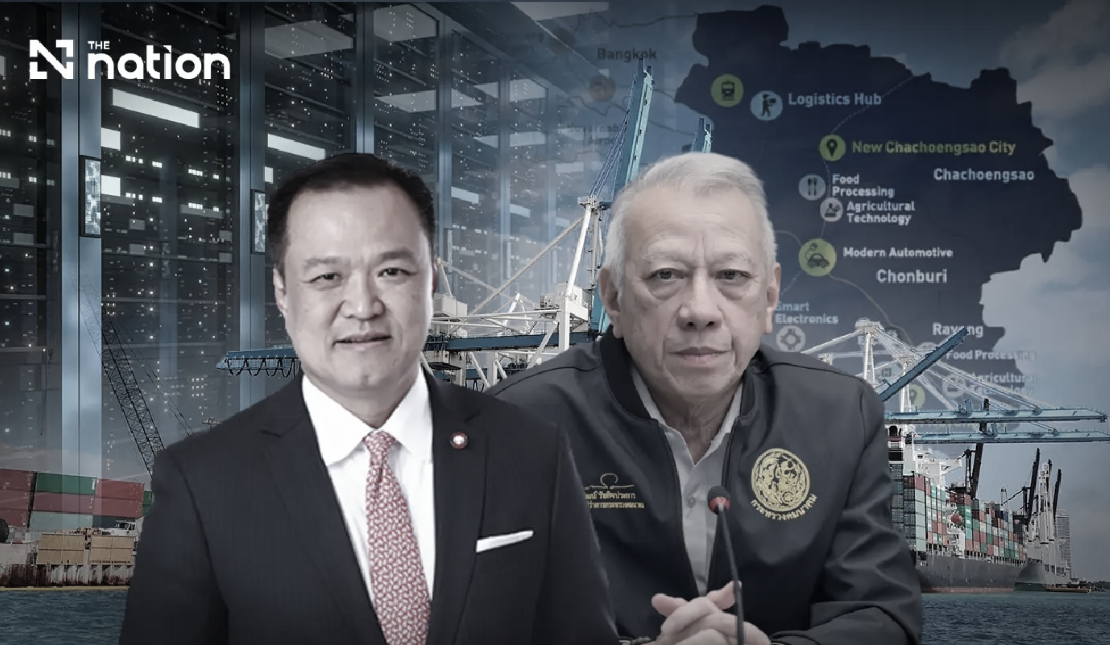
Prime Minister Anutin Charnvirakul has consolidated control over Thailand's Eastern Economic Corridor by transferring it from Deputy Prime Minister Phiphat Ratchakitprakarn's portfolio back to his own direct supervision. The shift represents a significant recalibration of how Bangkok intends to market its flagship development zone to international investors, with the government signalling a departure from traditional manufacturing-focused messaging toward sectors perceived as strategically critical in the coming decade. Cabinet orders signed on June 15 revoked Phiphat's authority over the EEC Office and his chairmanship of the Eastern Economic Corridor Policy Committee, with the changes taking immediate effect.
The repositioning carries particular relevance for Malaysia and the broader Southeast Asian region, where competition for foreign direct investment in high-value sectors remains intense. Thailand's decision to emphasise food security aligns with global concerns about supply chain vulnerability in agriculture and livestock, sectors where the eastern region possesses established infrastructure and expertise. For Malaysian investors and policymakers watching regional FDI flows, the Thai government's strategic reframing suggests that Bangkok believes traditional heavy industry positioning no longer suffices to attract premium-tier international capital to the corridor.
An alternative dimension underlying the portfolio transfer concerns Thailand's infrastructure constraints. Energy and water supply limitations have increasingly constrained the EEC's ability to accommodate additional heavy manufacturing expansion, a reality that prompted government reassessment of the corridor's future direction. Rather than attempting to resolve these bottlenecks through costly infrastructure upgrades, the administration has opted to redirect investment attraction toward sectors with more manageable resource requirements or those willing to absorb higher utility costs. This pragmatic recalibration reflects lessons learned from previous development cycles where infrastructure shortfalls undermined investment returns.
Food security emerged as the primary new strategic pillar within this reorientation. The eastern region already dominates Thailand's production of livestock, fisheries, agricultural commodities, fruit, and horticultural products. By consolidating and marketing these existing strengths as a cohesive food security ecosystem, the government hopes to tap growing international demand from nations concerned about agricultural supply stability. The sector offers particular appeal to sovereign wealth funds and multinational agribusiness corporations increasingly focused on securing reliable supply chains independent of geopolitical disruption. For Southeast Asia, where food security has become increasingly politicised, Thailand's positioning itself as a hub for integrated agricultural investment represents a significant competitive move.
Data centre development forms the second pillar of Anutin's reoriented strategy. This sector demands substantial coordination across multiple government agencies and ministries, given intensive requirements for electrical power, water supplies, and complementary infrastructure. The Energy Ministry's preparation of a new Type 9 electricity user category specifically for data centres demonstrates the scope of institutional reorganisation accompanying this pivot. Data centres willing to operate under premium tariff structures—reflecting their disproportionate power consumption—could absorb higher operational costs that traditional manufacturers cannot sustain. This positioning allows Thailand to compete for data centre investment not through subsidies but through regulatory streamlining and infrastructure reliability guarantees.
The government's rationale for the portfolio transfer emphasised operational friction rather than political conflict, though observers remain cautious regarding this characterisation. According to official sources, persistent institutional tensions between the EEC Office and the Board of Investment prompted Phiphat to propose that Anutin reclaim direct supervision. This framing allows both figures to avoid public conflict whilst executing a substantial strategic reorientation. The narrative also distances the reshuffle from contentious debates surrounding the three-airport high-speed rail project, where Phiphat had taken a firm stance against amending the original payment contract with private operator Asia Era One. By consolidating EEC authority, Anutin simultaneously removes a potential rival from authority over a major national infrastructure initiative.
Questions surrounding the Disneyland development proposal within the EEC territory suggest underlying disputes about the corridor's optimal investment mix. Anutin's reported questioning of when such projects would materialise, and whether investment returns justified the risks, indicates scepticism toward entertainment-focused development in favour of more economically productive sectors. This distinction matters significantly for Southeast Asian tourism industries, as it signals Thai government preference for economic value creation over tourism infrastructure expansion within the EEC framework. The implicit message to foreign investors is that speculative or tourism-dependent projects will face higher scrutiny and may require more robust feasibility justification than food security or data centre proposals.
From a Malaysian perspective, these developments warrant close attention regarding regional competitive positioning. Thailand's explicit strategy to attract data centre investment and develop food security supply chains addresses sectors where Malaysia also possesses comparative advantages and active government support. The consolidation of decision-making authority in Anutin's hands potentially accelerates Bangkok's ability to execute policy changes and incentivise foreign investment, compared to more distributed governance structures. Additionally, Thailand's shifting FDI narrative away from manufacturing toward technology and agriculture may influence regional perceptions about optimal investment locations and comparative sectoral advantages.
The timing of this portfolio consolidation reflects broader Thai government concerns about investment momentum and economic growth targets. By assuming personal leadership over the EEC and repositioning it around strategically contemporary sectors, Anutin signals government commitment to reinvigorating a development zone that has historically underperformed against original expectations. The direct involvement of the Prime Minister's office in international investor relations also elevates the EEC's profile within Bangkok's diplomatic and economic engagement strategy, potentially increasing access to high-level decision-makers for prospective foreign partners. This personalisation of authority mirrors patterns in other Southeast Asian nations where Prime Ministers maintain direct oversight of flagship economic zones to ensure policy coherence and accelerate implementation.
The structural implications of this shift extend beyond Thai borders. As Bangkok repositions the EEC around food security and data centres, it implicitly acknowledges that traditional manufacturing-centred development models require supplementation or replacement in Southeast Asia's evolving economic geography. Regional competitors must assess whether similar portfolio adjustments align with their own development strategies and investor attraction objectives. For multinational corporations evaluating Southeast Asian investment locations, Thailand's newly articulated focus on food security infrastructure and technology-enabling services represents material information about government priorities and long-term sectoral confidence.