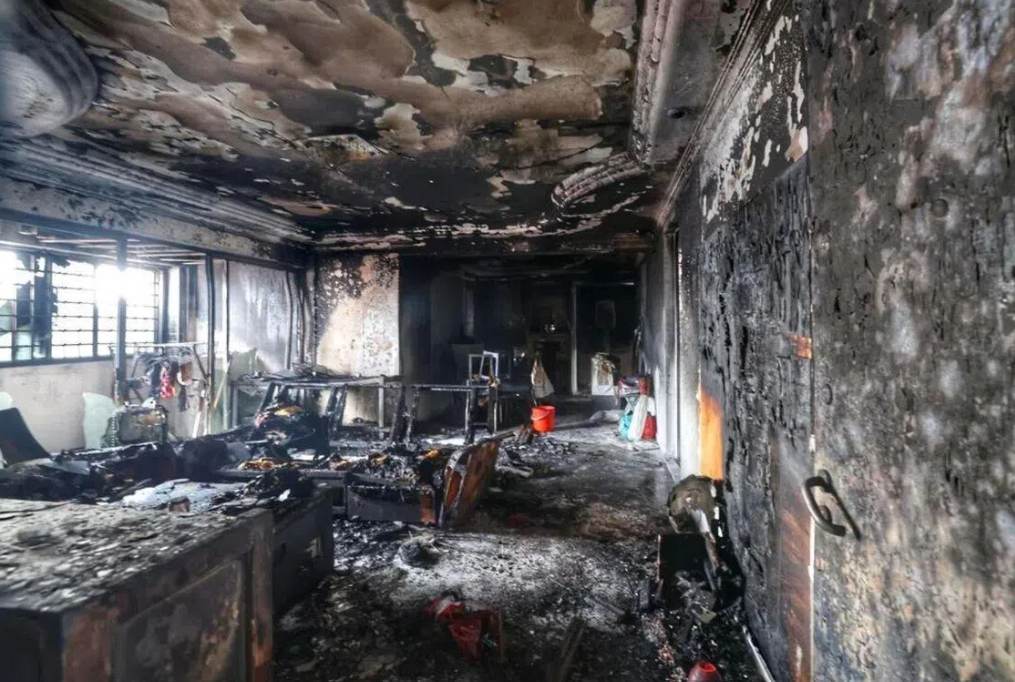
A predawn emergency in Singapore's Jurong West district on June 17 saw firefighters conduct a dramatic rescue operation at Block 842 Jurong West Street 81, where two residents were pulled from a smoke-filled 13th-storey flat engulfed in flames. The Singapore Civil Defence Force (SCDF) received the alert around 3.35am and swiftly deployed crews to the burning unit. Upon arrival, teams discovered the living room fully ablaze and immediately entered the heavily smoke-logged flat to extract occupants and combat the spreading fire. The blaze was eventually controlled and extinguished using water jets, though not before causing substantial damage to the residential space.
The family of four occupying the affected unit all received medical attention at Singapore General Hospital following the incident. In addition to the two residents rescued directly from the burning flat, two other family members were also treated for injuries sustained in the fire. The emergency response extended beyond the immediate unit, as roughly 40 neighbouring residents from the block were evacuated as a precautionary step to ensure their safety while firefighting operations were underway. The scale of the evacuation underscores how rapidly fire can spread through multi-storey residential buildings and the importance of swift community-wide response protocols in such situations.
Investigators examining the aftermath determined that the fire most likely originated from an electrical fault located in the living room. This finding aligns with a growing pattern in Singapore's fire statistics, where electrical malfunctions remain a persistent source of residential fires. The living room fire left visible scars on the unit—journalists from Lianhe Zaobao who visited the scene around 4pm that day documented severely blackened walls and ceilings, along with shattered windows that had blown outward from the heat and pressure inside the flat.
The sequence of events that brought attention to the fire offers insight into how residential fire detection still depends significantly on human vigilance. The family inside the affected unit had been asleep when the blaze ignited, leaving them vulnerable to the rapidly developing emergency. An 18-year-old student living directly above the burning flat played a crucial role in raising the alarm. While awake and occupied with gaming, the teenager detected smoke filtering up from the windows of the unit below. Rather than ignore the warning sign, he immediately descended to investigate, touching the door of the affected flat and finding it dangerously hot to the touch.
The young man's decisive actions potentially saved lives. He began knocking loudly on doors throughout the corridor to alert neighbouring residents to evacuate immediately, then hurried back to his own unit to warn his family. His mother subsequently contacted the police and summoned the SCDF, initiating the emergency response that would lead to the rescue operation. The student's account to media outlets revealed harrowing details of the residents' condition when they emerged: a young woman from the affected flat had knocked on his door moments before evacuation, her hair visibly singed and her face darkened by soot, requesting towels to treat her father's injuries. The teenager also observed a man with bright red burns covering his back and arms, injuries consistent with direct exposure to flames.
These observations paint a picture of residents actively fighting the fire within their own home before emergency services arrived, attempting basic first aid even as they faced life-threatening conditions. A neighbour on the 12th floor provided additional perspective on the scale of the emergency response, noting that at least five fire engines were stationed outside the block during the operation—a significant deployment that underscores the severity of the situation SCDF teams encountered.
The incident arrives amid rising concerns about residential fire hazards across Singapore. The SCDF has seized the opportunity to reinforce public education campaigns targeting electrical safety in homes. Officials specifically warn against overloading electrical outlets, a common practice in densely populated urban dwellings where multiple appliances compete for limited power sources. The agency recommends that residents switch off appliances when not in active use, rather than leaving them in standby mode or connected to power continuously. For Malaysian readers accustomed to similar high-density living conditions in cities like Kuala Lumpur and Penang, these safety practices carry direct relevance, as the electrical infrastructure and usage patterns in Southeast Asian apartments mirror those in Singapore.
Another key safety recommendation from SCDF involves purchasing only electrical devices and power plugs that bear the Safety Mark certification, a designation issued by Singapore's Consumer Product Safety Office. This certification requirement represents a quality control standard that consumers should actively seek out when selecting household electrical products. Additionally, SCDF has warned against leaving batteries and rechargeable devices charging unattended, particularly overnight or for extended periods. This guidance reflects the growing prevalence of lithium-ion battery fires, which have emerged as a distinct fire risk in modern homes filled with smartphones, laptops, and wireless devices.
The broader statistical context reveals an escalating fire problem in Singapore's residential sector. According to the SCDF's annual statistics released in February, the total number of fires rose by 3 per cent, climbing from 1,990 incidents in 2024 to 2,050 in 2025. More significantly, residential buildings accounted for roughly half of all fires, with 1,051 incidents occurring in homes. This concentration of fire incidents in residential areas suggests that preventive measures and public awareness campaigns must intensify to address the underlying causes. For Southeast Asian nations grappling with similar urbanization pressures and ageing building stocks, Singapore's experience offers cautionary lessons about the necessity of rigorous electrical safety standards and consistent enforcement mechanisms.
The Jurong West fire also highlights the interdependence between community awareness and formal emergency response systems. While professional firefighting capabilities remain essential, the quick thinking of ordinary residents—like the teenage student who detected smoke and alerted neighbours—can determine the difference between a controlled evacuation and a tragedy. As residential density increases across major Southeast Asian cities, fostering a culture of fire safety vigilance among residents becomes increasingly critical. Educational campaigns must extend beyond technical safety recommendations to emphasize the importance of immediate reporting and neighbour-to-neighbour communication during emergencies. The successful rescue of two people from the burning Jurong West flat demonstrates both the effectiveness of Singapore's emergency response infrastructure and the vital role played by alert community members in initiating that response.