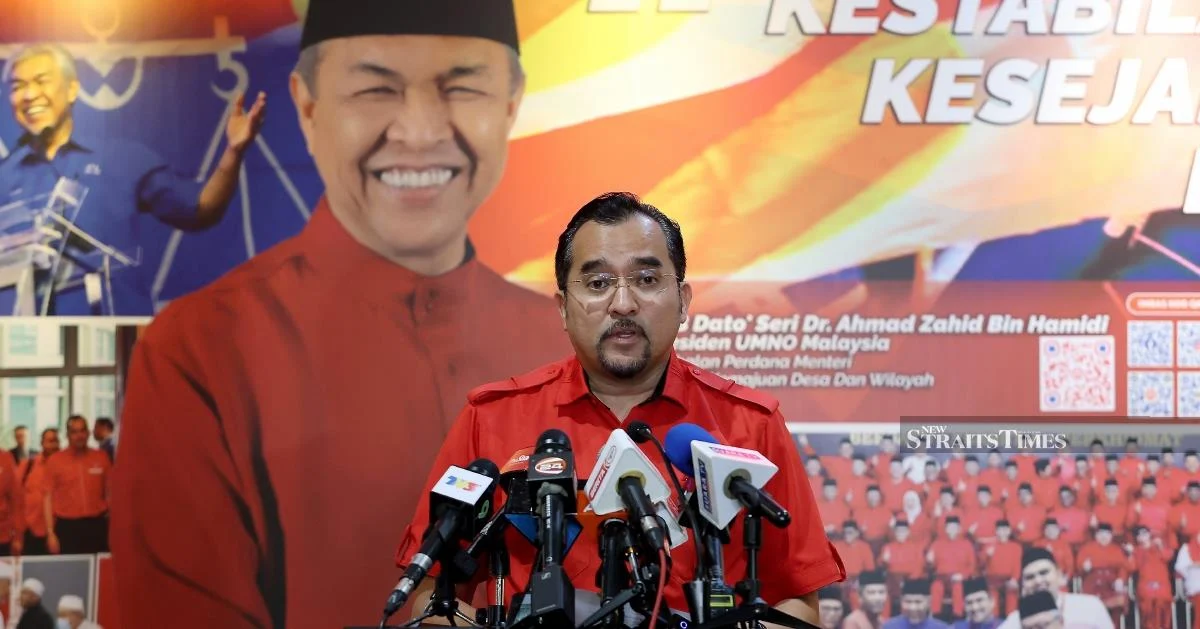
Umno's leadership has signalled a deliberate shift towards substance-centred campaigning ahead of upcoming state elections in Johor and Negri Sembilan, with party secretary-general Datuk Dr Asyraf Wajdi Dusuki declaring the party will eschew personal attacks in favour of discussing concrete policy offerings.
The commitment represents a notable positioning by Malaysia's largest Bumiputera party as it prepares for electoral contests that could significantly reshape the political landscape in two strategically important states. In an era when character assassination and negative campaigning have become commonplace across the region's political contests, Umno's explicit pledge to maintain a focus on substantive issues marks a departure from the divisive tone that has characterised many recent Malaysian electoral battles.
Datuk Dr Asyraf Wajdi Dusuki's emphasis on policy-driven discourse suggests Umno's hierarchy recognises growing voter fatigue with mud-slinging tactics. The party appears to be banking on the premise that Malaysian voters, particularly in Johor and Negri Sembilan, are increasingly receptive to candidates and manifestos that address tangible concerns: economic opportunity, service delivery, infrastructure development, and social provision. This calculation reflects a broader understanding that personalised attacks and unfounded allegations ultimately alienate moderate voters who prioritise competence and vision over partisan theatre.
Johor, as one of Malaysia's most economically significant states and a traditional powerhouse of Umno's electoral fortunes, presents both opportunity and vulnerability. The state has weathered significant political turbulence over the past decade, with shifts in ruling coalitions affecting investor confidence and administrative continuity. A campaign anchored in Umno's development agenda and economic stewardship record could resonate with business owners and professionals concerned about stability and growth. Meanwhile, addressing educational standards, healthcare accessibility, and youth unemployment through detailed policy platforms could appeal to younger demographics increasingly sceptical of personality-driven politics.
Negri Sembilan, historically more competitive than Johor, requires even more sophisticated messaging. The state encompasses diverse constituencies spanning industrial centres, agricultural communities, and urban residential zones, each with distinct priorities. By concentrating on tangible policy solutions—whether addressing rural infrastructure gaps, supporting smallholder farmers, or enhancing urban services—Umno can construct a more cohesive narrative that transcends regional parochialism. The commitment to avoiding mudslinging also signals respect for the intelligence and civic values of Negri Sembilan voters, potentially strengthening the party's appeal among centrist and independent-minded electors.
The timing of this declaration carries significance. Malaysian politics has increasingly witnessed opposition parties and component coalition partners engaging in increasingly vituperative exchanges, with social media amplifying negative messaging and fact-distortion. By publicly committing to elevating campaign discourse, Umno potentially claims moral high ground whilst simultaneously inviting scrutiny of its own internal conduct. The party's ability to deliver on this pledge—instructing party apparatus and grassroots machinery to maintain discipline and focus on substantive issues—will determine whether this represents genuine strategic repositioning or mere rhetorical flourish.
Historically, Umno's campaign apparatus has sometimes struggled to maintain unified messaging, particularly when ambitious individuals jostle for prominence or when rival factions pursue divergent electoral strategies. The secretary-general's pronouncement effectively establishes a benchmark against which party performance can be measured. Should Umno's candidates and surrogates violate this guideline through personal attacks or unfounded allegations, the credibility of the central leadership's positioning becomes compromised, providing ammunition to critics and opposition rivals.
For Malaysian voters across both states, this pledge offers an opportunity to evaluate competing visions without the fog of personalised attacks obscuring substantive differences. Electoral competition fundamentally depends on clear articulation of differing ideological perspectives, developmental priorities, and competency assessments. Campaigns centred on policy offerings allow voters to make informed choices based on programmatic substance rather than manufactured scandal or character demolition.
The broader implications extend beyond these two state elections. A successful demonstration that issue-focused campaigning can mobilise voters and produce electoral outcomes could influence the tenor of future Malaysian electoral contests. If Umno's commitment produces tangible results—stronger voter engagement, higher turnout, clearer differentiation from rivals—other political formations may recognise similar advantages in elevating campaign discourse. Conversely, if external actors or internal indiscipline generate mudslinging despite the secretary-general's statement, the failure could reinforce cynicism about politicians' capacity for genuine change in conduct.
Umno's positioning also reflects consideration of its coalition partners and broader stability concerns. In an era when political realignments remain possible and voter loyalties increasingly fluid, demonstrating institutional maturity and communication sophistication enhances the party's appeal to fence-sitters and traditional supporters reconsidering allegiances. This is particularly relevant given the complex coalition mathematics in both states and the possibility of post-election negotiations.
As Johor and Negri Sembilan head towards electoral contests, the coming weeks will reveal whether Umno can translate the secretary-general's commitment into disciplined campaign conduct. The party's success in maintaining this pledge whilst effectively communicating its policy platform will establish whether Malaysian politics can genuinely move beyond personalised attacks towards competition based on competing visions for state development and governance.